
LSA-274
Base for statue of Diocletian or Maximian, emperors. Ilium/Troy (Hellespontus). 286-305.
Record details
Photographs
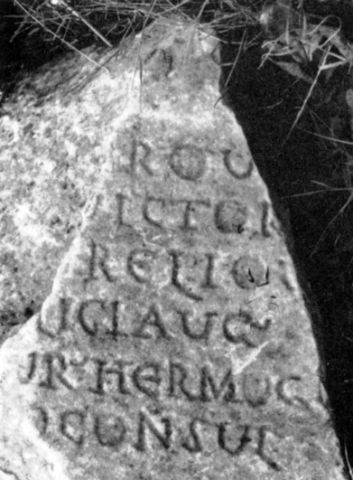
Inscription
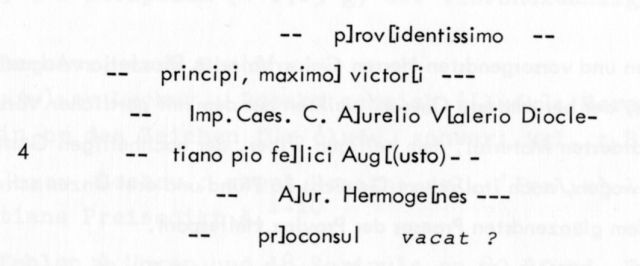
-- p]rov[identissimo --/ -- principi, maximo] victor[i --- / -- imp(eratori) Caes(ari) C(aio) A]urelio V[alerio Diocle/tiano, pio, fe]lici, Aug[(usto) -- / --A]ur(elius) Hermoge[nes --- / -- pr]oconsul ...
Inscription translation
To the most provident ... ruler, the greatest victor... the emperor Caesar Caius Aurelius Valerius Diocletianus, pious, fortunate Augustus ... Aurelius Hermogenes, governor (proconsul) ...
Bibliography
- Frisch, P. (ed.), Die Inschriften von Ilion. Inschriften griechischer Städte aus Kleinasien, vol. 3, Bonn 1975, no. 98
Discussion
INSCRIPTION
In six extant lines:
-- p]rov[identissimo --/ -- principi, maximo] victor[i --- / -- imp(eratori) Caes(ari) C(aio) A]urelio V[alerio Diocle/tiano, pio, fe]lici, Aug[(usto) -- / (5) --A]ur(elius) Hermoge[nes --- / -- pr]oconsul.
'To the most provident ... ruler, the greatest victor... the emperor Caesar Caius Aurelius Valerius Diocletianus, pious, fortunate Augustus ... Aurelius Hermogenes, governor (proconsul) .'
Letter height not recorded.
We reproduce the text here with the completions proposed by Frisch 1975. The naming of the honorand in the dative, and of an awarder towards the end of the inscription, make it probable that this was from a statue base.
DESCRIPTION (from Frisch 1975 and the published photo)
Fragment of an inscribed marble block, probably a statue base, broken on all sides. No published measurements.
PROVENANCE AND LOCATION
The inscription was found in the cemetery of the deserted village of Kum Köy, close to Ilium/Troy (Frisch 1975, 323 map 2, see also LSA-290; http://www.trismegistos.org/place/3681). Today in the storerooms of the Ilion Museum (without published inv. no.)
HONORAND, AWARDER AND DATE
The honorand is an emperor, as is very clear from the partially preserved imperial titles in lines 1, 2, and 4. However, of the imperial name, only '...urelio V..’ (in line 3) has survived. This can be completed either to Diocletian’s name, Caius A<b>urelius V</b>alerius Diocletianus (as proposed by Frisch 1975), or to Maximian’s, Marcus A<b>urelius V</b>alerianus Maximianus. Diocletian assumed the name Aurelius only in 286 on the occasion of Maximian’s accession as co-emperor. In both possible cases, therefore, the inscription dates to the common reign of the two emperos, 286-305.
The inscription was dedicated by a governor (proconsul) of Asia, Aurelius Hermogenes, whose name is partly preserved in line 5 (PLRE I, 424, Aurelius Hermogenes 8; Malcus 1967, 95-6). This may date our inscription to before the provincial reforms of the 290s, since these divided the province of Asia and placed Troy within a new province, Hellespontus, governed by a praeses. However, anomalously Hellespontus was subject, not to the praetorian prefect of the east, but to the proconsul of Asia (Böcking 1839, 5; Neira Faleiro 2005, 219-20, 506). So our dedication may post-date the reform, but pay homage to the governor of Hellespontus' immediate superior, the proconsul of Asia. (For a similar case, see LSA-287.)
The inscription was dated to the early years of Diocletian’s reign by Groag & Stein 1933, possibly because only one emperor is named. It is however very possible that it was originally accompanied by bases, now lost, to the other tetrarchs (Malcus 1967, 95 with n. 5 ; see below, ‘Further Discussion’).
FURTHER DISCUSSION
Malcus 1967, 95 proposed to connect this inscription with another one from Troy, recording the erection of a silver statue of Zeus commanded by the emperors themselves (LSA-287). He hypothesised, very plausibly that statues for the tetrarchs, one of them testified to by our inscription, were erected at the same time. If so, this would shrink the terminus post quem of our inscription to after 293 (all four tetrarchs being named in the other inscription).
Discussion references
- Böcking, E., Notitia Dignitatum et administrationum omnium tam civilium quam militarium in partibus Orientis et Occidentis, Bonn 1839
- Bowman, A. K., Garnsey, P. & A. Cameron, The Crisis of the Empire A. D. 193-337 (The Cambridge Ancient History. Second Edition. Volume XII), Cambridge 2005
- Groag, E. & A. Stein, Prosopographia Imperii Romani Saec. I. II. III Editio altera. Pars I, Berlin 1933, no. 1527
- Jones, A. H. M. et al., The Prosopography of the Later Roman Empire. Vol. I 260-395, Cambridge et al. 1971 (1975)
- Kuhoff, W., Studien zur zivilen senatorischen Laufbahn im 4. Jahrhundert n. Chr. Ämter und Amtsinhaber in Clarissimat und Spektabilität, Frankfurt am Main 1983
- Malcus, B. 'Die Prokonsuln von Asien von Diokletian bis Theodosius II', Opuscula Atheniensa, 7 (1967) 91-154
- Neira Faleiro, C., La notitia dignitatum. Nueva edición crítica y commentario histórico (Nueva Roma 25), Madrid 2005
Cite: Last Statues of Antiquity, LSA-274 (Ulrich Gehn).