
LSA-275
Base for statue of 'The People of Rome' (Demos Romaios); erected by the people (demos) of Side. Side (Pamphylia). Later third to very early fourth century
Record details
Photographs
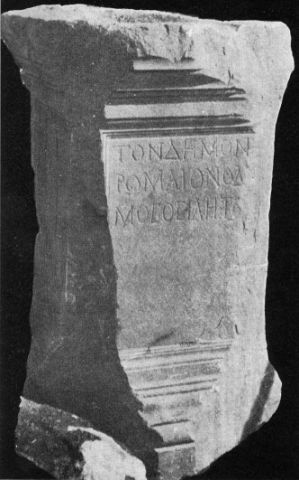
Inscription
τὸν Δῆμον τ[ὸν] / ‘Ρωμαίον, ὁ Δῇ/μος ὁ Σιδητῶ[ν].
Inscription translation
The people (demos) of the Sidetes [honours] the people of the Romans.
Bibliography
- Nollé, J. , Side im Altertum : Geschichte und Zeugnisse (Inschriften griechischer Städte aus Kleinasien ; Band 43), Bonn 1993, vol. 43, no. 25
Discussion
INSCRIPTION
In three lines:
τὸν Δῆμον τ[ὸν] / ‘Ρωμαίον, ὁ Δῇ/μος ὁ Σιδητῶ[ν].
'The people (demos) of the Sidetes [honours] the people of the Romans.'
Letter height 5.5 – 7.5 cm, with traces of red colour within the letters.
DESCRIPTION (from Bean 1965, Nollé 1993, and the published photo)
White marble base with mouldings at top and bottom of front, left, and right sides: H 161, W 76, D 56 cm. The back face is only roughly finished. On top there is a dowel hole, probably for the insertion of a plinth. The mouldings are heavily damaged; at the front all corners are broken, together with the left and right margins of the shaft; consequently the inscription is slightly damaged on the right. The inscription is carved over the erasure of an earlier one.
PROVENANCE AND LOCATION
The base was found in 1958 in the debris of the theatre, on the western side of the stage building. It is today in the Side museum.
HONORAND, AWARDER AND DATE
The honorand is the 'Genius populi Romani', the personification of the people of the city of Rome, but also of the commonwealth of the Roman empire (Wrede 1981, 114, 115, 129).
The awarder is the people of Side, the local equivalent to the honorand. As Nollé points out, the inscription manifests the 'homonoia' between the people of Side and the populus Romanus, in an attitude widespread on the coinage of the region in the later 3rd century, when the cities of southern Asia minor manifested their bonds with Rome and their belonging to the Roman world during the campaigns against Sasanian Persia (Nollé 1993, 284).
The letter forms were dated by Bean 1965, 9, to the late 3rd or early 4th century (followed by Nollé 1993, 283-4). However, a pre-tetrarchic date for our inscription cannot be ruled out (Nollé 1993, 284, citing the campaign of Carus in 282/3; Wrede 1981, 119, citing the dedication of a gilded statue of the Genius populi Romani on the rostra vetera in Rome by Aurelian (276-82)). A monument of this kind is unlikely after the tetrarchic period (Wrede 1981, 139).
FURTHER DISCUSSION
The Genius of the Roman people played a central role in the ideology and imperial self-legitimation of the tetrarchic system of power (Nollé 1993, 284; Wrede 1981, esp. 138-9). The 'Genius populi Romani' as the personification of a comprehensive, unifying 'Romanitas' is almost ubiquitious on the coinage of the period. This monotonous ubiquity is not, however, likewise present in the epigraphic habit; our inscription appears to be the only testimony to a statue of this kind known so far from the Greek East.
Discussion references
- Bean, G. E., Side Kitabeleri. The inscriptions of Side, Ankara 1965, p. 9 no. 91 pl. III fig. 8
- Wrede, H., Der genius populi Romani und das Fünfsäulendenkmal der Tetrarchen, Bonner Jahrbücher 181, 1981, 111-42
Cite: Last Statues of Antiquity, LSA-275 (Ulrich Gehn).