
LSA-276
Lost base for statue of 'Imperial Upbringing' (Anatrophe Augusta). Side (Pamphylia). Fourth century.
Record details
Photographs
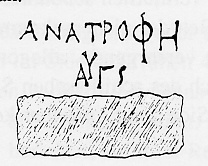
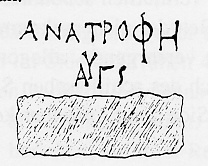
Inscription
Ἀνατροφὴ / Αὐγ(οῦστα) / [[ ]] / [[ ]]
Inscription translation
Imperial Upbringing ... (two erased lines).
Bibliography
- Nollé, J. , Side im Altertum : Geschichte und Zeugnisse (Inschriften griechischer Städte aus Kleinasien ; Band 43), Bonn 1993, vol. 43, no. 27
Discussion
INSCRIPTION
In two preserved lines:
Ἀνατροφὴ / Αὐγ(οῦστα) / [[ ]] / [[ ]]
'Imperial Upbringing ... (two erased lines).'
Letter height 3.5 cm. Αὐγ in line 2 is followed by an abbreviation mark. The 'Y' in line 2 appears to have been initially forgotten and inserted belatedly. The honorand unusually is in the nominative (see below 'Honorand, Awarder and Date’).
DESCRIPTION (from Bean 1956, Nollé 1993, and the published image)
Rectangular base of white marble: H 139, W 57, D 73 cm. The inscription is carved over the erasure of an earlier one; under the recorded lines, a secondary erasure had destroyed two lines of inscription.
PROVENANCE AND LOCATION
The base was found in 1948 built into the foundations of a modern house on the colonnaded street south of the theatre (Mansel 1978, map, ‚C’). Today it is lost.
HONORAND, AWARDER AND DATE
The honorand is Ἀνατροφὴ Αὐγοῦστα (Imperial Anatrophe; Latin 'educatio Augusta' or 'almities Augusta), the personification of an imperial virtue, Anatrophe, care for the material aspects of the upbringing of children, like food and clothing, as opposed to Paideia, the care of the mind (Nollé 1993, 291 with n. 43, 44). Robert's critical dismissal of Bean's proposal, that this was an otherwise unknown 4th-century empress, has been unanimously accepted (Bean 1956, 82; Robert 1967, Robert 1958, 22-4). The nominative in a statue dedication, as here, is reserved to deities and personifications, heroes, and 'Great men', such as cultural heroes and athletes (Robert 1965, 116-17; Ma 2007, 207).
The base is impossible to date with precision. However, it shares several characteristics with datable 4th-century imperial dedications in Side: it is a re-used piece of similar size and shape, with lettering of a similarly poor quality (Bean 1956, 82; LSA-261, LSA-262, LSA-263, LSA-264, LSA-265, LSA-266). Nollé 1993, 291, who also considered the letter forms to be 'late-antique’, followed Robert 1967 in linking the inscription with two laws by Constantine I regulating food supply (Codex Theodosianus XI, 27, 1-2). He suggested a connection between our statue and those dedicated in Side to Constantine’s mother Helena - Helena being, of course, a suitable example of imperial Anatrophe (LSA-262, LSA-263; Nollé 1993, 293, 323). We accept a 4th-century date, and find the connection with Helena attractive, though undemonstrable.
Discussion references
- Bean, G. E., Inscriptions, Mansel, A. M., Bean, G. E. & J. Inan, Die Agora von Side und die benachbarten Bauten. Bericht über die Ausgrabungen im Jahr 1948, pp. 79-98, Ankara 1956, pp. 80-2 no. 47
- Ma, J., Hellenistic statues and inscriptions, Art and Inscriptions in the Ancient world (eds. Newby, Z. & R. Leader-Newby), 203-20, Cambridge 2007, pp. 207-8
- Mansel, A. M., Side, Ankara 1978, map
- Robert, L., Hellenica XIII. D’Aphrodisias a la Lycaonie, Paris 1965
- Robert, L., Inscriptions grecques de Sidè en Pamphylie, Revue Philologique 32, 1958, 15-53; re-print in Robert, L., Opera Minora Selecta V, Amsterdam 1989,155-93
- Robert, L., L’impératrice Anatrophè a Sidè, Revue Philologique 41, 1967, 82-4, reprint in Robert, L., Opera Minora Selecta V, Amsterdam 1989, 422-4]
Cite: Last Statues of Antiquity, LSA-276 (Ulrich Gehn).