
LSA-278
Lost base for statue of 'The Council' (Boule ) of Side; erected by the people (demos) of Side. Side (Pamphylia). Late third century.
Record details
Photographs
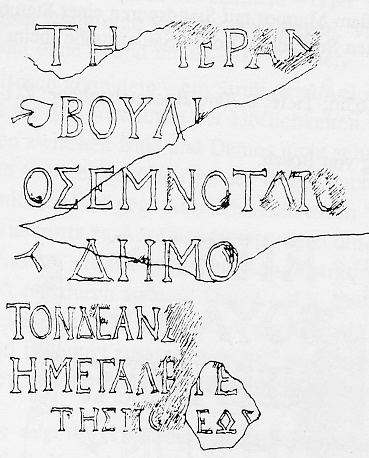
Inscription
τὴ[ν] ἱερὰν / (ivy leaf) βουλὴ[ν] / ὁ σεμνότατο[ς] / δῆμο[ς·] /(5) τὸν δὲ ἀνδ[ριάντα] / ἡ μεγάλη γε[ρουσία] τῆς πό[λ]εως.
Inscription translation
The Sacred Council (Boule); the most dignified people (demos) [honour her]. The great council of the elders (gerousia) of the city [set up] the statue.
Bibliography
- Bosch, C. E., Kitabeler - Die Inschriften, 1947 senesi Side kazılarına dair önrapor. Vorläufiger Bericht über die Ausgrabungen in Side im Jahre 1947 (eds. Mansel, A. M., C. E. Bosch & J. Inan), 46-80, Ankara 1951, p. 62 no. 10
- Nollé, J. , Side im Altertum : Geschichte und Zeugnisse (Inschriften griechischer Städte aus Kleinasien ; Band 43), Bonn 1993, vol. 43, no. 28
Discussion
INSCRIPTION
In seven lines:
τὴ[ν] ἱερὰν / (ivy leaf) βουλὴ[ν] / ὁ σεμνότατο[ς] / δῆμο[ς·] /(5) τὸν δὲ ἀνδ[ριάντα] / ἡ μεγάλη γε[ρουσία] τῆς πό[λ]εως.
'The sacred Council (Boule); the most august people (demos) [honour her]. The great council of the elders (gerousia) of the city [set up] the statue.'
Letter height 4.5 - 8 cm.
DESCRIPTION (from Bosch 1951, Nollé 1993, and the published image)
Rectangular base of white marble, with mouldings at top and bottom: H 180, W 68, D 61 cm. Broken into many pieces, parts of the inscription on the right lost.
PROVENANCE AND CURRENT LOCATION
The inscription was excavated in 1947 on the large colonnaded street in Side running north-south west of the theatre; the inscription was found about 100 m from the theatre. It is today lost.
HONORAND, AWARDER AND DATE
The honorand is the sacred 'Boule', the divine personification of the city council of Side. The statue was awarded by the demos, the other basic political body of the city; and set up by the gerousia, a further political body.
The inscription was dated to the later 3rd century by Nollé 1993, 294 on basis of the letter forms.
Our inscription to the boule was found together with a very similar one, this time dedicated by the boule to the demos (LSA-279); the two political bodies mutually honoured each other. This was probably after a conflict between them had been settled, probably through the mediation of the gerousia (the council of the elders) (Bosch 1951, 64). As Nollé 1993, 295 points out, in the critical period of the late 3rd century, parties within the cities often battled for the distribution of the burdens imposed on the cities by imperial policy; our inscription would thus fit well into the historical situation of the later 3rd century.
FURTHER DISCUSSION
Images propagating harmony (homonoia) among the civic bodies appear in the coinage of the period; the boule there appears as a female figure carrying a sceptre on her left arm (Bosch 1951, 64).
Cite: Last Statues of Antiquity, LSA-278 (Ulrich Gehn).