
LSA-280
Columnar monument, possibly statue base, for Modestus, local notable; erected by a city-quarter of Side. Side (Pamphylia). Late third century.
Record details
Photographs
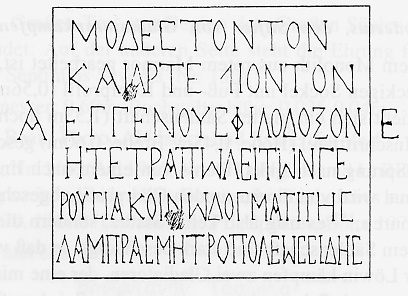
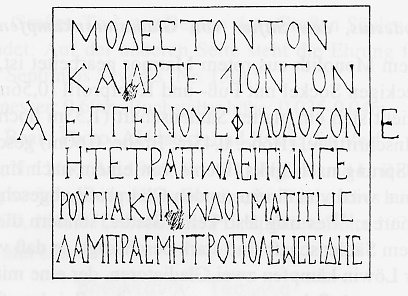
Inscription
Μοδέστον, τὸν / καὶ Ἀρτέμιον, τὸν / ἐγ γένους φιλὸδοξον. / (4) ἡ Τετραπωλειτῶν γε/ρουσία, κοινῷ δόγματι τῆς / λαμπρᾶς μητρόπολεως.
The inscription is flanked by the letters α’ (on the left), and ἐ (on the right).
Inscription translation
Modestus, also called Artemius, honour-loving by descent; the council of the elders (gerousia) of the city-quarter of Tetrapolis, by common decree of the splendid metropolis (of Side) [honours him].
Bibliography
- Nollé, J., Side im Altertum. Geschichte und Zeugnisse. Band II (Inschriften Griechischer Städte aus Kleinasien Band 44), Bonn 2001, pp. 415-16 no. 111
Discussion
INSCRIPTION
In six lines:
Μοδέστον, τὸν / καὶ Ἀρτέμιον, τὸν / ἐγ γένους φιλὸδοξον. /(4) ἡ Τετραπωλειτῶν γε/ρουσία κοινῷ δόγματι τῆς / λαμπρᾶς μητρόπολεως.
'Modestus, also called Artemius, honour-loving by descent. The council of the elders (gerousia) of the city-quarter of Tetrapolis, by common decree of the splendid metropolis (of Side), [honours him].'
The inscription is flanked by the letters α’ (to the left) and ἐ (to the right), standing for 'πρώτη ἔνδοξος, first in repute’ (Robert 1951, 194 no. 219a). This affirms Side’s claim to hold the first rank among the cities of Pamphylia, a claim seriously challenged by Perge (Nollé 1993, 88-94).
The Τετραπωλειτῶν of line 4 were the inhabitants of a region of Side known as the Tetrapolis (see below, 'Honorand, Awarder and Date')
The inscription, with the honorand in the accusative and the awarder in the nominative, displays the main features of Greek statue base inscriptions.
DESCRIPTION (from Bosch 1951, Nollé 2001)
Tall elaborate columnar monument of red marble: H 216, diameter at bottom 79, at top 77 cm. The monument is worked from a single block, and divided into three sections: (i) an octagonal socle with mouldings at top and bottom, H 56 cm; (ii) a round moulded plinth on top of the socle, H 27 cm: and (iii) a columnar shaft with a neck ring. The shaft is decorated with gladiatorial scenes in its lower part, and with a panel for the inscription (H 45, W 60 cm) in the shaft's upper part. The panel is flanked on the left by a jumping lioness with dugs, and on the right by a male lion. On the top face, Bosch 1951, 51 detected the traces of imprints for a statue ('Auf der Säule oben Standspuren einer Statue’), whereas Nollé 2001, 415 insists that it is smooth and without any such traces.
The exceptional height of this monument, and the absence of any clear evidence of fixings at the top for a statue or its plinth, suggest that this may well have been an honorific column, rather than a statue base.
PROVENANCE AND CURRENT LOCATION
The monument was first recorded, together with LSA-281, by Lanckoronski 1890, 133, in the region of the late antique city gate by the theatre; it was largely covered with soil at that time, but excavated by Mansel in 1947 (Bosch 1951, 51). It is now set up in the garden of the Side museum together with its pair (LSA-281).
HONORAND, AWARDER AND DATE
The honorand, Modestus signo Artemius, was a local man from an old and distinguished family (line 3). He was a relative, probably the father (given the similarity of name), of the Modesta who received a very similar monument very close by (LSA-281; Nollé 2001, 418-19). Our inscription does not mention any office held by Modestus, unlike the dedication to Modesta (which styles her 'priestess'), but gladiatorial games and beast hunts were closely associated with civic office, so he must either have held such an office himself, or, as Nollé hypothesised, supported another family member who did, perhaps Modesta's husband who may have been honoured in this same place by a third base, now lost (Nollé 2001, 418-19 with n. 160).
Our monument was awarded by the 'council of the elders’(gerousia) of the Tetrapolis, a quarter of Side named after a quadriga (Greek τετράπωλον) which was its focal point (Nollé 2001, 408-9); the decision of this civic body was confirmed by a common decree of the whole city (lines 5-6). Three further dedications by the gerousia of the Tetrapolis are known so far (Bryonianus Lollianus, Nollé 2001 Nr. 106; Quirinia Patra, Nollé 2001 Nr. 108; Modesta, LSA-281); they all are from the last quarter of the 3rd century (see below 'Further Discussion’).
A secure terminus post quem for the dedication is provided by the rank of metropolis (line 6) which Side was granted after 276, probably under Probus (276-82) (Nollé 1993, 91 and 288 n. 28). Nollé 2001, 419 proposed a date between 278 and 284 arguing that our inscription and its counterpart (LSA-281) are 'worked substantially more diligently than the late-antique dedications to emperors, including that to Diocletian' (LSA-261); at the same time he allowed explicitly for a somewhat later date ('wobei ... ein um einige Jahre späteres Datum nicht völlig ausgeschlossen werden kann’, Nollé 2001, 419).
The distinctive letter forms of our inscription (particularly the letters Phi and Omega in the form of a lozenge, and the letter Sigma in its traditional form with four bars) reoccur in a series of no less than eleven honorific inscriptions in Side (our base; Nollé no. 26; LSA-278; LSA-279; LSA-281; Nollé 2001 nos. 105-10). One of these, the dedication by the council and the people of Side to the Roman Senate (LSA-275) was dated to the years immediately before the tetrarchy, possibly 278-80 by Nollé 1993, 287-8, who therefore dated the whole set into the immediate pre-tetrarchic period, allowing, however, for the reservation mentioned above. However, in reality they cannot be so closely dated and we are including several within our catalogue (whose start-date is 284), partly because their dating is unclear, but also because they form such a fascinating group, testifying to the active civic and city-quarter life of Side at the end of the third century.
FURTHER DISCUSSION
Three further gerousiai of city quarters in Side, all named after conspicuous local monuments, are known so far: those of the 'Great Gate', of the 'Altar of Zeus', and of the 'Great Factory' (Nollé nos. 105, 107 and 109; Mansel 1963, 24-5). Side also had a 'great gerousia (μεγάλη γερουσία)', representing the whole city, which set up statues to the council (βουλή) and the people (δῆμος) at roughly this same time (LSA-278, LSA-279).
Dedications by city-quarters to benefactors feature prominently among the late-antique statues in Puteoli (LSA-43; LSA-44; LSA-47; LSA-332; LSA-335; LSA-1124; LSA-1908; LSA-1909; LSA-1910).
Discussion references
- Bosch, C. E., Kitabeler - Die Inschriften, 1947 senesi Side kazılarına dair önrapor. Vorläufiger Bericht über die Ausgrabungen in Side im Jahre 1947 (eds. Mansel, A. M., C. E. Bosch & J. Inan), 46-80, Ankara 1951
- Lanckoronski, K., Städte Pamphyliens und Pisidiens, I. Band, Wien 1890
- Mansel, A. M., Die Ruinen von Side, Berlin 1963
- Nollé, J. , Side im Altertum : Geschichte und Zeugnisse (Inschriften griechischer Städte aus Kleinasien ; Band 43), Bonn 1993
- Robert, J. & L. Robert, Bulletin Épigraphique 1951, Revue des Études grecques 64, 1951, 119-216
Cite: Last Statues of Antiquity, LSA-280 (Ulrich Gehn).