
LSA-281
Columnar monument, possibly statue base, for Modesta, high priestess; erected by a city-quarter of Side. Side (Pamphylia). Late third century.
Record details
Photographs
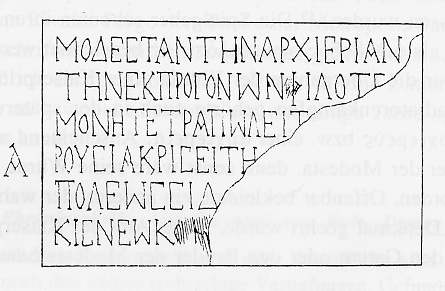
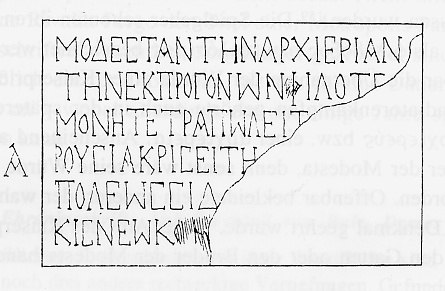
Inscription
Μοδέσταν τὴν ἀρχιέριαν / τὴν ἐκ προγόνων φιλότε[ι]/μον, ἡ Τετραπωλειτ[ῶν γε]/ρουσία κρίσει τῆ[ς μητρο]/πόλεως Σίδ[ης ἑξα]/[κις] / νεωκόρ[ου].
Inscription translation
Modesta, high priestess, honour-loving through her ancestors; the council of the elders (gerousia) of the city-quarter of Tetrapolis, by judgement of the metropolis of Side, six-times temple-guardian, [honours her].
Bibliography
- Nollé, J. , Side im Altertum : Geschichte und Zeugnisse (Inschriften griechischer Städte aus Kleinasien ; Band 43), Bonn 1993, vol. 44, no. 112
Discussion
INSCRIPTION
In six lines:
Μοδέσταν τὴν ἀρχιέριαν / τὴν ἐκ προγόνων φιλότε[ι]/μον, ἡ Τετραπωλειτ[ῶν γε]/ρουσία κρίσει τῆ[ς μητρο]/πόλεως Σίδ[ης ἑξα]/[κις] / νεωκόρ[ου].
'Modesta, high priestess, honour-loving through her ancestors; the council of the elders (gerousia) of the quarter of Tetrapolis, by judgement of the metropolis of Side six-times temple-guardian [honours her]. '
The inscription is flanked by the letter 'α’' to the left which will have been matched by 'ἐ' to the right, as in the companion inscription to Modestus LSA-280. This stands for 'πρώτη ἔνδοξος, first in repute’ (Robert 1951, 194 no. 219a), affirming Side’s claim to hold the first rank (πρωτεῖον) among the cities of Pampylia, a claim seriously challenged by Perge (Nollé 1993, 88-94). The city also proudly mentions its six temples of the imperial cult.
Letter height 3.5 cm.
DESCRIPTION (from Nollé 2001)
Columnar shaft of red marble with mouldings at top and bottom: H 183, diameter (top) 85, (bottom) 95 cm. The shaft is decorated with a panel framing the inscription, H 47, W 64 cm, and with reliefs showing gladiatorial scenes below the panel. The inscribed panel is flanked to the left by a jumping lioness, and to the right by a seated lion. The mouldings of the shaft are chipped at top and bottom; the reliefs are partly damaged. The top face is smoothly finished and without traces of fixings for a statue.
PROVENANCE AND CURRENT LOCATION
The monument was first recorded, together with LSA-280, by Lanckoronski 1890, 133, in the region of the late-antique city gate by the theatre; it was largely covered with soil at that time. It was still in that position in 1947 when it was excaveted by Mansel (Bosch 1951, 51). It is now set up in the garden of the Side museum together with its pair LSA-280.
HONORAND, AWARDER AND DATE
Modesta, the honorand, was priestress of the imperial cult (ἀρχιέριαν, line 1). In this office she was obliged to hold games, the animal hunts (venationes) and gladiatorial combats that are alluded to in the reliefs. Given the close similarity of their names and their monuments, she was certainly a relative, and probably the daughter, of the Modestus honoured by LSA-280 (Nollé 2001, 419).
The monument was awarded by the 'council of the elders' (gerousia) of the Tetrapolis, a quarter of Side named after a quadriga (Greek τετράπωλον) which was its focal point (Nollé 2001, 408-9); it was confirmed by a decision of the whole city (lines 4-6).
A terminus post quem for the dedication is provided by Side's rank of 'metropolis' (line 4-5) which the city was granted after 276, probably under Probus (276-82) (Nollé 1993, 91 and 288 n. 28). Nollé 2001, 419 proposed a date between 278 and 284 arguing that our inscription and its counterpart (LSA-280) are 'worked substantially more diligently than the late antique dedications to emperors, including that to Diocletian' (LSA-261); at the same time he allowed explicitly for a somewhat later date ('wobei (...) ein um einige Jahre späteres Datum nicht völlig ausgeschlossen werden kann’, Nollé 2001, 419). We think this dedication is of the last quarter of the 3rd century, and that it is impossible to pin it down with more precision.
FURTHER DISCUSSION
Three further dedications by the city quarter of Tetrapolis are known so far, all from the late 3rd century (Nollé 2001 Nr. 106; Nollé 2001 Nr. 108; Modestus, LSA-280). The importance of city quarters as administrative bodies in this period is testified to by further dedications by other city quarters of Side (Nollé 2001 nos. 105, 107, 109, 110).
Cite: Last Statues of Antiquity, LSA-281 (Ulrich Gehn).