
LSA-282
Fragmentary inscription, probably on base for statue, with dedication to Eunomius, possibly governor of Pamphylia. Side (Pamphylia). Late fourth to fifth century.
Record details
Photographs
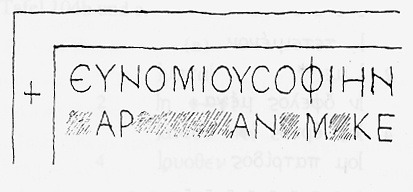
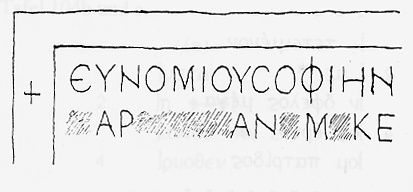
Inscription
cross Εὐνομίου σοφιὴν [ -- ] / [.]αρ[....]αν[.]μ[.]κε[ --
Inscription translation
The wisdom of Eunomius....
Bibliography
- Bosch, C. E., Kitabeler - Die Inschriften, 1947 senesi Side kazılarına dair önrapor. Vorläufiger Bericht über die Ausgrabungen in Side im Jahre 1947 (eds. Mansel, A. M., C. E. Bosch & J. Inan), 46-80, Ankara 1951, p. 76 no. 30
- Merkelbach, R. and J. Stauber (eds.), Steinepigramme aus dem griechischen Osten. Bd. 4. Die Südküste Kleinasiens, Syrien und Palaestina, Munich 2002, 150, no.18/15/8
- Nollé, J. , Side im Altertum : Geschichte und Zeugnisse (Inschriften griechischer Städte aus Kleinasien ; Band 43), Bonn 1993, vol 44. no. 289
Discussion
INSCRIPTION
In two preserved lines:
Εὐνομίου σοφιὴν [ --]/ [.]αρ[....]αν[.]μ[.]κε[--
'The wisdom of Eunomios....'
Letter height not recorded.
On the frame, left of the inscription, a cross is incised.
The dactylic start makes it likely that this was a verse inscription, in hexameters or elegiac distichs.
DESCRIPTION (from Bosch 1951 and the published image)
Upper left corner of a rectangular marble block, with no published measurements. The block was built into a later wall with the inscribed face down, and is partly legible only because the block below has partially weathered away. The inscription is surrounded by a simple frame, standing proud.
From the form of the block and the epigraphic field, as well as from the character of the inscription, this was possibly a statue base (see below, 'Honorand and Date').
PROVENANCE AND CURRENT LOCATION
The inscription was recorded by Bean in 1947 in the south wall of the so-called building 'M', east of the theatre (for map, see Mansel, Bean & Inan 1956, facing p. 1; on building M, see Mansel 1963, 108-21, and Mansel 1978, 169-86).
There is no recent record of the inscription’s location.
HONORAND AND DATE
These opening words of an inscription celebrate the wisdom of a certain Eunomius, presumably the honorand. Merkelbach 2002 assumed that Eunomius was a sophist, but also allowed for the possibility that he was a governor. In our view, this is probably an inscription to a late antique state official, and, if so, probably a governor. Wisdom (sophia) is a virtue repeatedly praised in late antique epigrams to governors, which enables them to judge justly (see, for instance, the inscription for Nonnus in Ephesus, LSA-731). The name, Eunomius, is possibly a signum, a punning name attributed to him because of his justice (eunomia). No person of this name, who could have been a governor of Pamphylia, is yet known.
Verse epigrams to late antique state officials were set up throughout the 4th and 5th century. However, the cross on the frame of the inscription suggests a date at the very end of the 4th century, or in the 5th.
Discussion references
- Mansel, A. M., Die Ruinen von Side, Berlin 1963
- Mansel, A. M., Side, Ankara 1978
- Mansel, A. M., Bosch, E. & J. Inan , Vorläufiger Bericht über die Ausgrabungen in Side im Jahre 1947, Ankara 1951
Cite: Last Statues of Antiquity, LSA-282 (Ulrich Gehn).