
LSA-2829
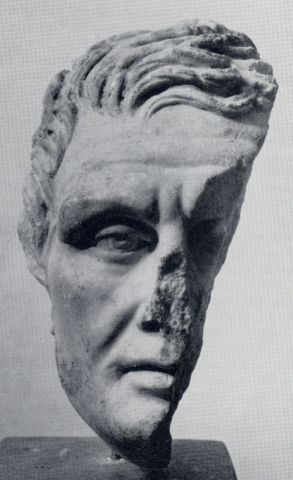
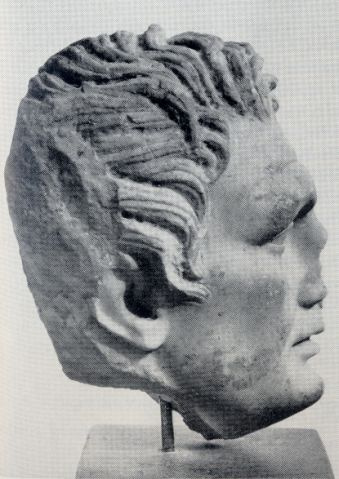
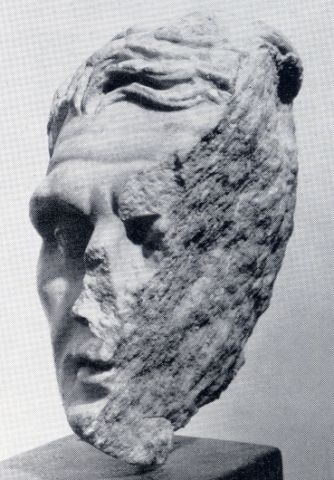
Under life-size head of Menander. From Italy. Later third or fourth century?
Record details
Photographs
Bibliography
- Vessberg, O. 'Sculptures in the Throne-Holst Collection', Medelhavsmuseet Bulletin 2 , Stockholm 1962, 46-51, figs. 6-8
Discussion
DESCRIPTION (Object)
Under life-size head. H: 17.5 cm. White marble with large crystals.
The head is broken at the top of the neck. The back and the left side are missing. The area above the right ear (including the top of the ear lobe) is abraded and broken. The tip of the nose is missing.
The extant right eye is heavily marked. The iris, three-quarters of a circle, is engraved, and the pupil is described as “hemispherically drilled”. Unfinished drill channels separate the locks of hair. Individual strands are indicated by the flat chisel.
PROVENANCE
The head was purchased by H. Throne-Holst in 1959 from an art dearler in Rome. It was subsequently sold at Christie’s London on 8 June 1988.
DESCRIPTION (Subject)
The portrait head shows a clean-shaven man with a lined face and a shock of hair that is swept across the brow from the proper left to right. It is a version of the portrait of Menander, the Greek playwright of new comedy who was immensely popular in the Roman world. There are c. 75 extant copies of this type.
The hair, facial features, lines across the brow and above the nose, naso-labial folds, and slightly open mouth closely follow the much-copied model which has been dated to the early third century BC. This version is distinctive in the coarse drill work in the hair which contrasts sharply with the fine details of the face and in the emphatic markings of the eyes which were usually painted in high-imperial period versions . In general it also seems to have more pronounced folds and creases in the skin.
DATE AND HONORAND
The portrait of Menander is the most popular Roman-period image of a cultural figure. There are c. 75 extant versions of the same portrait model. This particular under life-size head has eye markings and drill channels in the hair that indicate a date of manufacture no earlier than the third century. The popularity of the portrait in late antiquity --there are eight other late-antique versions recorded in LSA; LSA-238, LSA-680, LSA-1196, LSA-2106 , LSA-2109, LSA-2110, LSA-2111, LSA-2640-- makes it possible that this portrait was carved then. It greater animation of the main features of model is typical of the later versions.
Discussion references
- Fittschen, K.'Zur Rekonstruktion griechischer Dichterstatuen. 1. Die Statue des Menander', Mitteilungen des Deutschen Archäologischen Instituts, Athenische Abteilung 106, Berlin 1991, 349, no. 37
- Richter, G.M.A., The Portraits of the Greeks, London 1965, 232, no. 34, fig. 1604
Cite: Last Statues of Antiquity, LSA-2829 (J. Lenaghan).