
LSA-2830
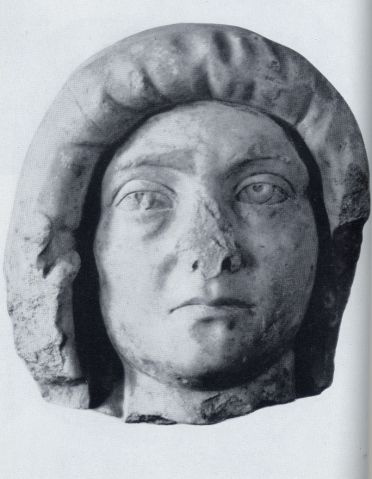
Portrait of woman with hair covered. From Ephesus. Probably fourth to fifth century.
Record details
Photographs
Bibliography
- Antiken aus Rheinischem Privatbesitz. Kunst und Altertum am Rhein 48, Bonn 1973, 228-9, no. 369, pl. 168 (W. Megow: Severan)
Discussion
DESCRI PTION (Object)
Life-size head. H: 23 cm. White fine-grained marble.
The head is broken through the neck. The nose, the covered hair along the left side of the face, and the left hand on the covered hair along the right side of the face are broken.
The irises and the lines defining the eyelids are sharply engraved with a flat chisel. The pupils are drilled out in a bean-shape.
This author believes that this head is likely to have been re-worked from an earlier draped
PROVENANCE
From Ephesus.
DESCRIPTION (Subject)
The head portrays an older woman and is probably from a statue. A hand is still visible on the cloth around the proper right side of the face. In the photograph it appears to be a left thumb, though Megow calls it a right hand. The pose is typical for statues and even busts in the Pudicitia scheme. Were it a left hand, it would mean that the left arm crossed the body, which would exclude that the head broke from a bust; such a composition was never attempted in bust form. Were it a left hand, the position of the hand on the outside of the head covering suggests that the head turned to its left.
The face is crisply separated from the hair which is tightly and completely covered by cloth. This cloth forms a uniform roll around a round face. Along the base of the neck on the right side seems to be the edge of another garment.
The brow is low, and the eyebrows appear to be rendered three-dimensionally. The mouth is bow-shaped with sharp corners. There is loose skin beneath the eyes, at the outer corners of the nostrils, and beneath the lower lip. The philtrum above the upper lip is sharply defined.
DATE
It is difficult to make secure assessment on the basis of a single photograph. Megow published the portrait as Severan and connected the hair covering with a priestly function. Although this possibility cannot be excluded, the face has an abstract aspect and such cloth head coverings appear with greater frequency in late-antique portraits of women; for example, in a fifth century mosaic from Sidi Ghrib, now in the Bardo Museum [I. Kalavrezou, Byzantine Women and Their World (Cambridge MA 2003), fig. 21], LSA-362, LSA-427, LSA-449, and in a statuette in the Ceres type from Aphrodisias (R.R.R. Smith, "Archeological Research at Aphrodisias, 1989-1992" in Aphrodisias Papers 3, 20-24, figs. 17-18). The size of the head is also smaller than the average high-imperial portrait.
Cite: Last Statues of Antiquity, LSA-2830 (J. Lenaghan).