
LSA-2832
Inscribed blocks of column, from base for statue of Diocletian, emperor. Arae Philaenorum (Tripolitania). 284-305
Record details
Photographs
Inscription
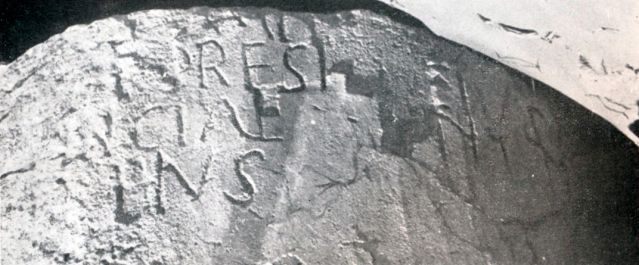
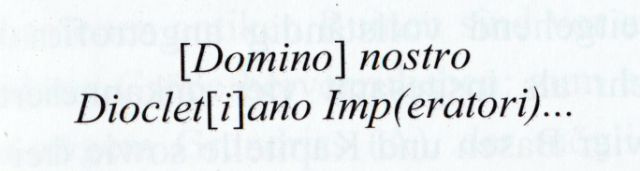
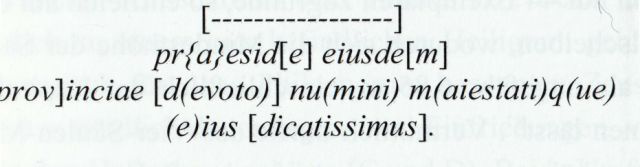
[Domino] nostro / Ḍiocletịano imp(eratori) ... / --- / pr(a)esid[e] eiusdẹ[m] / [prov]inciae [d(evoto)] nu(mini) m(aiestati)q(ue) / eius.
Inscription translation
To our lord, Diocletian, emperor,... being governor (praeses) of this province, devoted to his divine spirit and majesty.
Bibliography
- Goodchild, R. G., Arae Philaenorum and Automalax, Papers of the British School at Rome 20, 1952, 94-110
- L'Année épigraphique, , 1954, 184 a. b
- Thiel, W., Die 'Pompeius-Säule' in Alexandria und die Vier-Säulen-Monumente Ägyptens, Die Tetrarchie: Ein neues Regierungssystem und seine mediale Repräsentation (edd. D. Boschung and W. Eck), 249-322, Wiesbaden 2006, 304-10
Discussion
INSCRIPTION
Fragmentarily preserved in five lines:
[Domino] nostro / Ḍiocletịano imp(eratori) ... / --- / pr(a)esid[e] eiusdẹ[m] / [prov]inciae [d(evoto)] nu(mini) m(aiestati)q(ue) / eius.
'To our lord, Diocletian, emperor, ... being governor (praeses) of this province, devoted to his divine spirit and majesty.'
We reproduce the inscription with the completions suggested by Goodchild 1952, 110. The epigraphic formula with the honorand in the dative suggests that the four columns (see below, 'Description') were used as statue bases to the Tetrarchs (see below, ‘Honorand, Awarder and Date’). The title of the awarding governor is not, as would be usual, in the nominative and was extended to an ablative by Goodchild.
The two fragments of the inscription are carved on different blocks; it is possible either that they belong to one and the same inscription, or to two different ones.
DESCRIPTION (from Goodchild 1952)
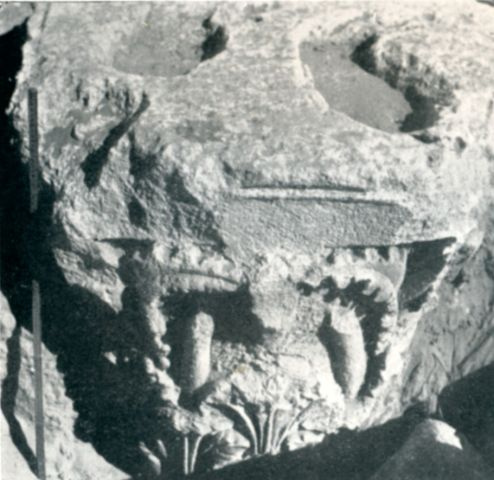
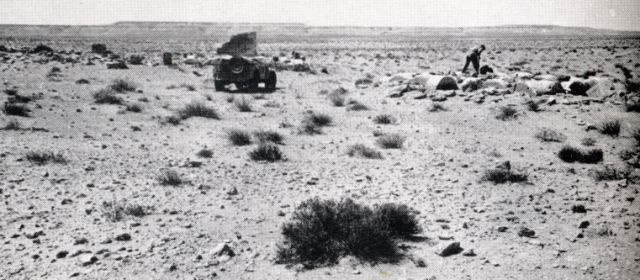
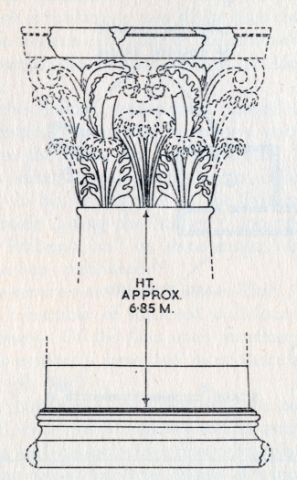
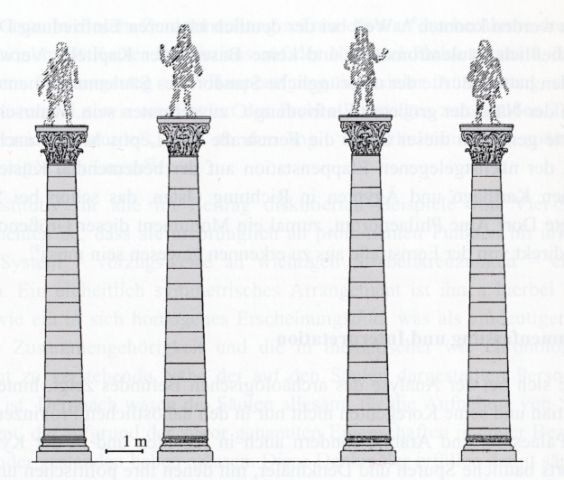
Two late buildings built from antique spolia in Gráret Gser et-Trab (see below, ‘Provenance and Current Location’) contained numerous column drums, four base drums, and four Corinthian capitals. The column drums are of local stone and have traces of stucco coating. The height of the four columns can be calculated to at least 6.85 m (7.85 with capitals).
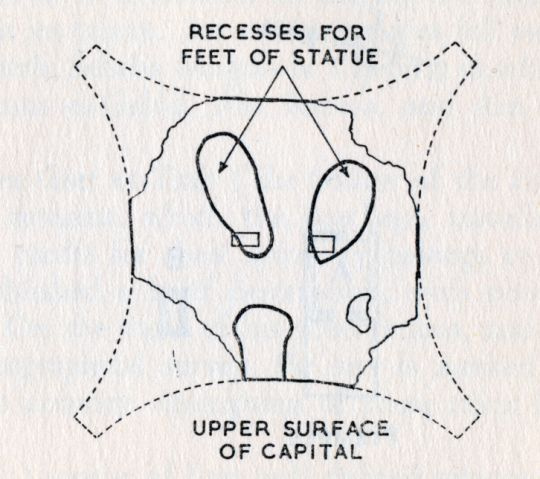
Three of the top drums with a decorative band (astragal) are extant; of these, one has a diameter of only 72 cm, while the other two have 90 cm; two of the columns were apparently slightly superior in height than the others (see below, ‘Further Discussion’). Each capital has the footprints of a bronze statue and a single recess at the back edge on its top face.
No architectural blocks were found; the four columns were probably free standing and supported statues. However, this was probably in a second use; rectangular holes overlapping the footprints on the top face of the capitals (dowel holes?) suggest that the capitals were possibly once attached to another architectural block.
Fragments of at least one inscription were legible on two of the drums (see above, ‘Inscription’).
PROVENANCE AND CURRENT LOCATION
The inscription was found in 1951 in the location called Gráret Gser et-Trab (‘the hollow of the little earth castles’), ca. 6 km south of the promontory called Ras el Aáli in Tripolitania (Goodchild 1952). This is the area of ancient Arae Philaenorum, the border city of the provinces of Tripolitania and Lybia Pentapolis, and at the same time of the dioceses of Oriens and Africa (http://www.trismegistos.org/place/16989).
There is no recent record of the inscription’s location; it is possibly still where found.
HONORAND, AWARDER AND DATE
Diocletian, the honorand, was Augustus 284-305. He shared power with another Augustus (Maximian, 285-305), and from 293-305, additionally with two Caesares (Galerius and Constantius I).
The inscription was set up under a governor (praeses) whose name is lost (PLRE I, Anonymus 100). This was probably a governor of Tripolitania.
The inscription to Diocletian was probably accompanied by similar inscriptions to his imperial colleagues.
FURTHER DISCUSSION
Stucchi 1975 and Purcaro 1998 suggested that the statues of the Caesars of the Tetrarchy (Constantius I and Galerius) were set up on the columns slightly inferior in height (see above, ‘Description’).
Similar monuments to the emperors of the first and second tetrarchies were set up in the military camp at Thebes (Luxor) (LSA-2621, LSA-2622, LSA-2623, LSA-2624, LSA-2625, LSA-2626, LSA-2627, LSA-2628). Thiel 2006 argued that more such monuments were set up in Egypt and the wider region under the Tetrarchs (see also LSA-874, 'Further Discussion'); however, all his suggestions apart from our inscription remain highly hypothetical, and are therefore not included in our database.
Discussion references
- Jones, A. H. M. et al., The Prosopography of the Later Roman Empire. Vol. I 260-395, Cambridge et al. 1971 (1975)
- Purcaro, V., Il monumento onorario architettonico in Cirenaica, La Cirenaica in età antica. Atti del convegno internazionale di Studi, Macerata 1995 (Ichnia 1) (eds. E. Catani & S. M. Marengo), , 1998, 462
- Stucchi, S., Architettura Cirenaica: Monografie di Archeologia Libica 9, 1975, 337-8
Cite: Last Statues of Antiquity, LSA-2832 (Ulrich Gehn).