
LSA-284
Base for statue of Constantius I. Heraclea Perinthus (Europa). 293-305.
Record details
Photographs
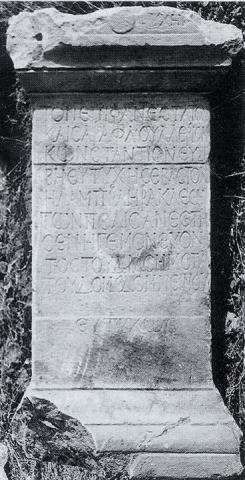
Inscription
[Ἀγαθῆι] Τύχηι / τὸν ἐπιφανέστατον / Καίσαρα Φλ. Οὐαλέριον / Κωνστάντινον Εὐσε/βῆ Εὐτυχῆ Σεβαστὸν / (6) ἡ λαμρὰ Ἡρακλεω/τῶν πόλις ἀνέστη/σεν ἡγεμονεύον/τος τοῦ διασημοτά/του Δομ(ιτίου) Δομνείνου / εὐτυχῶς
Inscription translation
To Good Fortune. The most distinguished Caesar Flavius Valerius Constantinus, pious, fortunate Augustus, The splendid city of Heraclitans set [him] up, in the governorship of Domitius Domninus, of perfectissimus rank. With good fortune.
Bibliography
- Hamdi Sayar, M. , Perinthos-Herakleia (Marmara Ereğlisi) und Umgebung, Vienna 1998, 200, no. 17, pl. 13 fig. 47
Discussion
INSCRIPTION
In eleven lines:
[Ἀγαθῆι] Τύχηι / τὸν ἐπιφανέστατον / Καίσαρα Φλ. Οὐαλέριον / Κωνστάντινον Εὐσε/βῆ Εὐτυχῆ Σεβαστὸν / (6) ἡ λαμρὰ Ἡρακλεω/τῶν πόλις ἀνέστη/σεν ἡγεμονεύον/τος τοῦ διασημοτά/του Δομ(ιτίου) Δομνείνου / εὐτυχῶς
'To Good Fortune. The most distinguished Caesar Flavius Valerius Constantinus, pious, fortunate Augustus, The splendid city of Heraclitans set [him] up, in the governorship of Domitius Domninus, of perfectissimus rank. With good fortune.'
Letter height: 3 - 5 cm
PROVENANCE
Found in the orchestra of the Theatre of Heracleia Perinthus. See also: LSA-301, LSA-403, and LSA-686. It is now on the north slope of the Acropolis.
DESCRIPTION (from Hamdi Sayar and the publiushed photo)
Rectangular marble statue base with upper and lower mouldings: H 157, W 79, D 78 cm.
The base appears well-preserved in the photograph. Both upper corners and the lower left corner are broken and lost. The inscribed panel has a central square-rectangular recess which seems to have been designed to contain the inscription. The current inscription runs, however, both above and below it. This same, rather particular, form was used for the bases for the Diocletian and Maximian from the same building (LSA-686, and LSA-301) and for a base for Septimius Severus (Hamdi Sayar no. 10). It is possibly a sign of re-use.
HONORAND, AWARDER AND DATE
The honorand was the Caesar Constantius I. It is part of a group of four virtually identically-shaped and worded bases found at the Theatre. The other three honoured Diocletian LSA-686, Maximian LSA-301, and Galerius LSA-403. This combination of honorands indicates a date after 21 May of 293, when Galerius became Caesar, and before 305, when Diocletian and Maximian abdicated.
The awarder was trhe city of Perinthus, whose name was officially changed to Heraclea by Diocletian in 286. Domitius Domninus, governor of Europa when the statue was erected, is known only from this group of four inscriptions (PLRE I, 266 Domitius Domninus 6).
FURTHER DISCUSSION
The wording on the bases for the Caesars is slightly different from that on the bases for the senior emperors. They are given the epithet ‘epifanestatos, most distinguished’, as opposed to saviour and founder of the civilised world. This adjective as a distinction between senior and junior emperors can also be found on a base from Tegea (LSA-355, found with one for Diocletian LSA-569), on a base from Mylasa in Caria (LSA-513), on two bases from Malla (LSA-934 and LSA-949), a series for the Tetrarchs from Gortyn (LSA-63 Maximian and LSA-89 Galerius), and on imperial dedications from Troy (LSA-287 and LSA-288).
Cite: Last Statues of Antiquity, LSA-284 (J. Lenaghan).