
LSA-2846
Base for statue of Julian, emperor. Ancyra (Galatia Salutaris). 362
Record details
Photographs
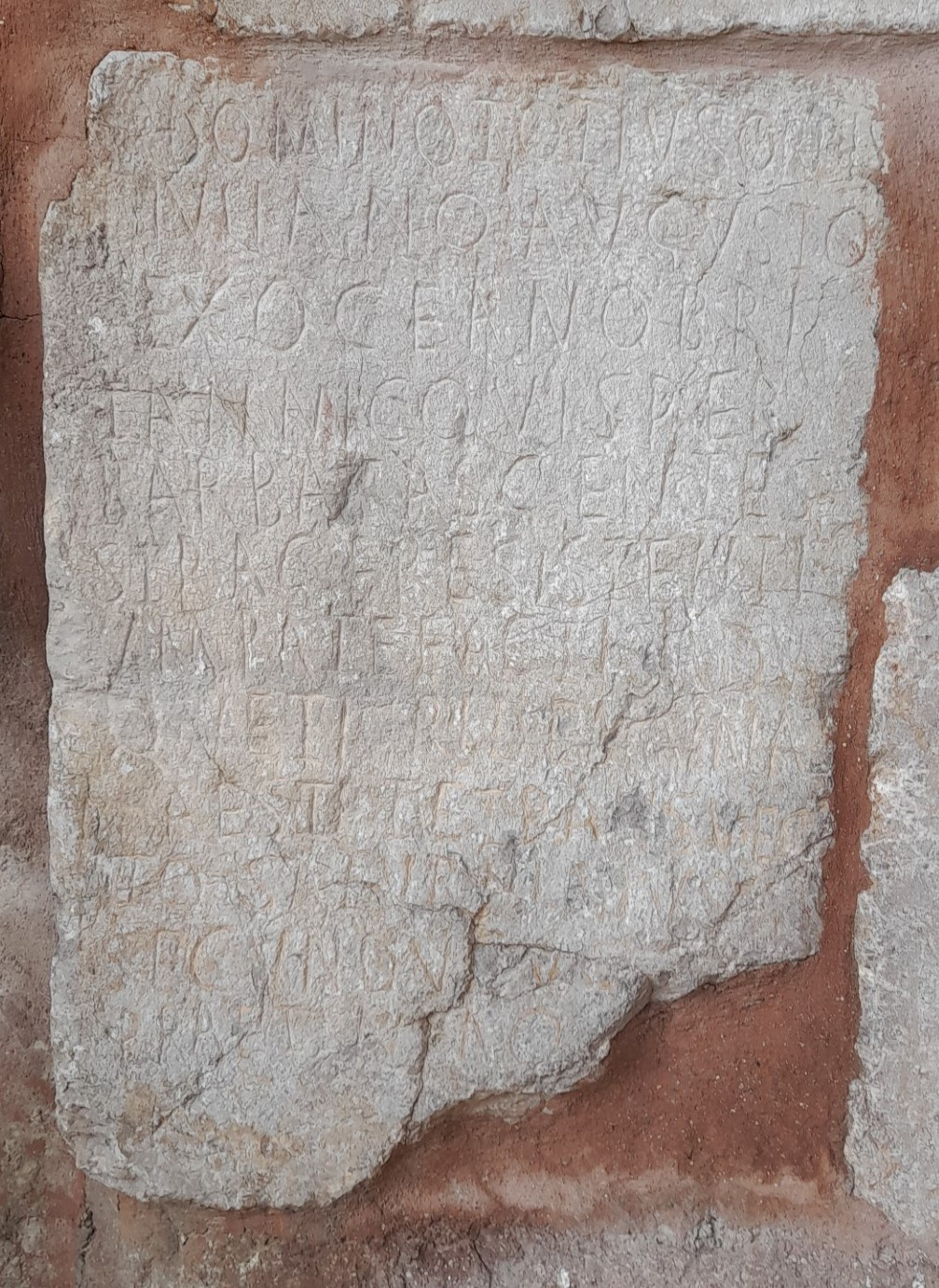
Inscription
Domino totius orbis / Iuliano Augusto / ex Oceano Britannico vi(i)s per /(5) barbaras gentes / strage resistenti/um patefactis adus/que Tigridem una /(9) aestate transvec/to Saturninius / Secundus v(ir) c(larissimus) p̣ṛạẹf̣(ectus) / praet(orio) d(evotus)] n(umini) m(aiestati)q(ue) [ei(us)].
Inscription translation
To the lord of the whole civilised world, Julian Augustus; from the Britannic Ocean through [lands of] barbarian peoples, massacring those who resisted, he opened ways and travelled to the Tigris in one summer. Saturninius Secundus, of clarissimus rank, praetorian prefect, devoted to his divine spirit and majesty, [set this up].
Bibliography
- Corpus Inscriptionum Latinarum; , III 247
- Conti, S. , Die Inschriften Kaiser Julians, Stuttgart 2004, 73-4 no. 20
- de Jerphanion S.J., G., Mélanges d'archeologie anatolienne (Mélanges de l'Université Saint-Joseph XIII, 1), Beyrouth 1928, 234-5 no. 8
- Dessau, H., Inscriptiones latinae selectae, Berlin 3rd ed. 1962, no. 754
Discussion
INSCRIPTION
In twelve lines:
Domino totius orbis / Iuliano Augusto / ex Oceano Britannico vi(i)s per /(5) barbaras gentes / strage resistenti/um patefactis adus/que Tigridem una /(9) aestate transvec/to Saturninius / Secundus v(ir) c(larissimus) p̣ṛạẹf̣(ectus) / praet(orio) d(evotus)] n(umini) m(aiestati)q(ue) [ei(us)].
'To the lord of the whole civilised world, Julian Augustus; from the Britannic Ocean through [lands of] barbarian peoples, massacring those who resisted, he opened ways and travelled to the Tigris in one summer. Saturninius Secundus, of clarissimus rank, praetorian prefect, devoted to his divine spirit and majesty, [set this up].'
We reproduce the inscription with the completions suggested by Mommsen (for CIL III) (p̣ṛạẹf̣(ectus), line 11). This reading was confirmed by an autopsy by De Jerphanion 1928, 234-5, no. 8.
The epigraphic formula with the honorand in the dative and the awarder recorded in the nominative suits a statue base (see below, 'Description').
Letter height not recorded.
DESCRIPTION (from de Jerphanion 1928)
Block, probably rectangular statue base (see above, 'Inscription', and below, 'Provenance and Current Location'). No measurements are published, and there is no published image.
PROVENANCE AND CURRENT LOCATION
The inscription was recorded built into the Byzantine fortification wall of Ankara by CIL in 1873, and again by de Jerphanion in 1928. De Jerphanion recorded it built into the right pillar of the gateway in the south-western angle of the citadel, the so-called bastion B (for a reconstruction of the section see de Jerphanion 1928 pl. 92; for a ground plan pl. 82, 83; for a plan of the south western sector of the citadel, pl. 81).
In January 2024, Chris Lightfoot saw the base in this same location..
HONORAND, AWARDER AND DATE
Julian, the honorand, was Augustus 361-3.
Saturninius Secundus Salutius (Saturninius Secundus in our inscription), the awarder, was an advisor and became a close friend and ally of the Caesar Julian (PLRE I, 814-17, Saturninius Secundus Salutius 3). He was praetorian prefect of the East in 361-5 and accompanied Julian on his campaign against Persia in 362. He was present at Julian’s deathbed. After Julian’s death he was offered the throne but refused on grounds of his bad health and old age (Ammianus Marcellinus 25, 5, 3). He stayed in office under Julian’s successor Iovian. He was awarded a gilded bronze statue on the forum of Trajan in Rome by the emperors Valentinian I and Valens (LSA-1408).
Saturninius Secundus set up the inscription in Ancyra on his way to the Persian border in 362. The inscription alludes to the events preceding the campaign against Persia (for a full discussion of this remarkable inscription see Tantillo 2014). Starting from the Channel coast in northern Gaul (ex Oceano Britannico, lines 3-4), Julian crossed the Rhine to traverse Germany ( viis per barbaras gentes ... patefactis, lines 4-7); he defeated the Alamanni (strage resistentium, lines 6-7) and reached Mesopotamia in the same year (..adusque Tigridem una aestate transvecto, lines 7-10).
FURTHER DISCUSSION
Like other inscriptions to Julian, this one also is exceptional, even unique, in wording and motifs. Since the awarder was a close friend of the emperor, the inscription probably reflects the public image the emperor wished to spread of himself. The motifs are unparalleled in honorific epigraphy; however, they are rooted in the encomiastic literature of the Constantinian period (Tantillo 2014).
ACKNOWLEDGEMENT
We are grateful to Prof. Ignazio Tantillo for pointing out this important omission from our database
Discussion references
- Jones, A. H. M. et al., The Prosopography of the Later Roman Empire. Vol. I 260-395, Cambridge et al. 1971 (1975)
- Tantillo, I., Panegirici e altri ‘elogi’ nelle città tardoantiche, 2014, 343-8
Cite: Last Statues of Antiquity, LSA-2846 (Ulrich Gehn, added 6/2014).