
LSA-286
Base for statue of Caelius Montius, governor of Asia. Klazomenai (Asia). 340-50
Record details
Photographs
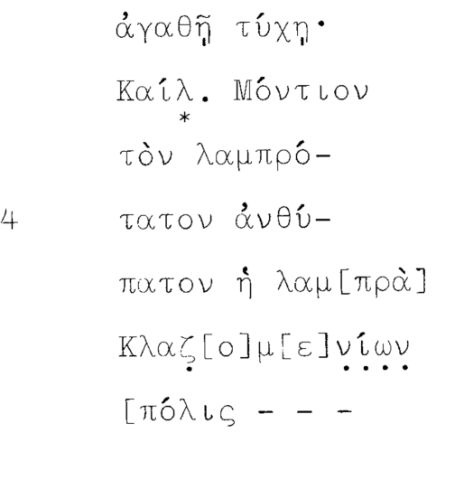
Inscription
Ἀγαθῇ τύχῃ. / Καίλ(ιον) Μόντιον, / τὸν λαμπρό/τατον ἀνθύ/πατον, ἡ λαμ[πρὰ] / (6) Κλαζ̣[ο]μ[ε]ν̣ί̣ω̣ν̣ / [πόλις ---
Inscription translation
To Good Fortune. Cael(ius) Montius, of clarissimus rank, governor (proconsul); the shining city of the Klazomenai [honours him] .
Bibliography
- Corpus Inscriptionum Graecarum; , III no. 3131
- Engelmann, H. and R. Merkelbach , Die Inschriften von Erythrai und Klazomenai. Inschriften griechischer Städte aus Kleinasien, vol. 1-2, Bonn 1972-1973, vol. 2, 522, no. 517
Discussion
INSCRIPTION
In seven preserved lines:
Ἀγαθῇ τύχῃ. / Καίλ(ιον) Μόντιον, / τὸν λαμπρό/τατον ἀνθύ/πατον, ἡ λαμ[πρὰ] / (6) Κλαζ̣[ο]μ[ε]ν̣ί̣ω̣ν̣ / [πόλις ---
'To Good Fortune. Cael(ius) Montius, of clarissimus rank, governor (proconsul); the shining city of the Klazomenai [honours him] .'
Letter height not recorded
DESCRIPTION (from Inscriptiones Graecae III)
Marble block. No measurements are given, and there is no published image.
PROVENANCE AND CURRENT LOCATION
The inscription was first recorded in Klazomenai (http://www.trismegistos.org/place/34304) in 1843 by Boeckh for the Corpus Inscriptionum Graecarum. There is no more recent record of its location.
HONORAND, AWARDER AND DATE
Lucius Caelius Montius, the awarder, was governor (proconsul) of Asia (PLRE I, 608, L. Caelius Montius; Robert 1948, 110-14). He set up bases to Constantius II (Augustus 337-61) and Constans (Augustus 337-50) in Ephesus (LSA-739, LSA-744, LSA-2079, LSA-2080), and one to Constantius II in Assos (LSA-291), and was himself honoured with statues here in Klazomenai and at Tralles (LSA-521). He was probably the same man as the proconsul Montius Magnus to whom Libanius dedicated his Argumenta Demosthenis (PLRE I, 535-6, Magnus Montius 11). If so, he was proconsul of Asia before 351, when Magnus Montius is recorded in the higher office of quaestor sacri palatii (this dating is supported by the dedications that Lucius Caelius Montius made to the emperor Constans, since he died in 350).
The awarder was the city of Klazomenai.
The fact that none of the several surviving imperial dedications set up by Lucius Caelius Montius are to the third son of Constantine I, Constantine II, strongly suggests that his governorship and his dedications date to the period after this emperor's death in 340. Our inscription can therefore be dated, with reasonable confidence, to the period 340-50.
Discussion references
- Jones, A. H. M. et al., The Prosopography of the Later Roman Empire. Vol. I 260-395, Cambridge et al. 1971 (1975)
- Merkelbach, R. (ed.), Die Inschriften von Assos. Inschriften griechischer Städte aus Kleinasien, vol. 4 , Bonn 1976, pp. 67-8 no. 30
- Robert, L., Epigrammes du Bas-Empire (Hellenica IV), Paris 1948, pp. 110-14
Cite: Last Statues of Antiquity, LSA-286 (Ulrich Gehn).