
LSA-2864
Honorific inscription, probably base for statue, of unknown emperor (name lost). Verecunda (Numidia). Late third to early fourth century, probably 286-324
Record details
Photographs
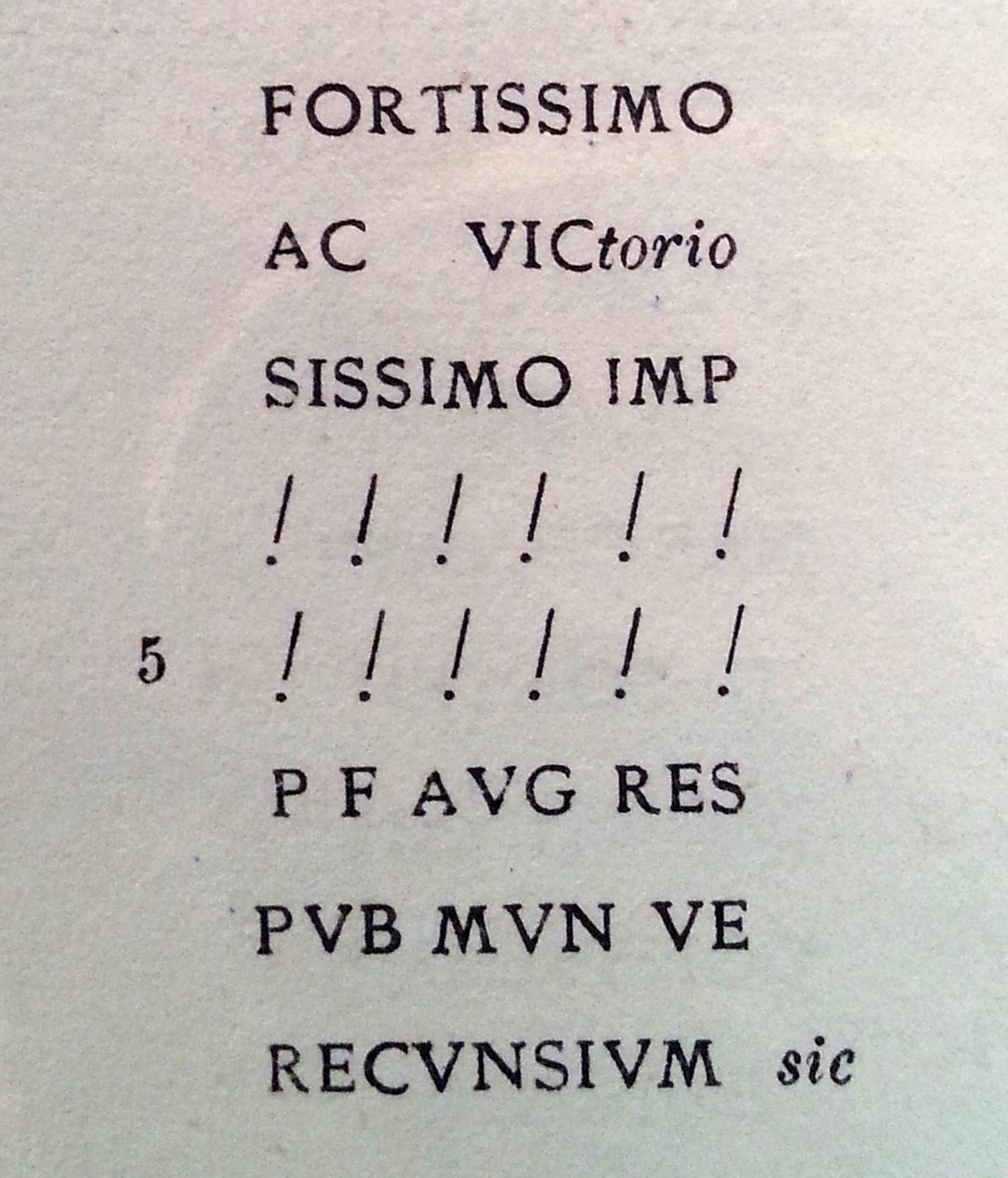
Inscription
Fortissimo / ac vic[torio]-/sissimo imp(eratori) / [---] / [---] / p(io) f(elici) Aug(usto) res / pub(lica) mun(icipii) Ve-/recun{en}sium
Inscription translation
To the most powerful and most victorious emperor (...), pious, fortunate Augustus; the community (res publica) of the city (municipium) of Verecunda [set this up].
Bibliography
- Corpus Inscriptionum Latinarum; , VIII 4225
- De Bruyn, G., Imago principum, imago deorum. Recherches sur les statues impériales et divines dans les cités d’Afrique (Ier - Ve siècles ap. J.-C.). Thèse de doctorat, Univerisité de Caen Basse-Normandie, Caen 2014, p. 1477
Discussion
INSCRIPTION
In eight lines:
Fortissimo / ac vic[torio]/sissimo imp(eratori) / [---] / [---] / p(io) f(elici) Aug(usto) res / pub(lica) mun(icipii) Ve/recun{en}sium
’To the most powerful and most victorious emperor (...), pious, fortunate Augustus; the community (res publica) of the city (municipium) of Verecunda [set this up].’
Letter height not recorded.
DESCRIPTION (from CIL)
CIL, the only publisher of our inscription, has no description of the block. No measurements are published, and there is no published image.
PROVENANCE AND CURRENT LOCATION
The inscription was found on private property in Marcouna, the location of ancient Verecunda, in the area of the ruins of the ancient city (CIL).
We know of no recent record of its location.
HONORAND, AWARDER AND DATE
The name of the honorand is lost on our inscription; however, the imperial titles make it certain he was an emperor. The honorand is styled fortissimo ac victoriossimo (lines1-3); this suggests a late antique date for our inscription (the same combination occurs on LSA-1149 (just possibly Constantius Gallus), LSA-1265 (Constantine); Epigraphic Database Heidelberg (EDH) HD015079 lists also LSA-2088 (but here the formula is mutilated); Epigraphic Database Roma additionally lists EDR 110650 (Aurelian, Rome); both EDH and EDR have no further records). The erasure of the imperial name in lines 4-5 suggests it was an Augustus who suffered damnatio memoriae; this could be Maximian (286-305), Galerius (305-11), Maximinus Daia (310-11), Severus (306-7), Maxentius (306-12), or Licinius (308-24).
We take 286, the year of Maximian’s appointment to the rank of Augustus, as our terminus post quem; our terminus ante quem is 324, the year of Licinius‘ death. Constantine who became sole ruler on this occasion used victor instead of earlier titles such as victoriosissimus (as on our inscription), invictus, invictissimus, or similar, on attribution of LSA-1149 to Constantius Gallus).
The inscription was set up by the city of Verecunda, styled res publica municipii Verecunensium (lines 6-8).
Cite: Last Statues of Antiquity, LSA-2864 (Ulrich Gehn with Gabriel de Bruyn, new entry 5/15).