
LSA-287
Base for silver statue of Zeus, set up to Athena Ilias by emperors Diocletian, Maximian, Galerius, and Constantius I. Ilium/Troy (Hellespontus). 293-305
Record details
Photographs
Inscription
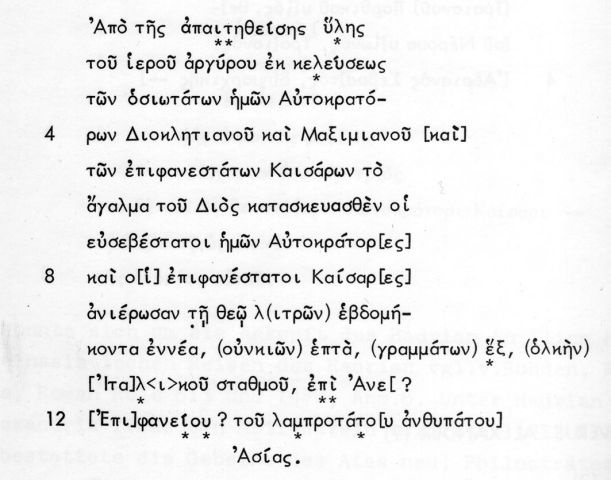
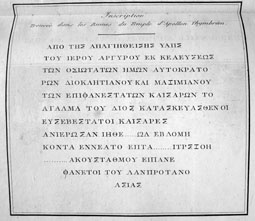
Ἀπο τῆς ἀπαιτηθείσης ὕλης / τοῦ ἱεροῦ ἀργύρου, ἐκ κελεύσεως / τῶν ὁσιωτάτων ἡμῶν Αὐτοκρατό/ρων Διοκλητιανοῦ καὶ Μαξιμιανοῦ [καὶ] /(5) τῶν ἐπιφανεστάτων Καισάρων, τὸ / ἄγαλμα τοῦ Διὸς κατασκευασθὲν οἱ / εὐσεβέστατοι ἡμῶν Αὐτοκράτορ[ες] / καὶ ο[ἱ] ἐπιφανέστατοι Καίσαρ[ες] /(9) ἀνιέρωσαν τῇ θεῷ λ(ιτρῶν) ἑβδομή/κοντα ἐννέα, (οὐνκιῶν) ἑπτὰ, (γραμμάτων) ἕξ, (ὁλκὴν) / [Ἰτα]λ<ι>κοῦ σταθμοῦ, ἐπὶ Ἀνε[-- /(12) [Ἐπι]φανείου τοῦ λαμπροτάτο[υ ἀνθυπάτου]/ Ἀσίας.
Inscription translation
Out of the material of sacred silver, commanded by order of our most hallowed Emperors Diocletian and Maximian and the most brilliant Caesars, our most pious Emperors and the most brilliant Caesars have dedicated a statue of Zeus to the goddess, constructed of seventy-nine pounds, seven ounces, six grams, according to Italian weight, during the governorship of Asia of An(nius?) Epiphanius, of clarissimus rank.
Bibliography
- Inscriptiones Graecae, IV, 214
- Frisch, P. (ed.), Die Inschriften von Ilion. Inschriften griechischer Städte aus Kleinasien, vol. 3, Bonn 1975, 200-202, no. 96
Discussion
INSCRIPTION
In 13 lines:
Ἀπο τῆς ἀπαιτηθείσης ὕλης / τοῦ ἱεροῦ ἀργύρου, ἐκ κελεύσεως / τῶν ὁσιωτάτων ἡμῶν Αὐτοκρατό/ρων Διοκλητιανοῦ καὶ Μαξιμιανοῦ [καὶ] /(5) τῶν ἐπιφανεστάτων Καισάρων, τὸ / ἄγαλμα τοῦ Διὸς κατασκευασθὲν οἱ / εὐσεβέστατοι ἡμῶν Αὐτοκράτορ[ες] / καὶ ο[ἱ] ἐπιφανέστατοι Καίσαρ[ες] /(9) ἀνιέρωσαν τῇ θεῷ λ(ιτρῶν) ἑβδομή/κοντα ἐννέα, (οὐνκιῶν) ἑπτὰ, (γραμμάτων) ἕξ, (ὁλκὴν) / [Ἰτα]λ<ι>κοῦ σταθμοῦ, ἐπὶ Ἀνε[-- /(12) [Ἐπι]φανείου τοῦ λαμπροτάτο[υ ἀνθυπάτου]/ Ἀσίας.
'Out of the material of sacred silver, commanded by order of our most hallowed Emperors Diocletian and Maximian and the most brilliant Caesars, our most pious Emperors and the most brilliant Caesars have dedicated a statue of Zeus to the goddess, constructed of seventy-nine pounds, seven ounces, six grams, according to Italian weight, during the governorship of Asia of An(nius?) Epiphanius, of clarissimus rank.'
Letter height not recorded.
DESCRIPTION
According to the Corpus Inscriptionum Graecarum, the inscription is carved on a half-column c. 70 cm in diameter ('Scriptus est in columna dimidiata diametri pedum II') (see also LSA-288).
PROVENANCE AND CURRENT LOCATION
The inscription was first recorded by Le Chevalier in the late 18th century within the cemetery of the village of Halileli (Le Chevalier 1802; Lenz 1800; for location see map 1 in Frisch 1975, 323). In antiquity it was set up in the sanctuary of Athena Ilias in Troy (line 9). There is no recent record of its location.
HONORAND, AWARDER AND DATE
The silver statue of Zeus, one of the 'protectors of the emperors (conservatores Augusti)' during the tetrarchy, was dedicated to Athena Ilias (τῇ θεῷ, line 9).
The statue was dedicated between 293 and 305, when Diocletian and Maximian, the Augusti, shared power with the Caesars Galerius and Constantius I.
The dedication took place when An(nius?) Epiphanius was governor (proconsul) of the province of Asia (PLRE I, 281, An(nius?) (Epi?)phanius 5). He is otherwise unknown, but was probably consul suffect before being promoted to the governorship of Asia (Kuhoff 1983, 168). The role of the proconsul of Asia in our inscription may date it to before the provincial reforms of the 290s, since these divided the province of Asia and placed Troy within a new province, Hellespontus, governed by a praeses. However, anomalously Hellespontus was subject, not to the praetorian prefect of the east, but to the proconsul of Asia (Böcking 1839, 5; Neira Faleiro 2005, 219-20, 506). So our dedication may post-date the reform, but pay homage to the praeses of Hellespontus' immediate superior, the proconsul of Asia. (For a similar case, see LSA-274.)
FURTHER DISCUSSION
The reference to 'sacred silver, τοῦ ἱεροῦ ἀργύρου' (in line 2) may refer to votive offerings at the temple (Frisch 1975, 200-2).
According to Lenz 1800, 201, another column with a similar inscription was lying close to this one; in this second inscription, which also recorded a statue of Zeus dedicated to Athena, the names of the Caesars were included. This second inscription is today lost.
It is possible that our dedication to Athena was accompanied by individual statues to the tetrarchs, one of whose inscriptions may be LSA-274 (Malcus 1967, 95).
Discussion references
- Corpus Inscriptionum Graecarum; , no. 3607
- Böcking, E., Notitia Dignitatum et administrationum omnium tam civilium quam militarium in partibus Orientis et Occidentis, Bonn 1839
- Jones, A. H. M. et al., The Prosopography of the Later Roman Empire. Vol. I 260-395, Cambridge et al. 1971 (1975)
- Kuhoff, W., Studien zur zivilen senatorischen Laufbahn im 4. Jahrhundert n. Chr. Ämter und Amtsinhaber in Clarissimat und Spektabilität, Frankfurt am Main 1983
- Le Chevalier, J. B., Recueil de cartes, plans, vues et medailles, pour servir au Voyage de la Troade, Paris 1802, pl. XVIII
- Lenz, C. G., Reise nach Troas, oder Gemählde der Ebene von Troja in ihrem gegenwärtigen Zustande, vom Bürger Lechevalier, Altenburg und Erfurt 1800, p. 201
- Malcus, B. 'Die Prokonsuln von Asien von Diokletian bis Theodosius II', Opuscula Atheniensa, 7 (1967) 91-154
- Neira Faleiro, C., La notitia dignitatum. Nueva edición crítica y commentario histórico (Nueva Roma 25), Madrid 2005
Cite: Last Statues of Antiquity, LSA-287 (Ulrich Gehn).