
LSA-2871
Base for statue of Constantine I, emperor. Seleuceia ad Calycadnum (Isauria). 306-310
Record details
Photographs
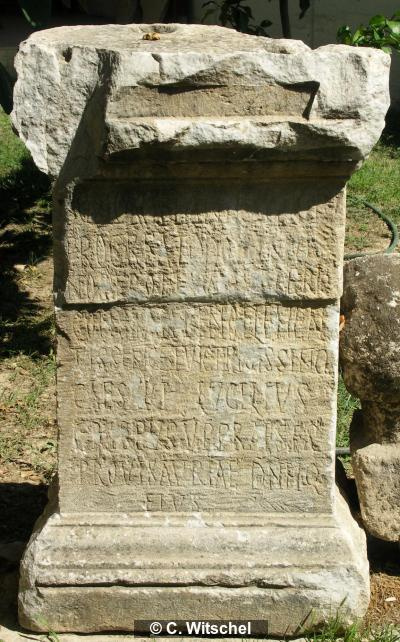
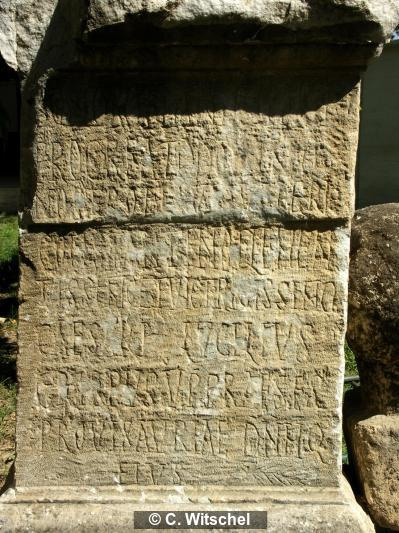
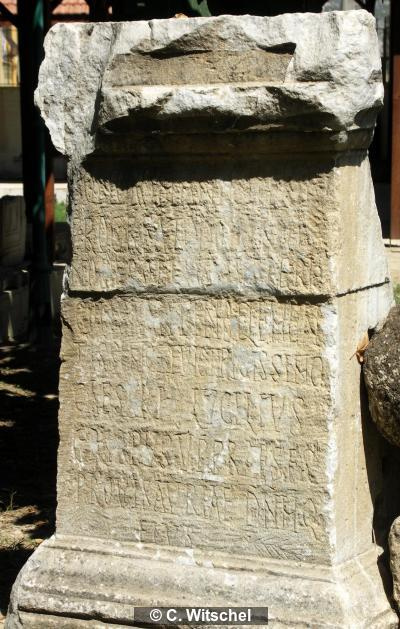
Inscription
Bono romani imperii / procreato domino / nostro Flavio Valerio / (4) Constantino clemen-/tissimo et victoriosissimo / Caesari, Lucilius / Crispus v(ir) p(erfectissimus), praeses / (8) prov(inciae) Isauriae, d(evotus) n(umini) m(aiestati)q(ue) / eius.
Inscription translation
To our lord, born to the good of the Roman empire, Flavius Valerius Constantinus, most clement and most victorious Caesar; Lucilius Crispus, of perfectissimus rank, governor (praeses) of the province of Isauria, devoted to his divine spirit and majesty [set this up]
Bibliography
- Dagron, G. & D. Feissel, Inscriptions de Cilicie (Travaux et Mémoires du Centre de Recherche d'Histoire et Civilisation de Byzance, 4), Paris 1987, 20-1 no. 2
- L'Année épigraphique, , 1978, 814
Discussion
INSCRIPTION
In nine lines:
Bono romani imperii / procreato, domino / nostro Flavio Valerio / (4) Constantino, clemen/tissimo et victoriosissimo / Caesari, Lucilius / Crispus v(ir) p(erfectissimus), praeses / (8) prov(inciae) Isauriae, d(evotus) n(umini) m(aiestati)q(ue) / eius.
’To our lord, born to the good of the Roman empire, Flavius Valerius Constantinus, most clement and most victorious Caesar; Lucilius Crispus, of perfectissimus rank, governor (praeses) of the province of Isauria, devoted to his divine spirit and majesty [set this up].’
Letter height 3.5 – 6.5 cm.
DESCRIPTION (from Année Épigraphique (AE), Dagron and Feissel 1987, Epigraphic Database Heidelberg (EDH), and the published images)
Rectangular limestone base moulded at top and bottom, H 121, W 57, D 37 cm. The upper moulding is heavily damaged. The published images show various holes on the top face. Our inscription is carved over an erased earlier one. The epigraphic field is without frame. The upper third of the shaft, with the first three lines of our inscription, is slightly standing proud of the lower portion. The last word of the inscription (line 9) is followed by an incised palm twig.
PROVENANCE AND CURRENT LOCATION
The inscription was found during excavations on the market place of Silifke in 1974 (Şahin 1991, 151). This is the location of ancient Seleucia ad Calycadnum (http://www.trismegistos.org/place/16507), .
It is now in the Silifke museum (without published inv. no.).
HONORAND, AWARDER AND DATE
Constantine, the honorand (full name Flavius Valerius Constantinus, as in our inscription) was Augustus 306-37, but recognized only as Caesar in the East in 306-10. After 310 Constantine was recognized as Augustus throughout the empire, this is our terminus ante quem.
Lucilius Crispus, the awarder, was of equestrian (perfectissimus) rank (PLRE I, 233 Lucilius Crispus 5). He was provincial governor (praeses) of Isauria. Crispus set up another statue, with a similar inscription, to Constantine’s fellow Caesar in 306-10, Maximinus Daia (LSA-2872, see also below, ‘Further Discussion’).
FURTHER DISCUSSION
Our inscription and its twin LSA-2872 were probably set up together with similar inscriptions to the Augusti of the third Tetrarchy, Galerius (Augustus 305-11) and Severus (Augustus 306-8) or Licinius (Augustus 308-24).
Lucilius Crispus, the awarder is on record in our sample with a further inscription he set up in Ancyra to an unknown emperor (LSA-2876). This was probably some time later than our inscription, since Crispus is recorded on the Ancyra inscription with the higher rank of vicar of the praetorian prefects.
Our inscription is one of five statue base inscriptions to late antique emperors, all in the early 4th century, that are known from Seleucia (our inscription, LSA-2872 LSA-2873, LSA-2874, LSA-2875). They all came to light in the later 20th century; they add three provincial governors to the fasti of the province of Isauria (see PLRE I, 1109, Fasti).
Discussion references
- Hagel, S. and K. Tomaschitz, Repertorium der westkilikischen Inschriften (Ergänzungsband zu den Titulia Asiae Minoris Nr. 22), Vienna 1998, 374 Seleukeia 140
- Jones, A. H. M. et al., The Prosopography of the Later Roman Empire. Vol. I 260-395, Cambridge et al. 1971 (1975), 233. 1109
- Şahin, S., Inschriften aus Seleukeia am Kalykadnos, Epigraphica Anatolica 17, Bonn 1991, 139-66; our inscription is 152-3, Text c
Cite: Last Statues of Antiquity, LSA-2871 (Ulrich Gehn, new entry 5/15).