
LSA-2872
Base for statue of Maximinus Daia, emperor. Seleucia ad Calycadnum (Isauria). 306-310
Record details
Photographs
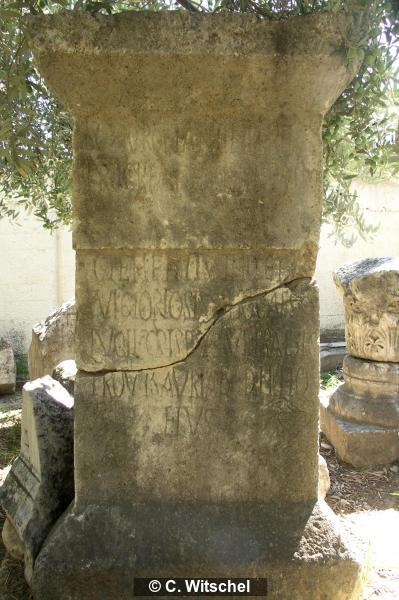
Inscription
Bono romani imperii / procreato domino nostro / [[[Gal(erio) Val(erio) Maximino]]], / clementissimo et /(5) victoriosissimo Caesari, / Lucil(ius) Crispus, v(ir) p(erfectissimus), praeses / prov(inciae) Isauriae, d(evotus) n(umini) maiestati)q(ue / eius.
Inscription translation
To our lord, born to the good of the Roman state, Galerius Valerius Maximinus, most clement and most victorious Caesar; Lucilius Crispus, of perfectissimus rank, governor (praeses) of the province of Isauria, devoted to his divine spirit and majesty [set thisup].
Bibliography
- Dagron, G. & D. Feissel, Inscriptions de Cilicie (Travaux et Mémoires du Centre de Recherche d'Histoire et Civilisation de Byzance, 4), Paris 1987, 21 no. 3 pl. II and Addendum p. 263
- Hagel, S. and K. Tomaschitz, Repertorium der westkilikischen Inschriften (Ergänzungsband zu den Titulia Asiae Minoris Nr. 22), Vienna 1998, 374-5 Seleukeia 141
- L'Année épigraphique, , 1978, 815
Discussion
INSCRIPTION
In eight lines:
Bono romani imperii / procreato domino nostro / [[[Gal(erio) Val(erio) Maximino]]], / clementissimo et /(5) victoriosissimo Caesari, / Lucil(ius) Crispus, v(ir) p(erfectissimus), praeses / prov(inciae) Isauriae, d(evotus) n(umini) maiestati)q(ue / eius.
‘To our lord, born to the good of the Roman state, Galerius Valerius Maximinus, most clement and most victorious Caesar; Lucilius Crispus, of perfectissimus rank, governor (praeses) of the province of Isauria, devoted to his divine spirit and majesty [set thisup].’
Letter height 6 cm.
We reproduce the text with the completions suggested Dagron and Feissel 1987, 263 Addendum, and accepted by Epigraphic Database Heidelberg (EDH). The imperial name in line 3 was later erased; however, it can with certainty be completed to Maximinus Daia (see below, ‘Honorand, Awarer and Date’, and ‘Further Discussion’).
DESCRIPTION (from Année Épigraphique (AE), Dagron and Feissel 1987, EDH, and the published images)
Rectangular limestone base moulded at top and bottom, H 127, W 57, D 54 cm (AE: H 120, W 73 cm). The base is horizontally broken; the fragments have now been joint again. The epigraphic field is not framed. The upper third of the shaft, with lines 1-3 of our inscription, is standing slightly proud of the lower portion. Behind the last word (line 8), an ivy leave is incised.
PROVENANCE AND CURRENT LOCATION
The inscription was found during excavations on the market place of Silifke, in 1974 (Şahin 1991, 151). This is the location of ancient Seleucia ad Calycadnum (http://www.trismegistos.org/place/16507).
It is now in the Silifke museum (without published inv. no.).
HONORAND, AWARDER AND DATE
Maximinus Daia, the honorand (full name Galerius Valerius Maximinus Daia, in inscriptions often Galerius Valerius Maximinus, as in our inscription), was appointed Caesar of the East of the second Tetrarchy, when the Augusti of the first Tetrarchy, Diocletian and Maximian, retired in 305 and their Caesars, Constantius I and Galerius, were promoted to the rank of Augustus. Maximinus kept his rank when, on the death of Constantius I in 306, Constantius’ Caesar Severus moved up to the rank of Augustus. On the same occasion Constantius’ son Constantine was acclaimed Augustus by his troops. Galerius, formally as senior Augustus the most authoritative of the emperors, recognized Constantine, but only as Caesar, in order to keep up the tetrarchic division of power, with an Augustus and a Caesar in both, East and West, at a time, hence Galerius Augustus and Maximinus Caesar in the East, and Severus Augustus and Constantine Caesar in the West. Maximinus continued to keep his rank when, on the death of Severus in 308, Licinius was appointed Augustus of the West. At that time, Constantine, though claiming the rank of Augustus, was still recognized only as Caesar by Galerius. Only in 310 all four emperors (Galerius, Licinius, Maximinus Daia, Constantine) mutually recognized each other as Augusti; this is the terminus ante quem for our inscription (see also below, ‘Further Discussion’).
Lucilius Crispus, the awarder, was of equestrian (perfectissimus) rank; he was provincial governor (praeses) of Isauria (PLRE I, 233 Lucilius Crispus 5). He was formerly only known in the office of vicar (see below, ’Further Discussion’); our inscription (and its twin LSA-2871) add the provincial governorship in Isauria to his cursus honorum. Crispus set up a similar inscription to Constantine (LSA-2871) in Seleucia. The two inscriptions certainly formed a pair (see also below, ‘Further Discussion’); this raises the terminus post quem of our inscription slightly to 306, the year of Constantine’s proclamation.
FURTHER DISCUSSION
In 306 Maxentius was acclaimed Augustus in Rome and was effective ruler in Italy and North Africa until his defeat by Constantine in 312. However, Maxentius was never recognized by his imperial colleagues and must therefore be ruled out as honorand of our inscription.
Our inscription and its twin LSA-2871 were probably accompanied by similar inscriptions to the Augusti of the third Tetrarchy, Galerius (Augustus 305-11) and Severus (Augustus 306-8) or Licinius (Augustus 308-24). Our inscription and its twin reflect the ideal of the Tetrarchy as kept up by Galerius, but soon to be overthrown by the ambitions of the emperors.
Lucilius Crispus is on record in our sample with a further inscription he set up in Ancyra when he held the office of vicar (LSA-2876), probably some time after the governorship in Isauria.
Our inscription is one of five honorific bases to emperors of the early 4th century in Seleucia (our inscription, LSA-2871, LSA-2873, LSA-2874, LSA-2875). All came to light by excavations in the later 20th century. They add the names of three governors, all formerly unknown, to the fasti of the province of Isauria (see PLRE I, 1109 Fasti).
Discussion references
- Jones, A. H. M. et al., The Prosopography of the Later Roman Empire. Vol. I 260-395, Cambridge et al. 1971 (1975), 233. 1109
- Şahin, S., Inschriften aus Seleukeia am Kalykadnos, Epigraphica Anatolica 17, Bonn 1991, 139-66; our inscription is p. 152 Text b
Cite: Last Statues of Antiquity, LSA-2872 (Ulrich Gehn, new entry added 5/15).