
LSA-2873
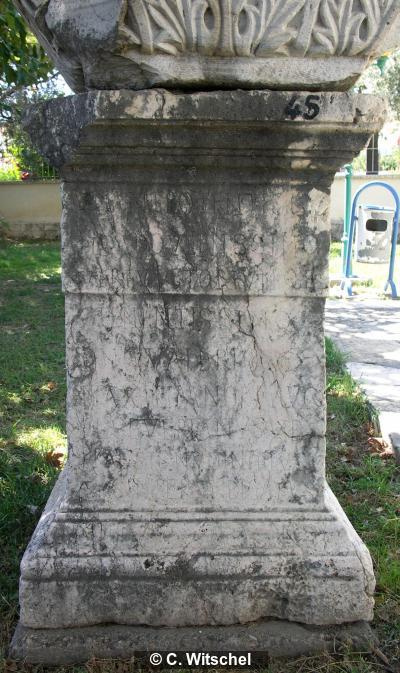
Base for statue of Galerius, emperor. Seleucia ad Calycadnum (Isauria). 305-311
Record details
Photographs
Inscription
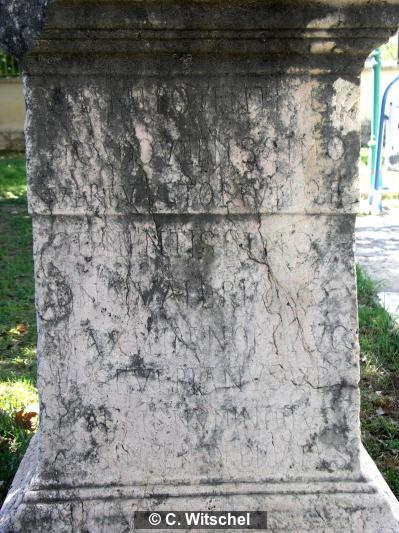
<H>umani(ssimo) potentissi-/mo adque(sic) piissimo / vere victori <omni>umque / clementissimo, / (5) d(omino) n(ostro) G(aio) Valerio / Maximiano ,p(io), f(elici) Aug(usto); / Fl(avius) Severianus ,v(ir) p(erfectissimus), / praes(es) Is(auriae), numini eius / semper dedicatus.
Inscription translation
To the most humane, most powerful, and truly most pious, victor and most clement of all, our lord Caius Valerius Maximianus, pious, fortunate Augustus; Flavius Severianus, of perfectissimus rank, governor (praeses) of Isauria [set this up], always dedicated to his divine spirit.
Bibliography
- Bean, G.E. and T.B. Mitford, Journeys in Rough Cilicia 1964-1968 (Ergänzungsbände zu den Tituli Asiae Minoris Nr. 3), Vienna 1970, 196-7 no. 217
- L'Année épigraphique, , 1972, 652
Discussion
INSCRIPTION
In nine lines:
<H>umani(ssimo) potentissi/mo adque(sic) piissimo / vere victori <omni>umque / clementissimo, / (5) d(omino) n(ostro) G(aio) Valerio / Maximiano ,p(io), f(elici) Aug(usto); / Fl(avius) Severianus ,v(ir) p(erfectissimus), / praes(es) Is(auriae), numini eius / semper dedicatus.
‘To the most humane, most powerful, and truly most pious, victor and most clement of all, our lord Caius Valerius Maximianus, pious, fortunate Augustus; Flavius Severianus, of perfectissimus rank, governor (praeses) of Isauria [set this up], always dedicated to his divine spirit.’
We reproduce the inscription with the completions suggested by Bean and Mitford 1970 and accepted by Hagel and Tomaschitz 1998 (with particular reference to line 3, where the block has victoriumque).
Letter height not recorded.
DESCRIPTION (from Bean and Mitford 1970, and the published images)
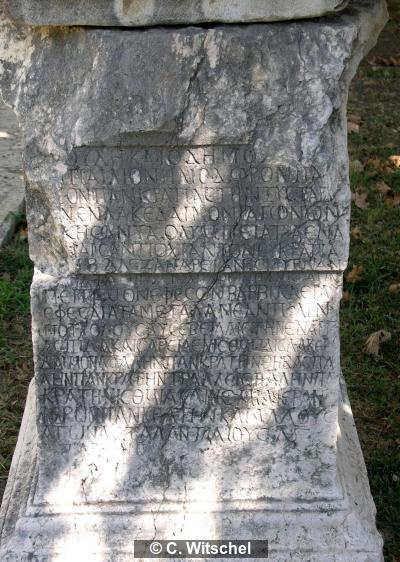
Rectangular white marble base moulded at top and bottom; H 111 cm. Our inscription is carved on the back side of an older honorific inscription to the famous athlete (pancratiast) Publius Aelius Heliodorus, a native of Seleucia, of the earlier imperial period (Robert 1966,101-5; Hagel and Tomaschitz 1998, 372-3 Seleukeia 135).
PROVENANCE AND CURRENT LOCATION
The inscription was found in the schoolyard of the Silifke primary school (Cumhuriyet Okulu), shortly before 1962. The schoolyard is located above an ancient colonnaded street flanked by a large building with a lavishly decorated floor, possibly a public building (Şahin 1991, 139-42; Keil and Wilhelm 1931, 7). In the same area the statue base possibly to Maximinus Daia LSA-2874, set up by the same awarder (see below, ’Honorand, Awarder and Date’), was found. Both, our inscription and LSA-2874 are carved on reused blocks which still carry the dedications to prominent athletes of the 2nd century from their original use (see above, ’Description’).
The old school has now become the Silifke museum. The inscription is standing in the Silifke Museum garden, close to the location where it was found (without published inv. no.).
HONORAND, AWARDER AND DATE
Galerius, the honorand (full name Caius Galerius Valerius Maximianus, Caius Valerius Maximianus in our inscription), was Augustus 305-11.
Flavius Severianus, the awarder, was of equestrian (perfectissimus) rank. He was provincial governor (praeses) of Isauria. Severianus who was formerly unknown is now on record with a further inscription he set up in Seleucia, probably to a co-Augustus of Galerius (LSA-2874).
FURTHER DISCUSSION
Our inscription is one of five honorific statue bases to late antique emperors, all in the early 4th century, that came to light in Seleucia in the later 20th century (LSA-2871, LSA-2872, LSA-2874, LSA-2875), and our inscription. These inscriptions add three formerly unknown governors to the fasti of the province of Isauria.
Discussion references
- Hagel, S. and K. Tomaschitz, Repertorium der westkilikischen Inschriften (Ergänzungsband zu den Titulia Asiae Minoris Nr. 22), Vienna 1998, no. 135 (1st use inscription). 136 (our inscription)
- Jones, A. H. M. et al., The Prosopography of the Later Roman Empire. Vol. I 260-395, Cambridge et al. 1971 (1975), 1109 Fasti
- Keil, J. and A. Wilhelm, Monumenta Asiae Minoris Antiqua. Bd. 3: Denkmäler aus dem rauhen Kilikien, London 1931, 7
- Robert, L., Documents de l’Asie Mineure méridionale, Paris 1966, 101-5
- Şahin, S., Inschriften aus Seleukeia am Kalykadnos, Epigraphica Anatolica 17, Bonn 1991, 133-69
Cite: Last Statues of Antiquity, LSA-2873 (Ulrich Gehn (added 5/15)).