
LSA-2875
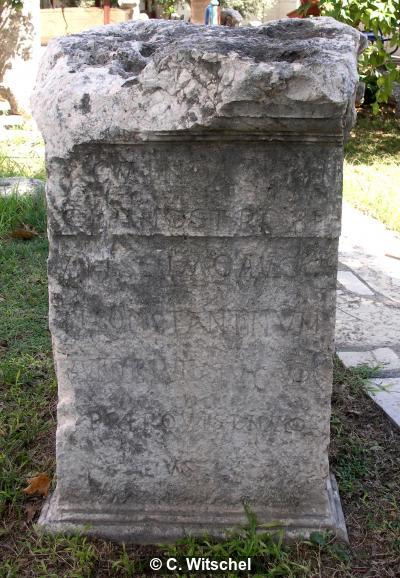
Base for statue of Constantine, emperor, probably replacing one of Licinius, emperor. Seleucia ad Calycadnum (Isauria). 324-37
Record details
Photographs
Inscription
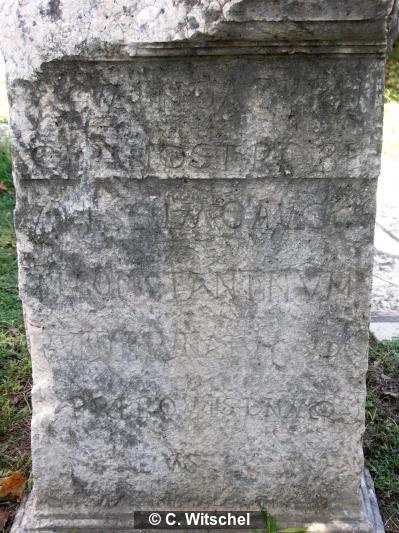
Domino ac prin/cipi nostro, be/atissimo Aug(usto) / Fl(avium) Constantinum;/ (5) Aur(elius) Fortunatus, v(ir) p(erfectissimus), / pr(aeses) pr(ovinciae) Is(auriae), d(evotus) n(umini) m(aiestati)q(ue) / eius.
Inscription translation
To our lord and emperor, the most blessed Augustus Flavius Constantinus; Aurelius Fortunatus, of perfectissimus rank, governor (praeses) of the province of Isauria, devoted to his divine spirit and majesty [set this up].
Bibliography
- Dagron, G. & D. Feissel, Inscriptions de Cilicie (Travaux et Mémoires du Centre de Recherche d'Histoire et Civilisation de Byzance, 4), Paris 1987, 22 no. 4
- L'Année épigraphique, , 1978, 816
Discussion
INSCRIPTION
In seven lines:
Domino ac prin/cipi nostro, be/atissimo Aug(usto) / Fl(avium) Constantinum;/ (5) Aur(elius) Fortunatus, v(ir) p(erfectissimus), / pr(aeses) pr(ovinciae) Is(auriae), d(evotus) n(umini) m(aiestati)q(ue) / eius.
‘To our lord and emperor, the most blessed Augustus Flavius Constantinus; Aurelius Fortunatus, of perfectissimus rank, governor (praeses) of the province of Isauria, devoted to his divine spirit and majesty [set this up].’
Letter height 3–5 cm.
The name of the emperor, Flavium Constantinum, which is anomalously in the accusative rather than the dative, clearly replaces an earlier erased name which is likely to have been that of Constantine’s defeated rival Licinius.
DESCRIPTION (from Année Épigraphique (AE), Epigraphic Database Heidelberg (EDH), Dagron and Feissel 1987, and the published images)
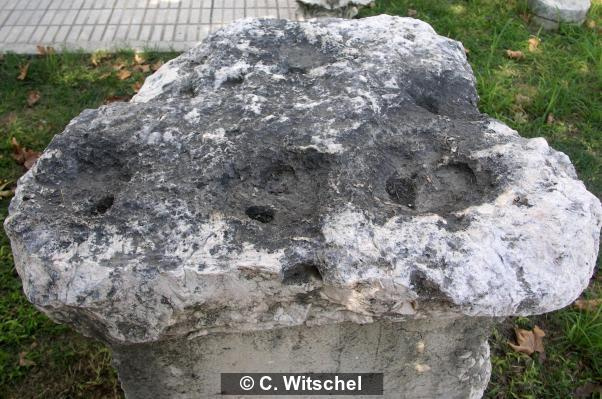
Rectangular limestone base with mouldings at top and bottom, H 111, W 84, D 66 cm. The upper moulding is broken at the left side (from viewer). On the top face there are traces of a bronze statue. The epigraphic field is without frame; the upper quarter of the shaft with the first two lines of our inscription is standing slightly proud of the lower portion.
The dedication to Licinius is carved over an erased earlier one, of which one letter (an M) is extant at the right edge of line 7. On the right lateral face, there is a Greek inscription (τό(πος) Τατιανοῦ - ‘place of Tatianus‘); Dagron and Feissel 1987, 22 suggest that this refers to a merchant who had his shop close to the base. Dagron and Feissel 1987, 22 record holes and notches at the right lateral face; they suggest that the base was set up in a colonnaded hall and that the holes were fittings for a fence which connected the base with the columns.
PROVENANCE AND CURRENT LOCATION
The inscription was found on the market place of Silifke, ancient Seleucia ad Calycadnum, in 1974 (together with LSA-2871 and LSA-2872).
It is now in the Silifke museum (without published inv. no.).
HONORAND, AWARDER AND DATE
Constantine, the honorand, was Augustus in the East from 310-37. His name in the inscription, however, replaces an earlier erased name which is likely to have been that of his defeated rival Licinius, Augustus 308-324.
Aurelius Fortunatus, the awarder, was of equestrian (perfectissimus) rank. He was provincial governor (praeses) of Isauria. Fortunatus was hitherto unknown (he has no entry in PLRE and cannot be identified with any of the men of his name recorded there; see also below, ‘Further Discussion‘).
FURTHER DISCUSSION
Five statue bases to late antique emperors, all from the early 4th century, were found in Silifke in the late 20th century (LSA-2871, LSA-2872, LSA-2873,LSA-2874 and our inscription); they carry the names of three different governors of the province of Isauria, all hitherto unknown. This is a considerable addition to the fasti of this province which are still particularly incomplete (see PLRE I, 1109, Fasti).
Discussion references
- Jones, A. H. M. et al., The Prosopography of the Later Roman Empire. Vol. I 260-395, Cambridge et al. 1971 (1975), 1109
Cite: Last Statues of Antiquity, LSA-2875 (Ulrich Gehn, added 5/15).