
LSA-2878
Base for gilded bronze statue of unknown honorand, senator. Rome, Forum of Trajan. 440-447
Record details
Photographs
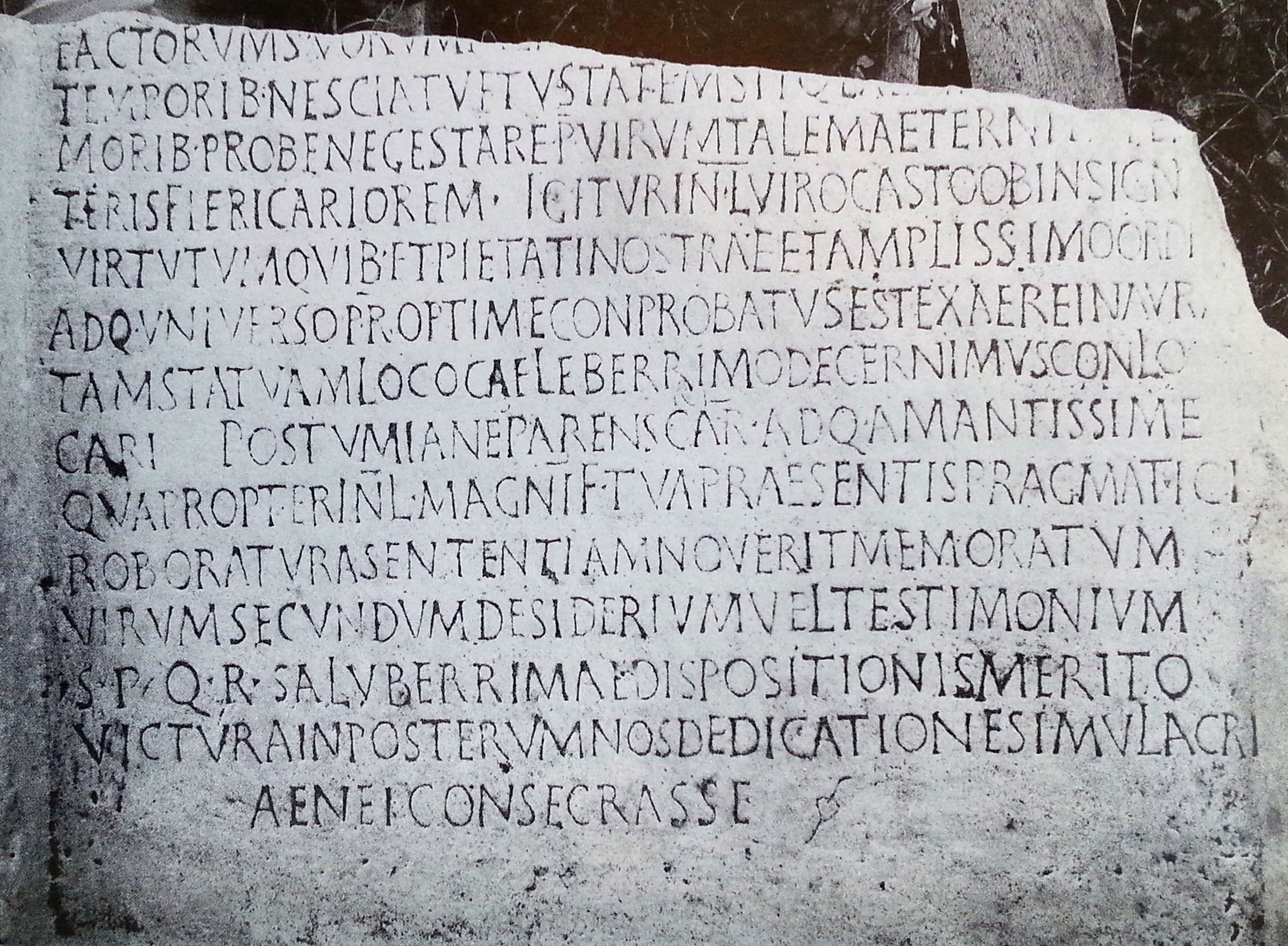
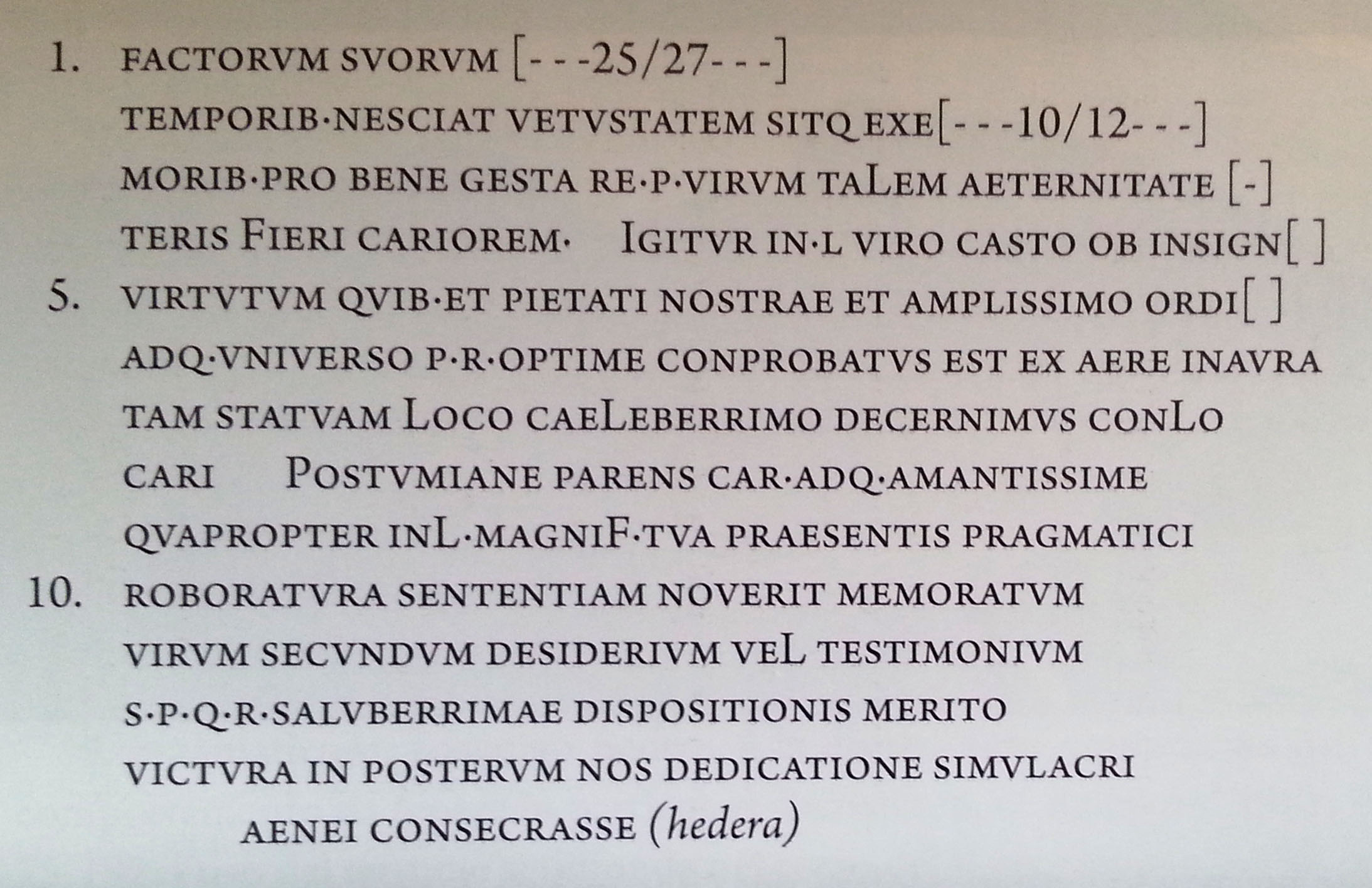
Inscription
--- ut bene-]/factorum suorum [---12-14--- difficillimis] / temporib(us) nesciat vetustatem sitq(ue) exem[plum optimis] / moribus, pro bene gesta re p(ublica) virum talem aeternitate [pos-]/teris fieri cariorem.
Igitur in l(ustro) (sic) viro casto ob insign[ia] /(5) virtutum, quibus et pietati nostrae et amplissimo ordi[ni] / adq(ue) universo p(opulo) R(omano) optime conprobatus est ex aere inaura-/tam statuam loco caeleberrimo (sic) decernimus conlo-/cari.
Postumiane parens car(issime) adq(ue) amantissime / quapropter inl(ustris) magnif(icentia) tua praesentis pragmatici / (10) roboratura sententiam noverit memoratum / virum secundum desiderium vel testimonium / s(enatus) p(opuli)q(ue) R(omani) saluberrimae dispositionis merito / victura in posterum nos dedicatione simulacri / aenei consecrasse.
Inscription translation
That (...) of his good deeds in most difficult times will never know old age, and that it be an example through its best morals, and that such a man, as a recompense for having adminstered the state (res publica) well, be even dearer to future generations in eternity.
Therefore we decide that a gilt bronze statue be set up, at a most frequented place, to this morally pure man, because of the splendour of his virtues, through which he is best acknowledged by ourselves (the emperor or emperors, pietate nostra - ’our piety’), by the senate (ordo amplissimus), and by the entire Roman people.
Postumianus, dearest and most beloved father, therefore your illustrious magnificence which will corroborate the decision of the present writing (pragmaticum) shall know that we sanctified the aforementioned man, according to the desire and the testimony of the Senate and the people of Rome, and by means of our imperial order (saluberrimae dispositionis merito), through the dedication of a bronze statue which will live on in future times.
Bibliography
- Scaroina, L. and A. La Regina, Resti della basilica Ulpia sotto il Palazzo Roccagiovine, Scritti in onore di Lucos Cozza, a cura di Robert Coates-Stephens and Lavinia Cozza (Lexicon Topographicum Urbis Romae - Supplementum VII), Roma 2014, 167-81
Discussion
INSCRIPTION
Partly preserved in 14 lines:
--- ut bene-]/factorum suorum [---12-14--- difficillimis] / temporib(us) nesciat vetustatem sitq(ue) exem[plum optimis] / moribus, pro bene gesta re p(ublica) virum talem aeternitate [pos-]/teris fieri cariorem.
Igitur in l(ustro) (sic) viro casto ob insign[ia] /(5) virtutum, quibus et pietati nostrae et amplissimo ordi[ni] / adq(ue) universo p(opulo) R(omano) optime conprobatus est ex aere inaura/tam statuam loco caeleberrimo (sic) decernimus conlo-/cari.
Postumiane parens car(issime) adq(ue) amantissime / quapropter inl(ustris) magnif(icentia) tua praesentis pragmatici / (10) roboratura sententiam noverit memoratum / virum secundum desiderium vel testimonium / s(enatus) p(opuli)q(ue) R(omani) saluberrimae dispositionis merito / victura in posterum nos dedicatione simulacri / aenei consecrasse.
’That (...) of his good deeds in most difficult times will never know old age, and that it be an example through its best morals, and that such a man, as a recompense for having adminstered the state (res publica) well, be even dearer to future generations in eternity.
Therefore we decide that a gilt bronze statue be set up, at a most frequented place, to this morally pure man, because of the splendour of his virtues, through which he is best acknowledged by ourselves (the emperor or emperors, pietate nostra - ’our piety’), by the senate (ordo amplissimus), and by the entire Roman people.
Postumianus, dearest and most beloved father, therefore your illustrious magnificence which will corroborate the decision of the present writing (pragmaticum) shall know that we sanctified the aforementioned man, according to the desire and the testimony of the Senate and the people of Rome, and by means of our imperial order (saluberrimae dispositionis merito), through the dedication of a bronze statue which will live on in future times.’
Letter height 2.2 – 2.8 cm.
We reproduce the inscription with the completions suggested by La Regina 2014, just slightly adapted to our layout standards.
The inscription is an imperial letter or constitution (pragmaticum) addressed to the official in charge of setting up the monument, Postumianus (line 8; see below, ‘Honorand, Awarder and Date‘). The three sentences/paragraphs of the text are separated by lacunae on the inscription. The record of an imperial decision on a statue base was an unusual honour which certainly enhanced the value of the monument (see below, ’Further Discussion’).
DESCRIPTION (from Scaroina and La Regina 2014, and the published image)
Lower portion of a Proconnesian marble base, H 77.5, W 83 cm. The base is horizontally broken; La Regina 2014, 175 suggests that about half of the original height, and a respective portion of our inscription, is now lost. The epigraphic field is framed. In its present state it is carved back against the original use of the base by c. 2.5 cm; the surrounding frame was also affected by this recarving. Our inscription is carved over an erased earlier one of which traces of some letters are still extant. This earlier inscription was already from a reuse of the base, for which the epigraphic field was cut back; our inscription is therefore at least the second reuse of the base.
The left lateral face is smoothly finished, while the right face lacks the final finish. The back face is only roughly finished and was probably set against a wall. This possibly suggests that the base was not moved from its original position when it was reused.
PROVENANCE AND CURRENT LOCATION
The inscription was excavated in 2001/4 on the north-eastern portion of the forum of Trajan, under today’s Palazzo del Gallo di Roccagiovine.
There is no published record of its present location; it is probably still where found.
HONORAND, AWARDER AND DATE
The name of the honorand is lost on our inscription; casto (line 4) is propably an epithet celebrating the virtues of the honorand, not a proper name. The name was probaly recorded on the upper portion of the inscription, now lost (see above, ’Description’). However, it is evident that the honorand was a high ranking member of the senatorial aristocracy: the Notitia Dignitatum of the late-4th/ early-5th century associates the rank of vir inlustris (line 4) only with the highest offices in the imperial administration (praetorian prefectures, prefecture of the city), in the military service (magister militum (commanding general of the field army) and comes domesticorum (commander of the imperial life guards)), and at court (praepositus sacri cubiculi (chamberlain), magister officiorum (chancellor), quaestor sacri palatii (minister of justice), comes sacrarum largitionum (minister of the imperial fisc), comes rerum privatarum (minister of the imperial estates)), and with the consulship. Our honorand must have held such high office since he is praised for having ‘administered the state well‘ (pro bene gesta re publica, line 3). Moreover, he is praised for his virtues (virtutum, line 5; casto, line 4).
The inscription (and the associated statue) were set up by imperial order (saluberrimae dispositionis merito, line 12), and on the instigation of the Roman senate and the Roman people (secundum desiderium vel testimonium senatus populique Romani, lines 11-12; see also below, ‘Further Discussion‘). The man in charge, Postumianus (line 8) is the only name preserved on our inscription. Postumianus is addressed parens carissime adque amantissime - ’dearest and most beloved father’ (line 8) and inlustris magnificentia tua - ’your illustrious magnificence’ (line 9). He was certainly a prefect of the city of Rome, probably Rufius Praetextatus Postumianus (PLRE II, 901-2 Rufius Praetextatus Postumianus 4). Postumianus was himself honoured with a statue and inscription in Rome (LSA-1465) which gives a detailed cursus honorum. He held the office of prefect of the city twice before he became consul in 448. The inscription boasts that he achieved all his honours at a very young age; this suggests that our inscription was set up not long before 448.
FURTHER DISCUSSION
Our inscription records the initiative of the senate and people of Rome together with the imperial order to set up the statue. This motif reoccurs on several statue base inscriptions to late Roman aristocrats on the forum of Trajan (LSA-314, LSA-319, LSA-342, LSA-404, LSA1247, LSA-1355, LSA-1395, LSA-1407, LSA-1410, LSA-1435, LSA-1458). Almost all these inscriptions are from the 5th century.
Moreover, our inscription records an imperial letter addressed to an official, most probably the prefect of the city (see above, ‘Honorand, Awarder and Date‘). This was apparently a distinguished honour; it reoccurs on only two further statue bases, both highly remarkable: LSA-1247 was set up to Nicomachus Flavianus almost 40 years after his death in order to restore his memory; LSA-1458 is to the later emperor Petronius Maximus (Augustus 455).
The gilt statue once associated with our base is another mark of distinction. Our honorand must have been an outstanding member of the senatorial élite of his time. La Regina 2014, 179 suggested that our honorand was possibly identical to the anonymous honorand of LSA-1410.
Discussion references
- Martindale, J. R., The Prosopography of the Later Roman Empire. Vol. II A.D. 395-527, Cambridge 1980, 901-2
Cite: Last Statues of Antiquity, LSA-2878 (Ulrich Gehn (new entry 5/15)).