
LSA-288
Base for silver statue of god Asclepius, set up to Athena Ilias by emperors Diocletian and Galerius. From Ilium/Troy (Hellespontus). 293-305.
Record details
Photographs
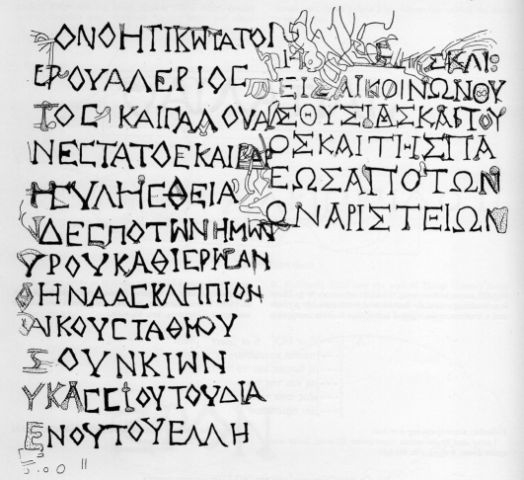
Inscription
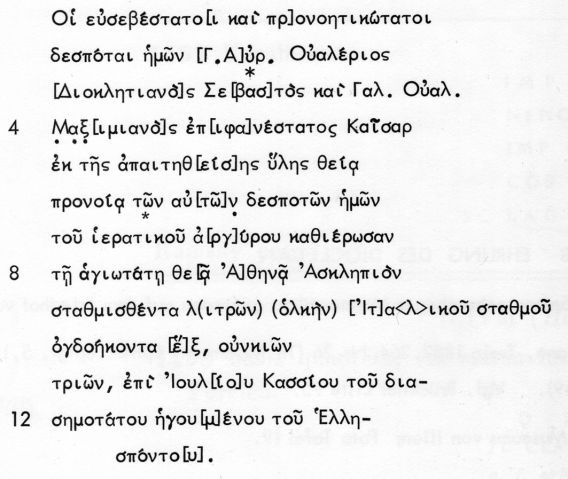
Οἱ εὐσεβέστατο[ι καὶ πρ]ονοητικώτατοι / δεσπόται ἡμῶν, [Γαλ] έ̣ρ(ιος) Οὐαλέριος / [Μαξιμιανὸ]ς Σε[βασ]τὸς καὶ Γαλ(έριος) Οὐαλ(έριος) / [Μ̣α̣ξ̣ιμῖνο]ς ἐπιφανέστατος Καῖσαρ, / (5) ἐκ τῆς ἀπαιτηθ[είσ]ης ὕλης θείᾳ / προνοίᾳ τῶν αὐ[τῶ]ν̣ δεσποτῶν ἡμῶν / τοῦ ἱερατικοῦ ἀ[ργ]ύρου καθιέρωσαν / τῇ ἁγιωτάτῃ θε[ᾷ Ἀ]θηνᾷ Ἀσκληπιὸν, / σταθμισθέντα λ(ιτρῶν) (ὁλκὴν) [Ἰτ]α<λ>ικοῦ σταθμοῦ / (10) ὀγδοήκοντα [ἕ]ξ, οὐνκιῶν / τριῶν, ἐπὶ Ἰουλ[ίο]υ Κασσίου τοῦ δια/σημοτάτου ἡγου[μ]ένου τοῦ Ἑλλη/σπόντο[υ].
Inscription translation
Our most pious and provident lords, Galerius Valerius Maximianus Augustus, and Galerius Valerius Maximinus the most brilliant Caesar, dedicated, out of the material ordered by the sacred foresight of our lords themselves, out of the sacred silver, to the most holy goddess Athena, an Asclepius, weighing eighty-six pounds and three ounces, according to Italian weight, during the governorship of Hellespontus of Julius Cassius, of perfectissimus rank.
Bibliography
- Supplementum Epigraphicum Graecum, , 52, 2002 no. 1182
- Frisch, P. (ed.), Die Inschriften von Ilion. Inschriften griechischer Städte aus Kleinasien, vol. 3, Bonn 1975, 203, no. 97
Discussion
INSCRIPTION
In 13 lines:
Οἱ εὐσεβέστατο[ι καὶ πρ]ονοητικώτατοι / δεσπόται ἡμῶν, [Γαλ] έ̣ρ(ιος) Οὐαλέριος / [Μαξιμιανὸ]ς Σε[βασ]τὸς καὶ Γαλ(έριος) Οὐαλ(έριος) / [Μ̣α̣ξ̣ιμῖνο]ς ἐπιφανέστατος Καῖσαρ, / (5) ἐκ τῆς ἀπαιτηθ[είσ]ης ὕλης θείᾳ / προνοίᾳ τῶν αὐ[τῶ]ν̣ δεσποτῶν ἡμῶν / τοῦ ἱερατικοῦ ἀ[ργ]ύρου καθιέρωσαν / τῇ ἁγιωτάτῃ θε[ᾷ Ἀ]θηνᾷ Ἀσκληπιὸν, / σταθμισθέντα λ(ιτρῶν) (ὁλκὴν) [Ἰτ]α<λ>ικοῦ σταθμοῦ / (10) ὀγδοήκοντα [ἕ]ξ, οὐνκιῶν / τριῶν, ἐπὶ Ἰουλ[ίο]υ Κασσίου τοῦ δια/σημοτάτου ἡγου[μ]ένου τοῦ Ἑλλη/σπόντο[υ].
'Our most pious and provident lords, Galerius Valerius Maximianus Augustus, and Galerius Valerius Maximinus the most brilliant Caesar, dedicated, out of the material ordered by the sacred foresight of our lords themselves, out of the sacred silver, to the most holy goddess Athena, an Asclepius, weighing eighty-six pounds and three ounces, according to Italian weight, during the governorship of Hellespontus of Julius Cassius, of perfectissimus rank.'
Letter height c. 4 cm.
We reproduce the text with the completions suggested by the republication in Supplementum Epigraphicum Graecum (SEG) 52 (see below, Acknowledgements). Frisch 1975 suggested another possible reading of the imperial names in lines 1-4:
Οἱ εὐσεβέστατο[ι καὶ πρ]ονοητικώτατοι / δεσπόται ἡμῶν, [Γ(αίος) Α]ὐρ(ήλιος) Οὐαλέριος / [Διοκλητιανὸ]ς Σε[βασ]τὸς καὶ Γαλ(έριος) Οὐαλ(έριος) / Μ̣α̣ξ̣ [ιμιανὸ]ς ἐπιφανέστατος Καῖσαρ, / (5) etc. - 'Our most pious and provident lords, Gaius Aurelius Valerius Diocletianus Augustus, and Galerius Valerius Maximianus the most brilliant Caesar', (etc.) (see below, 'Honorand, Awarder and Date').
DESCRIPTION (from Lolling 1881, Hereward 1962, and Frisch 1975)
Cylindrical base of grey marble (Lolling 1881: white with bluish stains), broken vertically into two pieces. Piece 1 (left side of inscription, Lolling 1881), H 110, W 60 cm; piece 2 (right side of inscription, Hereward 1962), H 104, W 67, D 30 cm. There is no published image of the monument, other than Hereward's detailed drawing of half the inscription.
Piece 1 is moulded at the top (with toothcut, eggs, and pearls), and at the bottom; below the first-use inscription (see below) it is decorated with a garland relief and a rosette of eight petals. This decoration has been destroyed to create the epigraphic field for our inscription (Lolling 1881, 212). Piece 2 is broken at the top and moulded at the bottom; Hereward 1962, 183 notes 'ornaments like a circle and a crescent’.
Piece 1 carries an inscription to the Greek divinities the Cabiroi from 209-5 BC (Lolling 1881; Frisch 1975, 117 no. 44). This is the first-use inscription on the base. At a later time, probably in the early imperial period, the block was re-used in the sanctuary of Athena Ilias at Troy, probably as a statue base to Athena; this dedication, by the confederation of the cities of the Troad, was carved on the opposite side of the first-use inscription, that is on piece 2 (Frisch 1975, 50 no. 13; Hereward 1962, inscription A; for the date, Frisch 1975, 117). In a second re-use, our inscription was carved between the two earlier ones, on the right side of the base when looking at the first use inscription. On piece 1, the left portion of our inscription partly overwrites the first-use inscription (Lolling 1881, 212), while on piece 2 it partly overwrites the second-use inscription (Hereward 1962, 183). The cut which divides the base into two pieces runs through the middle of our inscription.
The two portions of the inscription were found at different times (see below, 'Provenance and Location’) and were combined by Hereward 1962.
PROVENANCE AND CURRENT LOCATION
The two portions of our inscription were found at different times in the village of Jalowa, in the region of ancient Sestos on the Thracian Chersones, on the opposite side of the Hellespont to Troy. Piece 1 was first recorded by Lolling 1881, piece 2 by Hereward 1962.
Our inscription was certainly set up in the sanctuary of Athena Ilias at Troy, as witnessed by the reference to the goddess (τῇ ἁγιωτάτῃ θεᾷ Ἀθηνᾷ, line 8). A similar statue, of Zeus, was set up in the same sanctuary by all the tetrarchs (LSA-287). The base in its first use was probably set up in a sanctuary of the Cabiroi at Ilium/Troy or its environs, but the first re-use was already within the sanctuary of Athena Ilias. The base must have been brought over the Hellespont to Thrace at some unknown date after its third use (our inscription).
There is no recent record of the base's location.
HONORAND, AWARDER AND DATE
The silver statue of Asclepius was dedicated to Athena Ilias ('to the most holy goddess Athena, τῇ ἁγιωτάτῃ θε[ᾷ Ἀ]θηνᾷ' line 8).
The statue was dedicated in the period between 307 and 308, when Galerius (styled Galerius Valerius Maximianus in our inscription; full name Caius Galerius Valerius Maximianus)was Augustus (lines 2-3), and regarded his Caesar Maximinus Daia (styled Galerius Valerius Maximinus in our inscription) his only legitimate colleague (Corcoran 2006, 239-40). This explains the presence of only two members of the imperial college in our inscription (see above, ‘Inscription’).
The dedication certainly occured after the tetrarchic division of the province of Asia (at an uncertain date in the 290s), since it is dated to the administration of Julius Cassius, governor (praeses) of the newly created province of Hellespontus (PLRE I, 184, Iulius Cassius 1) (see also LSA-287 and LSA-274).
ACKNOWLEDGEMENT
We are grateful to Simon Corcoran, London, for help with this inscription.
Discussion references
- Corcoran, S., The Titulature of the Third Tetrarchy, Bulletin of the Institute of Classical Sstudies 49, 231-240, London 2006
- Hereward, D., Inscriptions from the Khersonese, The Annual of the British School at Athens 57, 1962, pp. 177-85, pp. 182-5 no. 10
- Jones, A. H. M. et al., The Prosopography of the Later Roman Empire. Vol. I 260-395, Cambridge et al. 1971 (1975)
- Lolling, H. G., Altar aus Sestos, Mittheilungen des Deutschen Archäologischen Institutes in Athen, 6, 1881, pp.209-12
Cite: Last Statues of Antiquity, LSA-288 (Ulrich Gehn).