
LSA-292
Dedication to Valentinian II, Theodosius I and Arcadius, emperors, perhaps for a statue. Assos (Asia). 383-392.
Record details
Photographs
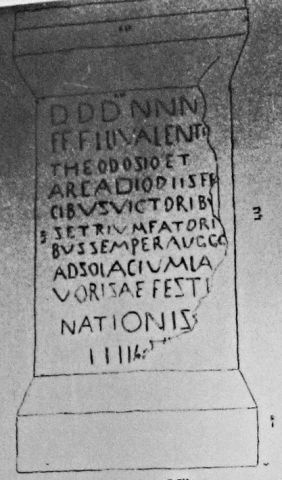
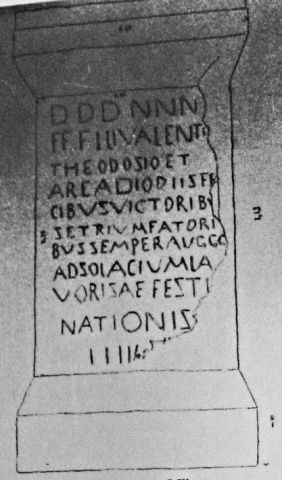
Inscription
DDD(ominis) nnn(ostris) / FFFlll(aviis) Valentin(iano), / Theodosio et /(4) Arcadio, piis, fe[li]/cibus, victoribus / et triumfatori/bus, semper Aug(ustis), / ad solacium la/vorisae (sic) festi/nationis.
Inscription translation
To our lords Flavius Valentinianus, Flavius Theodosius, and Flavius Arcadius, pious, fortunate, victorious and triumphant, eternal Augusti, as solace of laborious haste.
Bibliography
- Merkelbach, R. (ed.), Die Inschriften von Assos. Inschriften griechischer Städte aus Kleinasien, vol. 4 , Bonn 1976, 68-9, no. 31
Discussion
INSCRIPTION
In ten lines:
DDD(ominis) nnn(ostris) / FFFlll(aviis) Valentin(iano), / Theodosio et /(4) Arcadio, piis, fe[li]/cibus, victoribus / et triumfatori/bus, semper Aug(ustis), / (8) ad solacium la/vorisae (sic) festi/nationis.
'To our lords Flavius Valentinianus, Flavius Theodosius, and Flavius Arcadius, pious, fortunate, victorious and triumphant, eternal Augusti, as solace of laborious haste.'
Letter height not recorded.
The honorands are in the dative as usual in Latin statue base inscription; however, there is no named awarder. The meaning of the words in lines 8-10 is deeply obscure (see below 'Honorands, Awarder and Date').
DESCRIPTION (from Sterrett 1885, Merkelbach 1976, and the published image)
Tall rectangular marble block with mouldings at top and bottom: H 113 (between mouldings: 70), W 49 cm. On the opposite face to our inscription, a relief of serpents feeding from a sacrifice indicates that the block is a re-used altar from the 'Street of Tombs'. Its editors (Sterrett 1885 and Merkelbach 1976) believed that its second use (with our inscription) was as a milestone, though for this its form and inscription would be very unusual.
PROVENANCE AND CURRENT LOCATION
The inscription was first recorded by Sterrett 1885, 61 'at the principal gateway opening upon the western Street of Tombs'. There is no recent record of its location.
HONORANDS, AWARDER AND DATE
Valentinian II, the first honorand, was Augustus 375-92; Theodosius I, the second honorand, Augustus 379-95; Theodosius’ son Arcadius, the third honorand, Augustus 383-408. The date of our inscription is therefore supplied by the common reign of the three Augusti, 383-92.
Mommsen (in Dessau) interpreted the closing words of the inscription (lines 8-10) as a dedication by military road-builders grateful for relief from difficult labour. However this seems fanciful (and only possible if the block really was a milestone).
FURTHER DISCUSSION
The use of this block at the time of our inscription is very unclear. Possibly it was a statue base, for which it is roughly the right size and shape; but it may have been a simple dedicatory inscription. Whatever its use, the closing three lines remain mysterious. If it was for a statue, the naming of the three emperors suggests that there were originally identical bases for the other two.
Discussion references
- Dessau, H., Inscriptiones latinae selectae, Berlin 3rd ed. 1962, no. 785
- Sterrett, J. R. S., Inscriptions of Assos, Papers of the American School of Classical Studies at Athens, Vol. I, 1882-1883, 1-90, Boston 1885, pp. 61-2 no. 31
Cite: Last Statues of Antiquity, LSA-292 (Ulrich Gehn).