
LSA-293
Base, probably for statue, honouring Maximinus Daia, Constantine I and Licinius, emperors. Larisa (Asia). 311-313.
Record details
Photographs
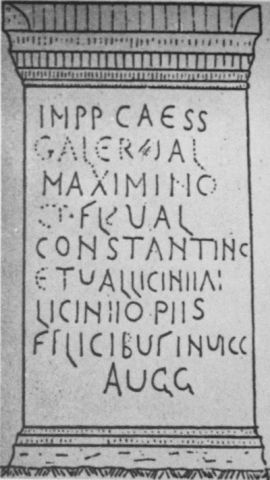
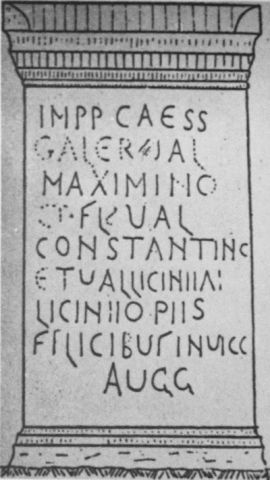
Inscription
Impp(eratoribus) Caess(aribus), / Galer(io) Val(erio) / Maximino, / et Fl(avio) Val(erio) / (5) Constantino, / et Val(erio) Liciniian[o] / Liciniio, piis, / felicibus, invicc(tis) / Augg(ustis).
Inscription translation
For the emperors Caesars, Galerius Valerius Maximinus, and Flavius Valerius Constantinus, and Valerius Licinianus Licinius, pious, fortunate, unconquered Augusti.
Bibliography
- Engelmann, H. (ed.), Die Inschriften von Kyme. Inschriften griechischer Städte aus Kleinasien, vol. 5, Bonn 1976, no. 105
- L'Année épigraphique, , 1909, 195
Discussion
INSCRIPTION
In nine lines:
Impp(eratoribus) Caess(aribus), / Galer(io) Val(erio) / Maximino, / et Fl(avio) Val(erio) / (5) Constantino, / et Val(erio) Liciniian[o] (sic) / Liciniio, piis, / felicibus, invicc(tis) / Augg(ustis).
'To the emperors Caesars, Galerius Valerius Maximinus, and Flavius Valerius Constantinus, and Valerius Licinianus Licinius, pious, fortunate, unconquered Augusti.'
Letter height 6.5 cm.
Anomalously for a statue base, the inscription does not name an awarder (see below, 'Further Discussion').
DESCRIPTION (from Engelmann 1976 and the published image)
Tall base of bluish marble, with mouldings at top and bottom: H 122.5, W 68 cm (without the mouldings: H 89, W 58, D 52.2 cm). On the top face there are the traces of the imprints for a bronze statue.
PROVENANCE AND CURRENT LOCATION
The inscription was first recorded by Keil & Premerstein 1907 in the village of Mussabayköy in the region of the ancient city of Larisa ad Hermum (http://www.trismegistos.org/place/5256). There is no recent record of its location.
HONORANDS AND DATE
Maximinus Daia, the first honorand (full name Galerius Valerius Maximinus Daia), was Augustus 311-13; Constantine I, the second honorand, was Augustus 306-37; Licinius, the third honorand, was Augustus 308-24.
The inscription therefore dates to the common reign of these three emperors. The terminus post quem is the death of Galerius in 311, who otherwise would have been mentioned; the terminus ante quem is Maximinus Daia’s death in 313.
FURTHER DISCUSSION
The absence of an awarder in the inscription could mean that the block was used as a milestone rather than a statue base; however, imprints for bronze feet are recorded on the top face, and there is no indications in the published record that these might be attributable to an earlier use of the block.
If the base carried a statue of one of the three emperors mentioned, it will have been accompanied by similar bases for the other two, since group dedications, with all emperors mentioned on all the bases, are common in the tetrarchic period.
Discussion references
- Keil, J. & A. von Premerstein, Bericht über eine Reise in Lydien und der Südlichen Aiolis : Ausgeführt 1906 im Auftrage der Kaiserlichen Akademie der Wissenschaften, Wien 1907, p. 92 no. 198
Cite: Last Statues of Antiquity, LSA-293 (Ulrich Gehn).