
LSA-297
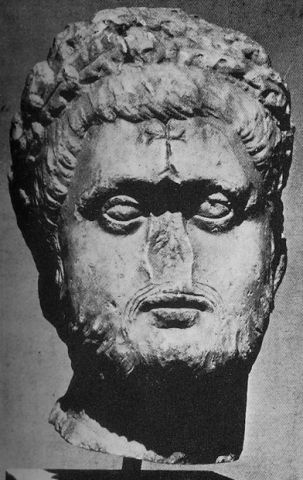
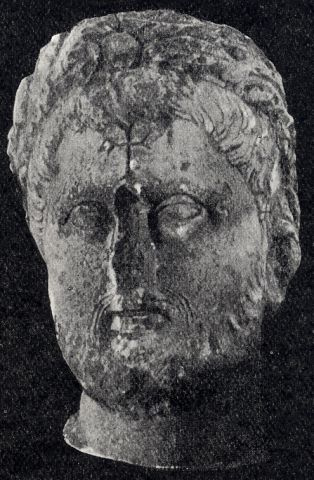
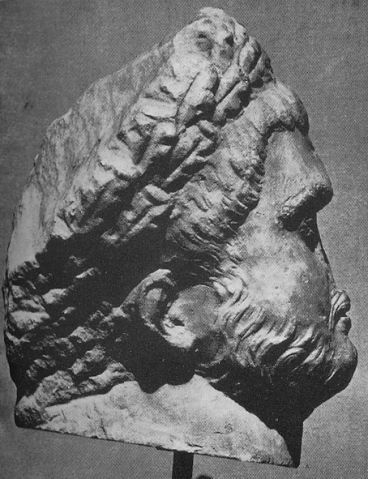
Portrait head of Tetrarch (?) with corona civica and cross on forehead. From Afyon. Late third to early fourth century.
Record details
Photographs
Bibliography
- Inan, J. and E. Rosenbaum, Roman and Early Byzantine Portrait Sculpture in Asia Minor, Oxford 1966, 85-6, no. 62, pl. 39.1-2
- Mendel, G. 'Catalogue des monuments grecs, romains, et byzantines du Musée impérial ottoman de Brousse', Bulletin de Correspondence Hellénique 33, Paris 1909, 271, no. 20, fig. 12
Discussion
DESCRIPTION (Object)
Over life-size head. H: 35.5, W: 21.5 cm. H (chin to crown): 24.5 cm. Fine-grained white marble.
The head has broken diagonally upwards from front to back at the middle of the neck. The top of the head above the crown is broken. The nose was repaired in antiquity and is missing. The top and back were probably never fully worked. This detail plus the thickness of the neck, which functions as a neck pillar, and the sheer size suggest the head broke from a statue.
The hair and most of the beard has been worked with a flat chisel. There are supposedly drill holes in the hair of the beard below the chin and mandible. The moustache has been cursorily engraved on a raised surface with a claw chisel. The eyes, according to Inan and Rosenbaum, are unmarked.
The head has been re-cut from an earlier portrait. This is clearly visible in the compact, little-differentiated mass of hair, and in the various treatments of the facial hair. The central part of the face appears to have been cut back into the plane of the original portrait. The cross on the forehead has been engraved at yet another later moment.
PROVENANCE
Afyon
DESCRIPTION (Subject)
The head shows an emperor who wears a crown of stiffly rendered oak leaves, a corona civica. The corona consists of two tiers of oak leaves and a round central ornament in the lower tier. The man turns to his right.
He has short-hair which is combed forward. Across the brow the locks slant to the proper left until the left temple. The beard is made of long wispy locks which twist naturally and fall in two layers. The moustache is unnaturally and impressionistically rendered. The brow is tall and unmarked. The eyeballs and lids bulge forward. The upper lip is flat, broad, and down-turned.
DATE AND HONORAND
The corona civica indicates that the honorand is an emperor. The short hair and beard indicate an emperor of the later third century. The lack of any emotional element and the youthful aspect suggest a date in the last quarter of the century. The corona civica provides a terminus ante quem since it disappears by the second quarter of the third century.
There many examples of portraits of Tetrarchs from Asia Minor which wear the corona civica. They vary greatly in style; see, for example, LSA-298, LSA-396, LSA-494,LSA-2542. All of the examples from Perge (LSA-2542, LSA-2543, LSA-2544) feature hair that is rendered similarly to this one.
Cite: Last Statues of Antiquity, LSA-297 (J. Lenaghan).