
LSA-299
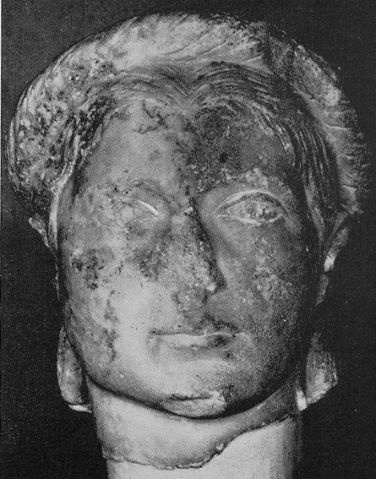
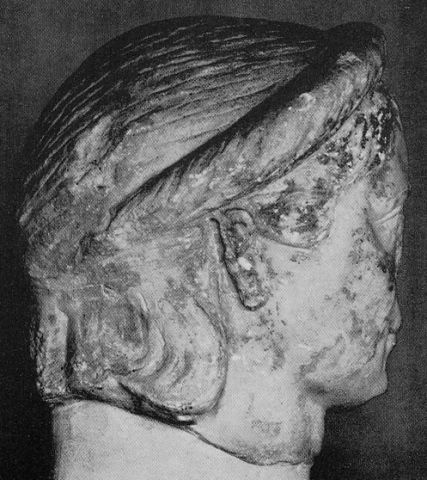
Portrait head of woman with encircling braid hairstyle. Nicaea (Bithynia). Mid- third to early fourth century.
Record details
Photographs
Bibliography
- Inan, J. and E. Rosenbaum, Roman and Early Byzantine Portrait Sculpture in Asia Minor, Oxford 1966, 97, no. 86, pl. 52.3-4 (230-240)
Discussion
DESCRIPTION (Object)
Life-size head. H: 22.5, W: 15.5 cm. Fine-grained white marble.
The head is broken through the neck; more of the right side of the neck is preserved. Most of the nose and tip of the chin have broken off. The back of the neck preserves part of a neck pillar or support.
The pupils are circular and drilled out. The irises are finely engraved and larger than semi-circular.
PROVENANCE
Found ‘in the neighbourhood of Iznik.’ It was together with the portrait of a man with a round, clean-shaven face and short hair (Inan and Rosenbaum, I no. 85).
DESCRIPTION (Subject)
The portrait head shows a woman with a full round face that is unmarked by age. The brow is tall; the cheekbones are widely spaced; the mouth is small but with perfect bow-shaped lips and upturned corners; the chin is small but projecting.
Her hair is parted at the centre. It rises slightly upwards and then falls to both sides of the part. It is pulled around the ears, then looped upward, and braided. The braid or braids are pulled around the head to form a diadem.
DATE
On the basis of hairstyle this portrait should belong to the late third or early fourth century. The same hairstyle can be found on three portraits of women, LSA-1194, LSA-1271, andLSA-1298, which are dated by all scholars between 290 and 330. Von Heintze, in fact, dates this head precisely there.
The Nicaea head, however, was found with a male head with which it is technically identical. They are the same size and have the same support, the same eyes, the same lips, and the same chin. Inan and Rosenbaum suggest that they are by the same hand. The male portrait head has short hair-do which relates to that of Gordian III and thus carries a date of c. 240. Thus, Inan and Rosenbaum date this head to c. 230-240.
CONTEXT
The head and its male counterpart came from a family monument which may have been funerary. They are smaller than most public monuments.
Discussion references
- von Heintze, H. ‘Ein spätantikes Mädchenportät in Bonn. Zur stilitischen Entwicklung des Frauenbildnisses im 4. und 5. Jahrhundert’, Jahrbuch für Antike und Christentum 14, Münster 1971, 65, no. II 4 (first third of fourth century)
Cite: Last Statues of Antiquity, LSA-299 (J. Lenaghan).