
LSA-30
Base for statue of Theodosius, emperor; Theodosius I or II. Constantinople. 379-450
Record details
Photographs
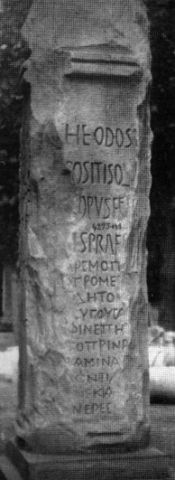
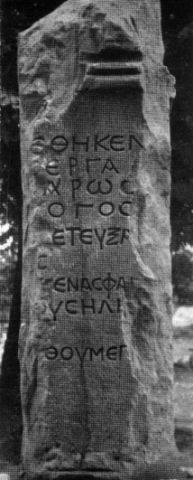
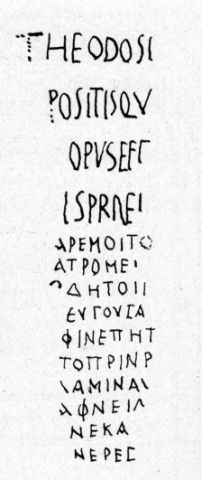
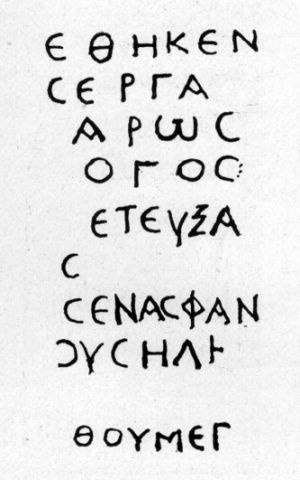
Inscription
Side 1 (in 14 partial lines):
[---]Τ̣heodos[ ---] / [---] Ṣ̣OSITISqu [---] / [---] opus fec̣ [---] / [---]s praef [---] / (5) [---] ΑΡΕΜΟΠ [---] / [---] ΑΤΡΟΜΕΙ̣ [---] / [---] ΔΗΤΟ [---] /(8) [---] ΥΓΟΥΣΑ [---] / [---]Φ̣ΙΝΕΠΗ[---] /(10) [---]Τ̣ΟΠΡΙΝΡ [---] / [---]ΑΜΙΝΑ [---] /(12) [---]Α̣ΦΝΕΙΛ[-̣--] / [---]Ν̣ΕΚΑ [---] / ΝΕΡΕΣ [---]
Side 2 (in 9 partial lines):
[---] ἔθηκεν [---] / [---] ἔργα /(3)[---] ΑΡΩΣ [---] / [---ΟΓΟΣ [---] / [---] ΕΤΕΥΞΑ [---] /(6)[---]Σ̣ / [---] Σ̣ΕΝΑΣΦΑΝ̣ [---] / [---] Ο̣ΥΣΗΛΕ̣ [---] / (vacat) [---] ΟΥΜΕΓ ̣[---]
Inscription translation
Very few words of these two inscriptions can be fully read, or reconstructed:
...Theodosius ...and ... the work ...s, prefect ....
...set up ... works...
Bibliography
- Schneider, A. M., Archäologischer Anzeiger, 1940, pp. 589-92 fig. 18-20
Discussion
INSCRIPTION
Inscriptions on two opposite sides of the base.
Side 1 (in 14 partially preserved lines). Bilingual: Latin in lines 1-4; Greek thereafter.
[---]Τ̣heodos[ ---] / [---] Ṣ̣OSITISqu [---] / [---] opus fec̣ [---] / [---]s praef [---] / (5) [---] ΑΡΕΜΟΠ [---] / [---] ΑΤΡΟΜΕΙ̣ [---] / [---] ΔΗΤΟ [---] /(8) [---] ΥΓΟΥΣΑ [---] / [---]Φ̣ΙΝΕΠΗ[---] /(10) [---]Τ̣ΟΠΡΙΝΡ [---] / [---]ΑΜΙΝΑ [---] /(12) [---]Α̣ΦΝΕΙΛ[-̣--] / [---]Ν̣ΕΚΑ [---] / ΝΕΡΕΣ [---]
Letter height 9 cm (Latin) - 4 cm (Greek).
For the Latin portion, a tentative partial completion and translation are possible:
D(omino) n(ostro)] Theodos[io ...]OSITISqu[e ... opus fec[it ... –u]s praef[ectus urbi]
'To our lord Theodosius ... and ... made this work ... ...--us, prefect of the city ... [set this up]'.
In line, 2, Schneider 1940, 588 read –POSITISqu(e) which we hesitate to accept. The letter before the O is rounded, but not closed, in our view more likely an S than a P. This word is possibly an adjective in the dative plural, describing more than one emperor (see below, 'Honorand, Awarder and Date’). If 'praef—' in line 4 refers to the awarder of the statue, which we think likely, then the preceding '–s’ is either the end of his name, or the end of a rank attribute (such as 'vir clarissimus’). Of the Latin epigraphic formula enough survives to make it highly likely that this was a statue base (though the clinching evidence - the honorand's name in the dative - is missing).
Side 2 (in nine partially preserved lines):
[---] ἔθηκεν [---] / [---] ἔργα /(3)[---] ΑΡΩΣ [---] / [---ΟΓΟΣ [---] / [---] ΕΤΕΥΞΑ [---] /(6)[---]Σ̣ / [---] Σ̣ΕΝΑΣΦΑΝ̣ [---] / [---] Ο̣ΥΣΗΛΕ̣ [---] / (vacat) [---] ΟΥΜΕΓ ̣[---]
' ...set up ... works ...'.
Letter height 4 - 6.5 cm.
Of the Greek inscription on Side 2, nine lines are represented by extant letters, but the wide space between lines 8 and 9 might well represent an additional line now completely lost (see below, 'Description’). Schneider 1940, 591 argued that the Greek inscription on Side 2 was a translation of the Latin text. This theory finds some support in the congruence of 'opus’ (Latin line 3) and ἔργα (Greek, Side 2 line 2) and of '(p?)ositis’ (Latin line 2) and ἔθηκεν (Greek, Side 2 line 1). It was, however, certainly not a literal translation, since there are only four lines of Latin inscription, and many more of Greek. The lines of the Greek inscription on Side 2 are, moreover, partly indented (lines 2, 6, and a possible line after line 8), a sign that the text may have been in verse (Schneider 1940, 591; for an imperial base in Constantinople of 403, which certainly has one inscription in Latin prose and another in Greek verse, see LSA-27).
DESCRIPTION
Fragment of a marble base with mouldings at top and bottom: H (fully preserved) 220, W 55 cm. Schneider 1940, 591 extrapolated an original width of 150 cm. The base is badly damaged at the top, and broken on both sides, removing much of the inscriptions. Schneider 1940, 591 assumed that the left side of the base when facing the Latin inscription (the right side when facing the Greek) was original, though badly chipped both front and back. This is plausible, because the indented lines of the Greek inscription (2, 6, and possibly after 8) indicate, that the lines are ending.
PROVENANCE AND CURRENT LOCATION
The inscription was found in the 1930s in the street immediately west of the Laleli Camii (Müller-Wiener 1977, map E7 no. 5; p. 254 fig. 287 (section of map), p. 61). The Laleli Camii is situated between the Forum of Theodosius (Forum Tauri) to the East and the Forum Bovis to the West (Site of Laleli Camii between the two fora: Mango 1990, fig. 4).
It was brought to the forecourt of St. Sophia in 1939 (Schneider 1940, 590), where it is currently displayed.
HONORAND, AWARDER AND DATE
The honorand was certainly an emperor Theodosius: either Theodosius I (Augustus 379-95), or Theodosius II (Augustus 402-50). From the form of the letters, Schneider 1940 argued for a date in the reign of Theodosius II, but we are less confident that letter-forms can be reliably used to differentiate between the two reigns, and have preferred to leave the choice open.
The awarder was an anonymous prefect, almost certainly praefectus urbi of Constantinople (Latin inscription line 4).
FURTHER DISCUSSION
From the region of Laleli Camii also come a 5th-century togate statue (LSA-1040) and a fragment of a late antique portrait head (LSA-1183).
Discussion references
- Mango, C., Le Développement urbain de Constantinople (IVe-VIIe siècles) (Travaux et Memoires du Centre de Recherche d’Histoire et Civilisation de Byzance, Collège de France, Monographies 2), Paris 1990
- Müller-Wiener, W., Bildlexikon zur Topographie Istanbuls, Tübingen 1977
Cite: Last Statues of Antiquity, LSA-30 (Ulrich Gehn).