
LSA-304
Base for statue of Constantine I, emperor. Rome. 312-324
Record details
Photographs
Inscription
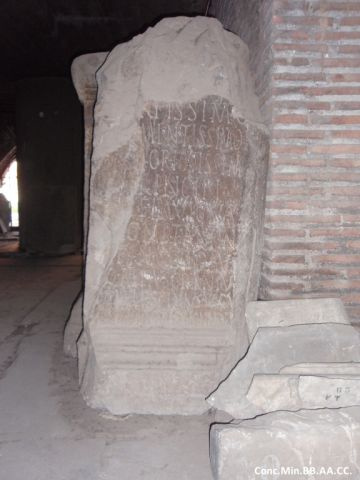
[Fo]rtissimo, / [cle]mentissimo e[t] / [gl]oriosissim[o] / [p]rincipi, /(5) [d(omino)] n(ostro) Flavio Va[l(erio)] / Constantin[o], / [p(io)], f(elici), invicto Aug(usto). / Q(uintus) Attius Graniu[s] / Caelestinus v(ir) c(larissimus), cu[r(ator)] /(10) alv(ei) Tib(eris) et cloac(arum) s(acra) U(rbis), d(evotus) n(umini) m(aiestati)q(ue) ei[us].
Inscription translation
To the most powerful, merciful, and glorious prince, our lord Flavius Valerius Constantinus, pious, fortunate, invincible Augustus; Quintus Attius Granius Caelestinus, of clarissimus rank, caretaker of the bed of the Tiber and sewers of the sacred City, devoted to his divine spirit and majesty.
Bibliography
- Corpus Inscriptionum Latinarum; , VI, 1143 (p. 4329)
Discussion
INSCRIPTION:
In ten lines, with letters 7-4.5 cm.:
[Fo]rtissimo, / [cle]mentissimo e[t] / [gl]oriosissim[o] / [p]rincipi, /(5) [d(omino)] n(ostro) Flavio Va[l(erio)] / Constantin[o], / [p(io)], f(elici), invicto Aug(usto). / Q(uintus) Attius Graniu[s] / Caelestinus v(ir) c(larissimus), cu[r(ator)] /(10) alv(ei) Tib(eris) et cloac(arum) s(acra) U(rbis), d(evotus) n(umini) m(aiestati)q(ue) ei[us].
'For the most powerful, merciful, and glorious prince, our lord Flavius Valerius Constantinus, pius, fortunate, invincible Augustus. Q. Attius Granius Caelestinus, of clarissimus rank, caretaker of the bed of the Tiber and sewers of the sacred City, devoted to his divine spirit and majesty.'
DESCRIPTION:
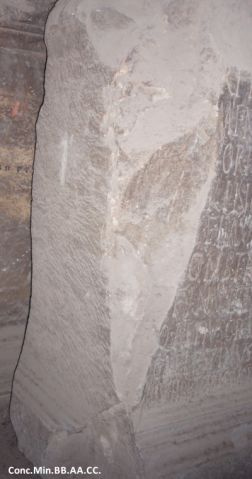
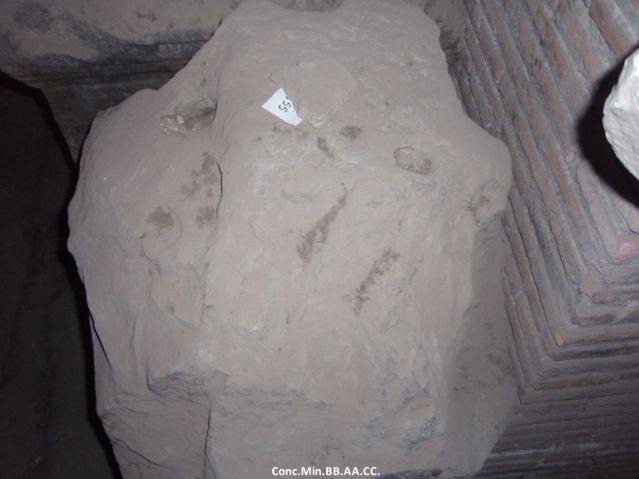
White marble base with mouldings top and bottom, broken at the back and badly damaged on the left side. The base is worn and darkened by dirt. Right and left sides are finished, but slightly damaged. The back is rough/unfinished. The top of the base has two dowel holes, still clearly visible, for fitting the statue above. The epigraphic field is rough, indicating the erasure of an earlier inscription.
PROVENANCE AND LOCATION:
The base was discovered in 1829, during works in the Forum of Trajan, during excavation of a street next to the forum (Lanciani 2000, 314). The findspot suggests that the base came from the forum itself, although the low level of the dedicant is unusual for the area: most dedications in the F.T. were carried out by emperors or the senate. It is still there, at the deposit of basilica Ulpia (FT 14455).
HONORAND AND AWARDER:
The base was dedicated to Constantine I. The awarder, Quintus Attius Granius Caelestinus was a member of the senatorial order (a vir clarissimus), but his low rank at the time of this dedication (as curator alvei Tiberis et cloacarum Urbis) makes this an unusual initiative in such a prestigious space as the Forum of Trajan. However, a large number of early 4th century dedications was carried out by local officials in Rome, at a time when the administration of the city was reorganized, and therefore an original siting for this statue in the Forum of Trajan should not be ruled out (see PLRE I, 167 Caelestinus 2).
DATE:
The dedication took place between 312, when Constantine defeated Maxentius and conquered Rome, and 324, when he abandoned the title invictus in favour of the less religiously charged victor (Eusebius, Vita Constantini 2.19.2, a shift in titulature that can also be traced in the epigraphic record (Camodeca 1971, 30-33; Chastagnol 1988, 30-32)). Constantine visited the city twice during this period, in 312 (when he conquered it) and in 315, for the celebration of his decennalia, and these would be the most likely dates.
Discussion references
- Camodeca, G., "Iscrizioni inedite di Pozzuoli", Atti dell'Accademia di Scienze Morali e Politiche di Napoli, 82, 1971, 30-3
- Chastagnol, A. "Le formulaire de l'épigraphie latine officielle dans l'Antiquité Tardive", Donati, A. (ed.), La terza età dell'Epigrafia, Faenza 1988, pp. 11-65
- Jones, A. H. M. et al., The Prosopography of the Later Roman Empire. Vol. I 260-395, Cambridge et al. 1971 (1975), 167 (Caelestinus 2)
- Lanciani, R., Storia degli scavi di Roma e notizie intorno le collezioni romane di antichità, vol. 6 (1700-1878), Rome 2000, 314
Cite: Last Statues of Antiquity, LSA-304 (Carlos Machado).