
LSA-307
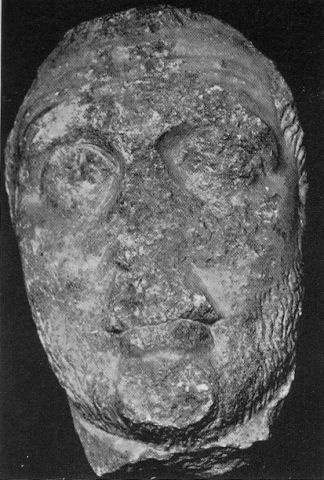
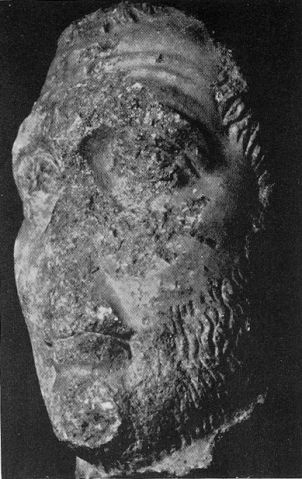
Battered face from portrait of man with short hair and beard. Pompeiopolis (Paphlagonia). Later third century to earlier fourth century..
Record details
Photographs
Bibliography
- Inan, J. and E. Rosenbaum, Roman and Early Byzantine Portrait Sculpture in Asia Minor, Oxford 1966, 105, no. 104, pl. 63.1-2 (270-285)
Discussion
DESCRIPTION (Object)
Life-size head. H: 21, W: 16 cm. Coarse-grained white marble.
The head has broken through the upper part of the neck. The back of the head is entirely missing. The nose has broken off; the chin is chipped; and the brow and cheeks are badly battered.
The hair and beard have been engraved into the surface with long curving strokes of the flat chisel.
PROVENANCE
Found in Pompeiopolis in Paphlagonia.
DESCRIPTION (Subject)
The head shows a mature man with short hair, which recedes at the temples; a short moustache; and a short beard. The brow is heavily creased, with three modelled folds. The eyes are large.
DATE
The linear technique used to represent the hair and the beard suggests that this head has been re-cut. The fashion style represented is typical of the later third and fourth centuries. The dated monuments of C. Valerius Vibius Obsequius AD 303 (LSA-2136) and of C. Saturninus Dogmatius AD 324-337 (LSA-903) show similar technique and fashion.
Discussion references
- Fittschen, K., “Rezension zu: Roman and Early Byzantine Portrait Sculpture in Asia Minor” , GGA 225 (1973), 60, no. 104 (post-Gallienic)
Cite: Last Statues of Antiquity, LSA-307 (J. Lenaghan).