
LSA-309
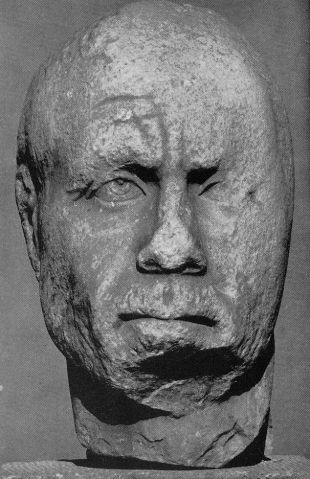
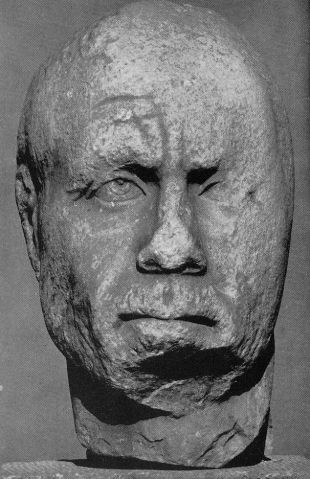
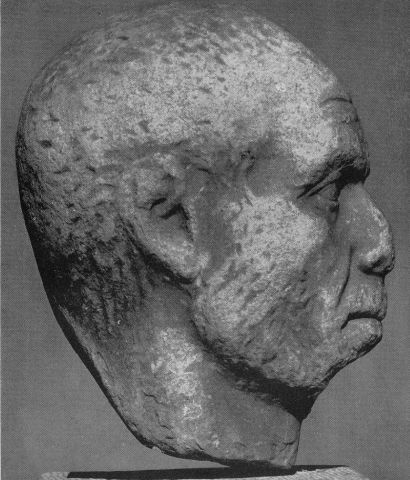
Portrait head of gaunt man with receding short-cropped hair and stubble beard. Now Manisa. Late third century.
Record details
Photographs
Bibliography
- Inan, J. and E. Rosenbaum, Roman and Early Byzantine Portrait Sculpture in Asia Minor, Oxford 1966, 165, no. 218, pl. 120 (275-300)
Discussion
DESCRIPTION (Object)
Over life-size head. H: 27, W: 14.5 cm. H (chin to crown): 23 cm. Medium to coarse-grained white marble.
The head is broken through the middle of the neck. The back of the neck slants upward in a regular line which suggests that it was shaped to fit into a statue. Tip of the nose and chin are missing.
The hair of the head has been roughly defined by large chisel work. It may have been re-cut; possibly there are longer locks of a different, wavier, hairstyle visible behind the right ear. According to Inan and Rosenbaum the back and top of the head are only summarily treated.
The pupil of the right eye is rendered as U shaped. The iris is an engraved semi-circle which does not touch the lower lid.
PROVENANCE
The findspot is unknown, according to Inan and Rosenbaum. It is now in the Manisa Museum, which is 50 km northeast of Izmir.
DESCRIPTION (Subject)
The head shows a mature man with short receding hair; a short moustache; and a short beard. He has a creased and sloping brow, sunken cheeks, a projecting nose, deep naso-labial folds, and a broad mouth.
DATE
The impressionistic chisel work used to represent the hair and the beard suggests that this head has been re-cut. The fashion style represented is typical of the later third and fourth centuries. The monuments of C. Valerius Vibius Obsequius AD 303 (LSA-2136) and of C. Saturninus Dogmatius AD 324-337 (LSA-903) provide dated examples of this sort of portraiture. Undated heads of similar technique and fashion (for example, LSA-891from Italy, LSA-2137 from North Africa, and LSA-307 from Asia Minor) abound from all over the empire and are difficult to date because they have been re-cut, re-used, and found without strong contextual evidence.
Cite: Last Statues of Antiquity, LSA-309 (J. Lenaghan).