
LSA-31
Column base for statue of Theodosius II, emperor. Constantinople, Hebdomon. 402-450
Record details
Photographs
Inscription
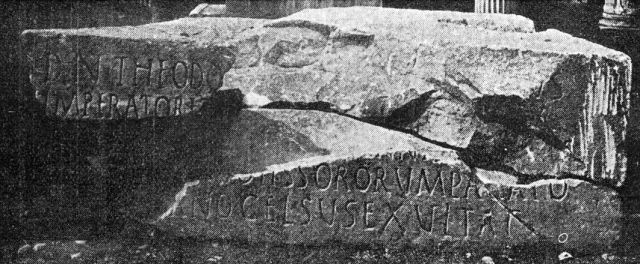
D(omino) n(ostro) [---c. 17---] ..us / imperatori [--- c. 20---] / [--- c. 30---] / [--- c. 10 ---] ...iis sororum pa--ATO / [--- c. 10 ---] ano Celsus exvitat (sic, for 'evitat').
Inscription translation
To our lord ...us the emperor ... of the sisters ... having pacified ... Celsus avoids.
Bibliography
- Makridou, Th. K., 'Kion kai Andrias Theodosiou tou Neoterou', Thrakika, 10 (1938) 170-173, 170-173
- Stichel, R. H. W., Die römische Kaiserstatue am Ende der Antike, Roma 1982, pp. 98-9 no. 100
Discussion
INSCRIPTION
Fragmentary inscription in five lines, the third line completely destroyed:
D(omino) n(ostro) [---c. 17---] ..us / imperatori [--- c. 20---] / [--- c. 30---] / [--- c. 10 ---] ...iis sororum pa--ATO / [--- c. 10 ---] ano Celsus exvitat (sic, for 'evitat').
'To our lord ...us the emperor ... of the sisters ... having pacified ... Celsus avoids.'
Letter height not recorded.
DESCRIPTION (from Makridou 1938, Mango 1990 and the published photos)
Two elements of this columnar monument were found, the column shaft, and the inscribed base or plinth on which the statue itself was set:
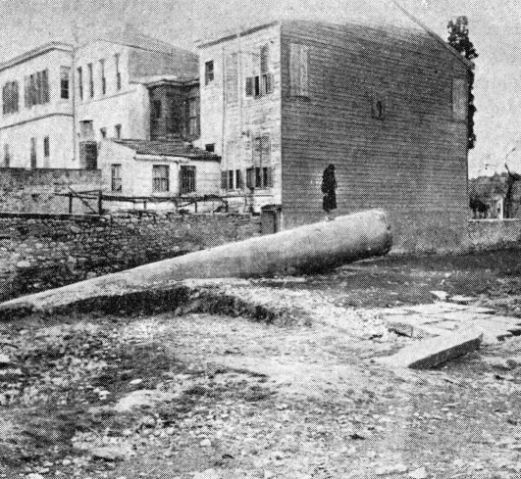
(1) Monolithic column of grey granite: H 11.25 m (Makridou 1938, 170; Mango 1993, X p. 2 no. 3); diameter 1.50 m. The stone is the same granite as the shaft of Marcian's column, but over 2 m longer (LSA-2461; Makridou 1938, 170).
(2) Inscribed marble block: H 56, W 235, D 195 cm. On the upper face are the traces of the fixings for a bronze statue.
Makridou 1938 and Demangel 1945 assumed, reasonably in our opinion, that the column and the inscribed block belong together; and have been followed in this by Mango 1951, and Mango 1993, X. Stichel 1982 argued that clamp holes on the back of the marble block excluded its association with the column (since they would have been impractical for fixing it to the column). However this argument is unconvincing, since the block must have been placed on top of a (lost) capital, and the clamp holes therefore probably served for fixing together block and capital.
PROVENANCE AND CURRENT LOCATION
The column and the inscribed base were found in 1938 on the main street of the then suburb of Istanbul, Bakirköy (Makriköy), in the area of the ancient suburb known as the Hebdomon (Makridou 1938, 170), on the coast west of Constantinople (Demangel 1945; van Millingen 1899). Here there were two imperial palaces, the Magnaura and the Jucundianae, eight major churches, and the barracks and exercise ground of the Thracian army (Janin 1964, 446-7). Makridou suggested that the column was set up between the Jucundianae and the large church of John the Baptist (Makridou 1938, 170). The excavations in 1938 were able to show that the area where the column was set up was paved (Makridou 1938, 173).
The column shaft was left in situ after the excavation campaign of 1938. Part of the inscribed pedestal has been moved to the garden in front of Hagia Sophia (Ayasofya Müzesi) (Mango 1993, X p. 2; Demangel 1945, 33-5 figs. 18, 20-3).
HONORAND, AWARDER AND DATE
From the inscription it is clear that the monument was set up to an emperor Theodosius by his sisters; this speaks in favour of Theodosius II (402-50) whose sisters were highly influential at court, rather than Theodosius I (379-95). Makridou 1938, 171-2, connected the elevation of the monument with the readmission of Pulcheria to court in 449, after she had been exiled to the Hebdomon in 448 through the intrigue of the eunuch Chrysaphius.
FURTHER DISCUSSION
The suburb of Hebdomon played a central role in imperial ceremonial. It was here that several emperors, including Theodosius II, were proclaimed, and the imperial court frequently visited to attend military parades, to welcome the emperor back from campaign, and to pray in the churches of St. John Baptist and St. John the Evangelist (Janin 1964, 446-7). From the 4th century onwards, the Via Egnatia passed through the Hebdomon to the Golden Gate (earlier it had taken a route further to the north, Mango 1990, 33). Processions and triumphs therefore began their progress to the city from the Hebdemon, before entering the Golden Gate and processing up the Mese to the Hippodorome and Palace. Our column should therfore be seen as one of the succession of imperial columns along the way.
Some late antique and Byzantine sources record a porphyry column for an unnamed emperor in front of the Iucundianae palace at the Hebdomon. Since our column is of grey granite, Makridou 1983, 172 (followed by Stichel 1982, 115 no. 146) convincingly argued that this literary reference must be to another column monument at the Hebdomon, as yet undiscovered (LSA-2776).
Discussion references
- Demangel, R., Contribution à la topographie de l'Hebdomon, Paris 1945, 33 ff., figs. 18, 20-23
- Janin, R., Constantinople byzantine : développement urbain et répertoire topographique, Paris 1964
- Mango, C., Le Développement urbain de Constantinople (IVe-VIIe siècles) (Travaux et Memoires du Centre de Recherche d’Histoire et Civilisation de Byzance, Collège de France, Monographies 2), Paris 1990
- Mango, C., The Byzantine Inscriptions of Constantinople: A Bibliographical Survey, American Journal of Archaeology 55, 1951, 52-66, 52-66; p. 66 Hebdomon no. 1
- Mango, C., The columns of Justinian and his successors, C. Mango, Studies on Constantinople, ch. X, Aldershot 1993, ch. X, p. 2 no. 3
Cite: Last Statues of Antiquity, LSA-31 (Ulrich Gehn).