
LSA-311
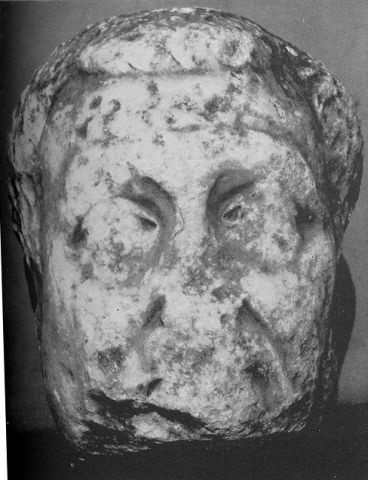
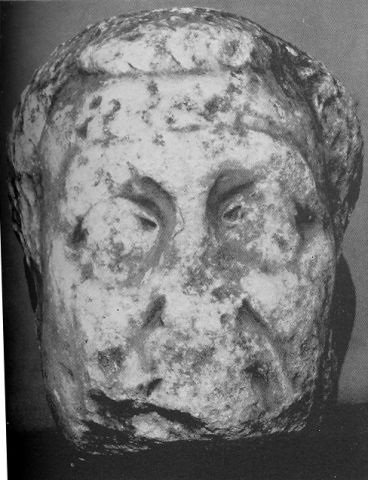
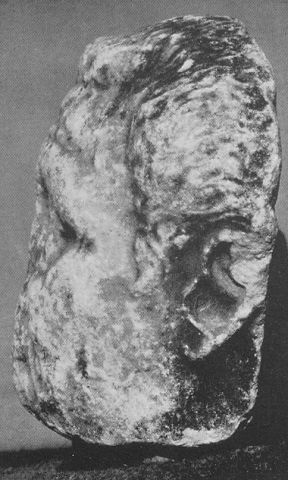
Fragmentary portrait of clean-shaven man with hair brushed forward. Laodicea or Hierapolis?, now Denizili. Mid to later fourth century.
Record details
Photographs
Bibliography
- Inan, J. and E. Rosenbaum, Roman and Early Byzantine Portrait Sculpture in Asia Minor, Oxford 1966, 186-7, no. 253, pl. 139.3-4
Discussion
DESCRIPTION (Object)
Fragment of over life-size head. H: 24, W: 17.5 cm. Coarse-grained white marble.
The head is broken at the top of the neck and behind the ears. Missing are the nose, the mouth, the chin, and the back of the head. The surface is badly battered.
The hair is worked with long strokes of a flat chisel. No eye markings are preserved.
The portrait may have been re-cut from an earlier one. The deep creases on the brow may reflect the bottom edge of the original fringe.
PROVENANCE
The head has no recorded findspot (Inan and Rosenbaum) but was in the ‘Old School’ in Denizli. This suggests a provenance of either Hierapolis or Laodicea.
DESCRIPTION (Subject)
The head shows a mature man with a clean-shaven and flabby face. His hair is combed forward, recedes over both temples, and has twisting sideburns.
He has a tall brow with an accentuated horizontal furrow and high arching eyebrows. The eyes have heavy lids and deep inner canthi. The naso-labial folds are set deep in the full cheeks, and the corners of the mouth seem down-turned.
DATE
The hairstyle and lack of beard should place this head in the middle or later fourth century. The imperial portraits of Valentinian I and Valens show this fashion style and combine it with a mature physiognomy; see for example, LSA-578, LSA-580, and LSA-597. The private portrait of a man from Aphrodisias, LSA-180 , shows a similar manner of representation and is dated with good probability to c. 380.
Discussion references
- Fittschen, K., “Rezension zu: Roman and Early Byzantine Portrait Sculpture in Asia Minor” , GGA 225 (1973), 65, no. 253 (Tetrarchic-Constantinian?)
Cite: Last Statues of Antiquity, LSA-311 (J. Lenaghan).