
LSA-312
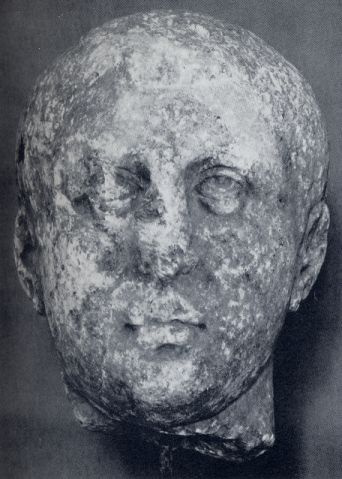
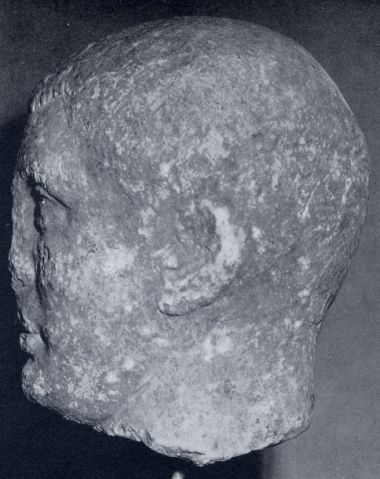
Portrait head of man with irregular short-cropped hair (re-cut). Pamphylia (modern Güzelsu). Late third to early fourth century.
Record details
Photographs
Bibliography
- Inan, J., Antalya bölgesi Roma devri portreleri. Römische Porträts aus dem Gebiet von Antalya , Ankara 1965, 74-5, no. 19, pl. 19 (AD 235-245)
- Inan, J. and E. Rosenbaum, Roman and Early Byzantine Portrait Sculpture in Asia Minor, Oxford 1966, no. 290, pl. 165.1-2 (AD 235-245)
Discussion
DESCRIPTION (Object)
Life-size head. H: 26 W: 21 cm. Coarse-grained bluish marble.
The head is broken diagonally through the top of the neck. The nose is missing. The outer corner of the right eye and the lips are damaged. The surface is worn.
The head has been re-cut from an earlier portrait. Most of the original hair has been cut down to give the skull a rounded shape, on the back and top of which no hair is rendered. Between the ears hair is indicated by short chisel strokes into a slightly raised surface. Longer locks are visible in front of the ears. The ears seem also to have once been covered with some hair. The full long shape of the face seems probably to depend on the shape of a thick beard.
The pupils are drilled out in a thick U-shape. The irises are engraved and shown as three-quarters of a circle.
PROVENANCE
The head was found in Güzelsu. This is c. 30 km south of Akseki and c. 65 km northeast of Side.
DESCRIPTION (Subject)
The head represents a clean-shaven man with a marked angular recession of hair over the right eye. The recession over the left eye is also angular but less marked. The hair itself is barely indicated. The face is long and full with a slight double chin.
DATE
Inan dates the head to the period of Gordian III and Bergmann considers it Tetrarchic. Neither author speaks of the re-cutting which has a significant impact on the technical assessment of the head. Similar re-cutting is visible in two examples from nearby Side which are reliably dated to the late third to early fourth century; both LSA-244 and LSA-250 are similar (and mentioned by Bergmann in the same sentence). Also, on the basis of fashion style, a date in the early fourth century seems most probable for the this portrait of a mature man without a beard.
Discussion references
- Bergmann, M., Studien zum römischen Porträt des 3. Jahrhunderts n. Chr., Bonn 1977, 156 (Tetrarchic)
Cite: Last Statues of Antiquity, LSA-312 (J. Lenaghan).