
LSA-313
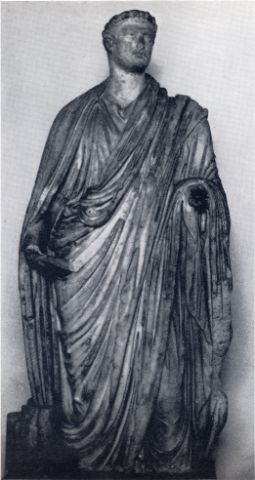
Togate portrait statue with laurel wreath. Polybotus (Phrygia Salutaris). Late third to early fourth century.
Record details
Photographs
Bibliography
- Inan, J. and E. Rosenbaum, Roman and Early Byzantine Portrait Sculpture in Asia Minor, Oxford 1966, 187-8, no. 254, pl. 134.2 and 138.3-4 (mid-third century)
Discussion
DESCRIPTION (Object)
Over life-size statue missing lower legs. H (chin to crown): 179 cm. H (head): 20 cm. Fine-grained white marble.
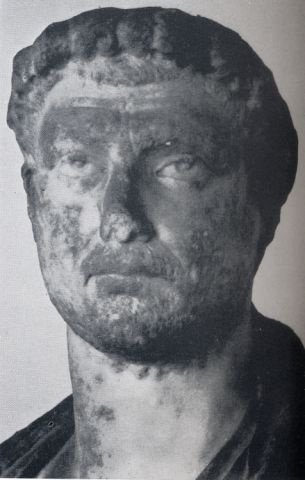
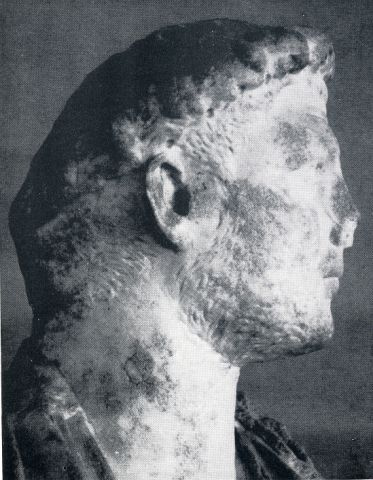
The statue is broken through the lower legs. The right hand is broken: the left was separately worked and is now missing. The head was worked together with the statue. The top of the head is unusually flat and the area behind the ears is disproportionately deep. According to Inan and Rosenbaum, there is ‘a series of large round drill-holes below the wreath.’
Hair and beard are worked with a flat chisel. The eyes are not uniformly marked. An engraved U-shape indicates each iris and pupil.
PROVENANCE
From Bolvadin which is ancient Polybotus.
DESCRIPTION (Subject)
The statue shows a togate man who wears a wreath, possibly made of laurel. The head, which is too small for the body, turns sharply to its left. He wears a short beard and short hair.
The toga is depicted as especially wide. It has a very small umbo near the right hip and a deep sinus which reaches below the right knee. The weight is on the right leg; the right hand held an object against the body. The left hand extended away from the body
The face shows an older man. It has furrows across the brow, deep naso-labial folds, and hair that recedes over the corners of the brow.
DATE
The style of the toga (small umbo, long sinus) probably belongs best in the early second century. The fashion of the head places it anywhere between 250 and 350. The markings of the eyes suggest a date after 280.
Inan and Rosenbaum argued that the head was not re-cut because it was made in one piece with the statue. This is not a good argument. There are examples of togate statues worked in one piece from foot to head which have re-cut portraits; for example, in the fourth century, Virius Audentius Aemilianus, LSA-46. Here the unusual proportions of the head (small for the statue, depth behind the ears and flatness on top, eye markings, and illegible wreath suggest a later re-use, probably in the later third or fourth century.
The laurel wreath plus the series of drill holes below might suggest that this was intended to represent a Tetrarch.
Cite: Last Statues of Antiquity, LSA-313 (J. Lenaghan).