
LSA-314
Base for re-erected gilded bronze statue (now posthumous) of Flavius Eugenius, consul designate; commanded by the emperors. Rome, Forum of Trajan. 355-360
Record details
Photographs
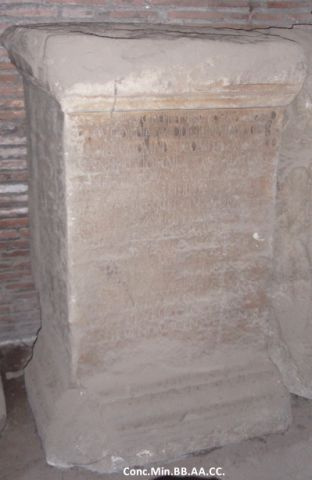

Inscription
Fl(avio) Eugenio, v(iro) c(larissimo), ex praefecto praetorio, / consuli ordinario designato, magistro / officiorum omnium, comiti domestico / ordinis primi omnibusque palatinis /(5) dignitatibus functo, ob egraegia (sic) eius / in rem publicam merita, huic / dd nn (ie, domini nostri) Constantius victor ac / triumfator, semper Augustus, et / Iulianus nobilissimus Caesar /(10) statuam sub auro in foro divi / Traiani quam ante sub divo / Constante vitae et fidelissimae / devotionis gratia meruit, / adprobante amplissimo senatu, /(15) sumptu publico loco suo / restituendam censuerunt.
Inscription translation
To Flavius Eugenius, of clarissimus rank, former praetorian prefect, designated ordinary consul, master of all offices, domestic count of the first order and having served all dignities in the palace, for his distinguished public merits. Our lords Constantius [II], victorious and triumphant Augustus, and Julian the most noble Caesar, oversaw the restitution in its proper place of the gilt statue in the forum of the deified Trajan that he had deserved before, under the reign of the deified Constans, in gratitude for his life and most devoted loyalty, with the approval of the most distinguished senate, with public money.
Bibliography
- Corpus Inscriptionum Latinarum; , VI, 1721 (+p. 4743)
Discussion
INSCRIPTION
In 16 lines:
Fl(avio) Eugenio, v(iro) c(larissimo), ex praefecto praetorio, / consuli ordinario designato, magistro / officiorum omnium, comiti domestico / ordinis primi omnibusque palatinis /(5) dignitatibus functo, ob egraegia (sic) eius / in rem publicam merita, huic / dd nn (ie, domini nostri) Constantius victor ac / triumfator, semper Augustus, et / Iulianus nobilissimus Caesar /(10) statuam sub auro in foro divi / Traiani quam ante sub divo / Constante vitae et fidelissimae / devotionis gratia meruit, / adprobante amplissimo senatu, /(15) sumptu publico loco suo / restituendam censuerunt.
'For Flavius Eugenius, of clarissimus rank, former praetorian prefect, designated ordinary consul, master of all offices, domestic count of the first order and having served all dignities in the palace, for his distinguished public merits. Our lords Constantius [II], victorious and triumphant Augustus, and Julian the most noble Caesar, oversaw the restitution in its proper place of the gilt statue in the forum of the deified Trajan that he had deserved before, under the reign of the deified Constans, in gratitude for his life and most devoted loyalty, with the approval of the most distinguished senate, with public money.'
Letters 3.5-2 cm.
DESCRIPTION (based on personal inspection)
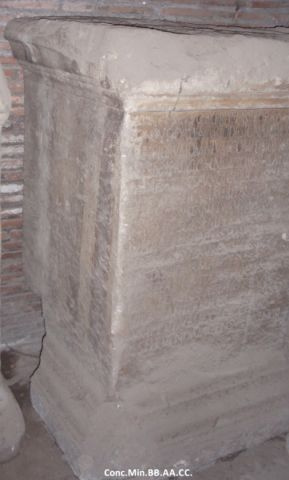
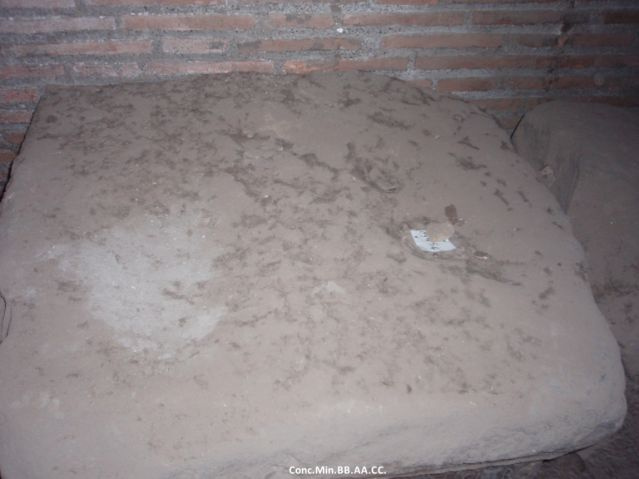
Tall marble base with mouldings top and bottom on three sides, well preserved. The front is smooth, with no traces of re-use; there is damage on lower left corner. Crown is corroded. Back is not visible; right and left sides are finished, left side is damaged on lower left angle. The right side could not be photographed. The top of the base is rough; it has traces of three dowel holes for fitting the statue, but these are not very clear.
LOCATION
The base was discovered in the Forum of Trajan, where it still is.
HONORAND
Flavius Eugenius occupied important functions in the imperial court. This inscription is the main source of information for his career (PLRE I, 292 Eugenius 5). He died after being appointed consul, but before taking office, in 349 or 350. The original statue was dedicated by Constans, under whom he served, but it was removed or destroyed during the usurpation of Magnentius, either by the latter's supporters or by the supporters of Nepotianus (who initially took Rome) (see Jones 1964, 112-113, for the context).
AWARDER
The statue was originally dedicated by the emperor Constans. It was later re-dedicated, with a new inscription, by the emperors Constantius II and Julian, with the approval of the Senate.
DATE
As the inscription tells us, the statue was dedicated while Constantius II was Augustus and Julian was Caesar, therefore between 355 and 360 (Julian was proclaimed Augustus by the troops in February 360).
FURTHER DISCUSSION
This inscription is a good example of the variety of honours that could be conferred on a powerful Roman, through the granting of a statue: its material, its location, the virtues celebrated, the dedication by emperors, the explicit approval of the senate, as well as the use of public funds. It also illustrates the intricate politics behind the setting up (or removal) of a statue, which were subject to the fluctuations of imperial politics.
Discussion references
- Jones, A. H. M., The Later Roman Empire, 2 vols., Oxford 1964
- Jones, A. H. M. et al., The Prosopography of the Later Roman Empire. Vol. I 260-395, Cambridge et al. 1971 (1975), p. 292 (Eugenius 5)
Cite: Last Statues of Antiquity, LSA-314 (Carlos Machado).