
LSA-315
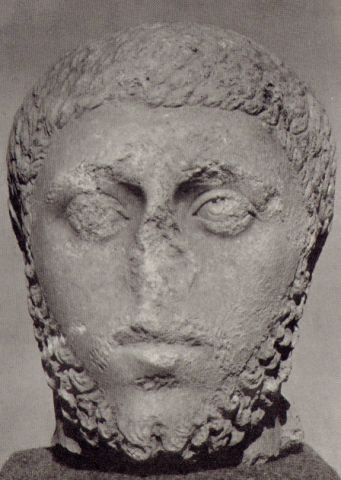
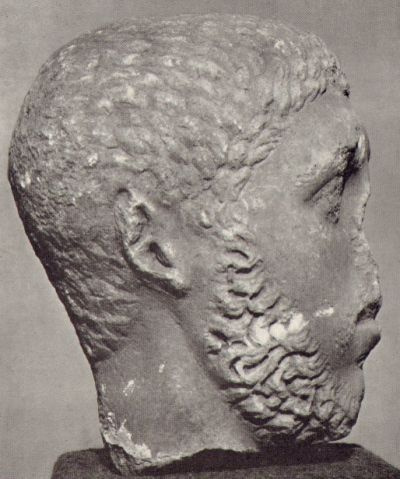
Portrait of bearded man with heavily re-cut hair. Ephesus (Asia). Later third century.
Record details
Photographs
Bibliography
- Fittschen, K., “Rezension zu: Roman and Early Byzantine Portrait Sculpture in Asia Minor” , GGA 225 (1973), 62, no. 181 (230s)
- Inan, J. and E. Rosenbaum, Roman and Early Byzantine Portrait Sculpture in Asia Minor, Oxford 1966, 143-4, no. 181, pl. 106.1-2 (270-285)
- Miltner, F. '23. Vorläufiger Bericht über die Ausgrabungen in Ephesos', Jahreshefte des Österreichischen Archäologischen Institutes in Wien 44, Vienna 1959, fig. 168
Discussion
DESCRIPTION (Object)
Life-size head. H: 25.1, W: 16.1 cm. White marble.
The head is broken through the middle of the neck; it was worked together with its support. The nose is mainly missing. The right eye and both eyebrows are abraded.
The head has been re-cut from an earlier portrait. The original longer hair is visible on the insides of both ears; and at the left temple, the locks on the brow have been obviously shortened and taken down. A fine moustache seems to have been incised over the upper lip.
The beard is heavily drilled; the hair of the head is indicated with a flat chisel. The pupil of the left eye is drilled either in a U-shape or indicated by two disconnected drill points immediately under the upper lid.
PROVENANCE
The head was found on the Curetes street at the Baths of Scholasticia.
DESCRIPTION (Subject)
The head shows a man with short hair that is cropped close to the head; a full, under-the-chin beard; and a light moustache. He has large, bulging eyes and probably had full lips. The chin is especially long. Drapery is visible around the back of the neck.
DATE
The date of the head has been discussed without reference to the fact that it has been used twice.
The original head wore a deeply drilled, under-the-chin beard which was an element of Lucius Verus’ main type (AD 161-169). The second use is more problematic. These beards came back into fashion under Gallienus and remained so until Carinus. Fittschen placed this head in the 230s and certainly no later than Gallienus. The markings of the pupils suggests a later, rather than earlier date. It seems to this author that the second use was more likely to fall in the period between 260-290 which more or less corresponds to the assessment in Inan and Rosebaum (post-Gallienic, 270-285).
Cite: Last Statues of Antiquity, LSA-315 (J. Lenaghan).