
LSA-316
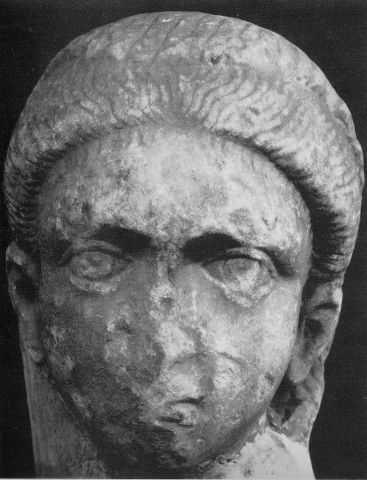
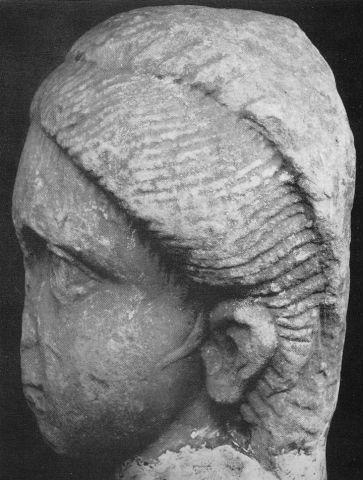
Portrait head of woman with broad central braid. Antiochia ad Sarum (Cilica I)? Fourth century or fifth century.
Record details
Photographs
Bibliography
- Inan, J. and E. Rosenbaum, Roman and Early Byzantine Portrait Sculpture in Asia Minor, Oxford 1966, 205-206, no. 283, pl. 157 (c. 400)
Discussion
DESCRIPTION (Object)
Life-size head. H: 23, W: 15.6 cm. Fine-grained white marble.
The head is broken irregularly at the top of the neck. The nose and mouth are missing. Inan and Rosenbaum write that the back has been roughly cut-off.
The hair around the face is carefully rendered with long repetitive strokes of a flat chisel. The pupils are encircled by a channel which makes them seem like ‘circular knobs’ (Inan and Rosenbaum). The irises are represented by engraved arcs equal to three-quarters of circles.
The head has probably been re-carved. The ears are at different heights and awkwardly tucked into the hair.
PROVENANCE
Unknown (Inan and Rosenbaum). It is, however, currently in Adana (Antiochia in Cilicia) and probably came from the general area.
DESCRIPTION (Subject)
The head preserves a woman with a central braid hairstyle. The round face is unmarked by any sign of age. The eyes are large.
The hair is pulled back off the brow and around the ears. Some strands may be engraved onto the brow below the cap of pulled back hair. A small lock, represented in relief, escapes onto the cheek in front of the ear. Behind the ears, the hair is collected in a broad plait which is pulled forward to almost the front of the head.
DATE
The head is difficult to date because of the long duration and the variation of the hairstyle. The fashion of the ‘central braid’ pulled from the back to the front began in the later third century and continued into the early fifth century. See, for example, LSA-989 from Rome which wears a similar style and dates probably to the middle of the fourth century and LSA-91 from Thessaloniki which belongs to the early fourth or fifth century.
Here the manner in which the eye is rendered is a technique which would seem later rather than earlier. It appears on the statue of Pytheas from Aphrodisias, LSA-147, which dates to the end of the fifth century.
Cite: Last Statues of Antiquity, LSA-316 (J. Lenaghan).