
LSA-317
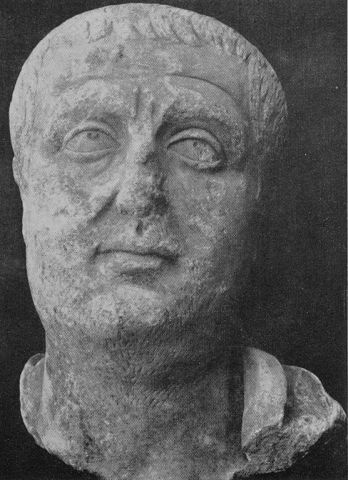
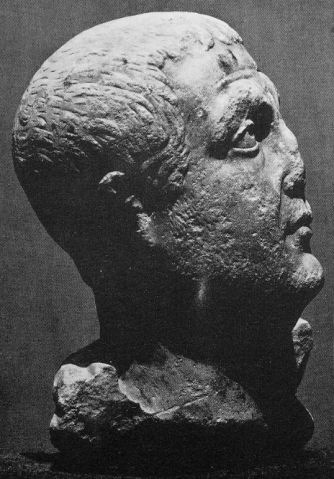
Draped portrait bust of man with stubble beard. Ancyra (Galatia). Later third century.
Record details
Photographs
Bibliography
- Inan, J. and E. Rosenbaum, Roman and Early Byzantine Portrait Sculpture in Asia Minor, Oxford 1966, 212, no. 294, pl. 166.3-4 (end of third century)
Discussion
DESCRIPTION (Object)
Life-size head from bust. H: 32, W: 16.5 cm. H (chin to crown): 20.5 cm. Fine-grained white marble.
The head is broken from a bust. Some of the draped left shoulder is preserved. The nose and the shells of the ears have broken off.
The hair of the head is rendered with a flat chisel. The pupils are deeply drilled; they are U-shaped and begin and end with a drill point. The irises are not indicated.
The head may have been re-cut from an earlier portrait. The stubble is incised into the skin of the face, and on the upper lip the philtrum has been defined but covered with stubble.
PROVENANCE
Found at Ankara (Inan and Rosenbaum)
DESCRIPTION (Subject)
The head shows a mature man who wears a himation, the most common civic costume for a Greek man, and who turns to his left. He has short hair and a stubble beard and moustache. The fringe sits high on the brow and ends in short spits. There is a part over the inner corner of the right eye and another smaller one above the outer corner of the right eye. The stubble beard extends onto the neck.
The face is broad with loose skin under the jaw line. There are two deep horizontal creases across the brow, one of which is only on the right side, and two modelled vertical lines of contraction above the nose. The mouth seems to smile slightly.
DATE
The fashion style represented is typical of the later third century and possibly even fourth. Inan and Rosenbaum consider it ‘early Tetrarchic or in the time immediately preceding it’ and Fittschen, comparing it to a head of Valerian now in Copenhagen, considers it early Gallienic.
To this author both the hair, with its forks and pincers, and the beard, which grows onto the neck, seem most comparable to those of the portrait type known as the ‘Dresden-Stockholm-Torlonia’ type (LSA-895, LSA-896, LSA-897) which is often associated with Maxentius.
Discussion references
- Fittschen, K., “Rezension zu: Roman and Early Byzantine Portrait Sculpture in Asia Minor” , GGA 225 (1973), 66, no. 294 (early Gallienic)
Cite: Last Statues of Antiquity, LSA-317 (J. Lenaghan).