
LSA-318
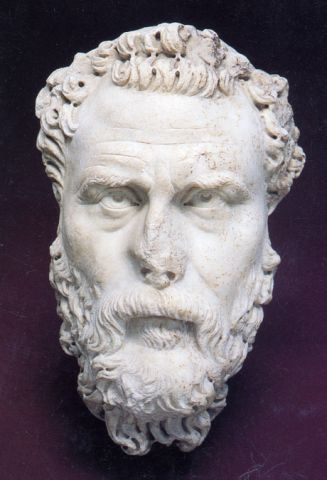
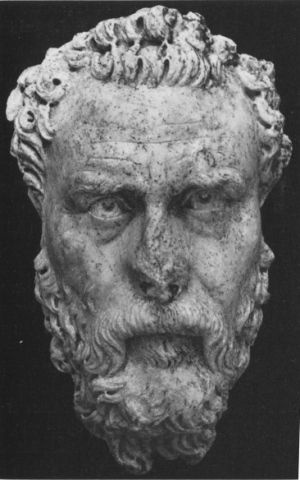
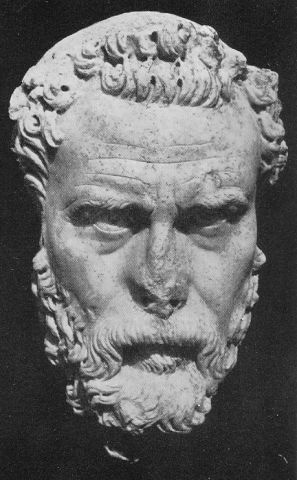
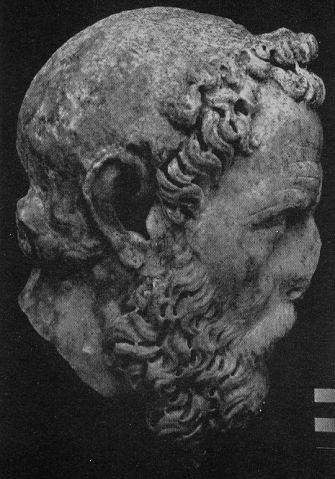
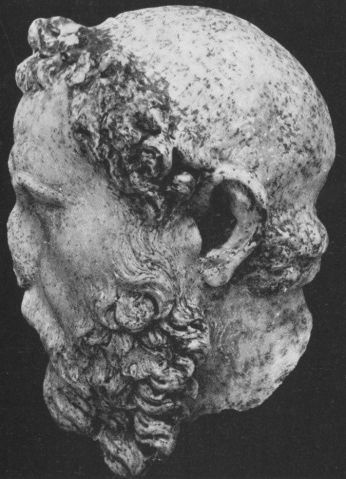
Portrait head of bearded man with tall brow from chlamys statue (?). Sardis (Lydia). Fifth century.
Record details
Photographs
Bibliography
- Cahill, N., Lidyalılar ve Dünyaları. The Lydians and their World, Istanbul 2010, 575, no. 219 (inscription on head)
- Hanfmann, G. M. A. 'The fourth campaign at Sardis (1961)'
, Bulletin of the American Schools of Oriental Research 166, Baltimore April 1962, 45 with fn. 73 and fig. 37 (late fourth or early fifth c.) - Hanfmann, G.M.A., Sculpture from Sardis : the finds through 1975, Cambridge MA 1978, no. 92, figs. 206-207 (late third c.)
- Inan, J. and E. Rosenbaum, Roman and Early Byzantine Portrait Sculpture in Asia Minor, Oxford 1966, 166-7, no. 220, pl. 180.3-4 (mid fifth century)
Discussion
DESCRIPTION (Object)
Over life-size head. H: 30 cm. Marble
The head is broken through the neck. The nose is broken.
The hair around the face and the hair of the beard are carefully drilled. Bridges have been left over many of the channels. The hair at the top and the back of the head is not fully rendered though the mass indents at the base of the skull.
The pupils are drilled out in deep crescent forms. The irises are finely engraved.
PROVENANCE
Excavated on the Marble Avenue in 1961. The Avenue was apparently fitted with colonnades and shops in c. 400 (Hanfmann BASOR April 1962), which were subsequently levelled for a later road in c. AD 650. This head was found face down to the south of the stylobate of the colonnade. It was found with ‘scattered fragments of a cloaked statue’ (Hanfmann BASOR April 1962, page 45 fn. 73) which included a marble hand clenched around a bar like object, folds of drapery, and a foot on a base.
DESCRIPTION (Subject)
The head, which turns slightly to its left, portrays an energetic man older man. He has curly hair which is brushed forward. It recedes at the temples and over the centre of the brow falls in two tiers. The beard and moustache are both full and curly.
The physiognomy is carefully modelled. The brow is tall and creased. The eyebrows are bushy and contracted. The nose, though broken, was once clearly hooked. The skin around the eyes sags and features wrinkles.
DATE
The technical details of the head (the definition of the back, the drilling of the brow and beard hair, the cutting of the pupils) bear strong similarity to a group of virtuoso portraits from Aphrodisias. These portraits all share a general fashion sense, brushed forward hair and full beards. They however leave ample space for personal identity and often seem influenced by the images of past intellectuals. Some prominent examples of this group are LSA-174, LSA-176 , LSA-182 . All of these heads should date to the fifth century, probably in the first half of it.
INSCRIPTION ON HEAD
The head has been marked discretely with a Christian abbreviation, the intent of which is not entirely clear. The abbreviation Chi Mu Gamma appears also on the head of Oecumenius LSA-150, who can be loosely dated to the late fourth or early fifth century, and on the head of a stylistically similar head, also from Aphrodisias and now in Brussels, LSA-176. It appears also prominently on the base of a statue of a priest resurrected by Fl. Anthemius Isodorus LSA-662 in the first or second decade of the fifth century and, perhaps less prominently, on the side of a contemporary base for Anthemius the father LSA-224, as well as on the base for a second statue of Maximus of Stratoniceia LSA-1200, which again assuredly belongs in the fifth century.
STATUE
The fragments, reportedly found with the statue, seem to belong to a chlamys statue (such as LSA-169) and would further strength the connection to the fifth century and with the group from Aphrodisias.
Discussion references
- Hanfmann, G.M.A . 'Portraits from Sardis', Hommage à Marcel Rennard III. Collection Latomus 103, Brussels 1969, 288-290, pl. 113, figs. 1-2 (late third c.)
- Kranz, P, 'Ein Bildnis frühtheodosianischer Zeit in der Sammlung Georg Ortiz bei Genf', Archäologischer Anzeiger, Berlin 1979, figs. 8-14
- Meischner, J., 'Das Porträt der valentianischen Epoche,', Jahrbuch des Deutschen Archäologischen Instituts, 107 (1992), 217-34, pl. 87-91, 227, pl. 90.4
Cite: Last Statues of Antiquity, LSA-318 (J. Lenaghan).