
LSA-319
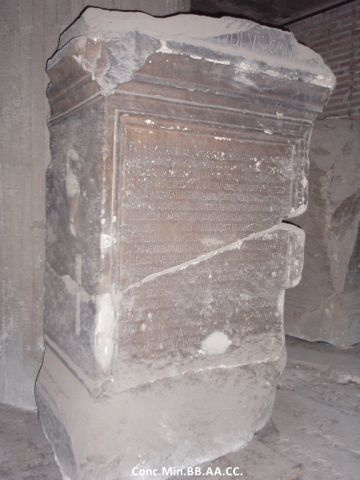
Base for statue of Flavius Merobaudes, poet and military man ('aeque forti et docto'); statue commanded by the emperors. Rome, Forum of Trajan. 435
Record details
Photographs
Inscription
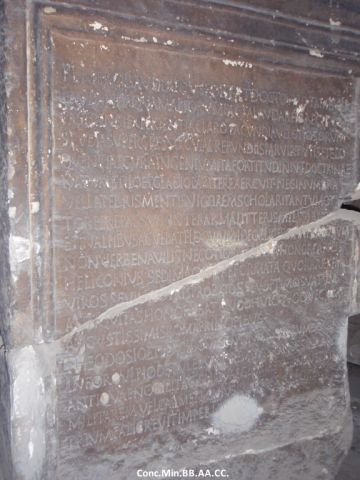
[Fl(avio) Merob]audi, v(iro) s(pectabili). com(iti) s(acri) c(onsistori). / Fl(avio) Merobaudi, aeque forti et docto viro, tam facere / laudanda quam aliorum facta laudare praecipuo. /(4) Castrensis experientia, claro faciunda vel otiosorum / studia supergresso. Cui a crepundiis par virtutis et elo/quentiae cura, ingenium ita fortitudini ut doctrinae / natum stilo et gladio pariter exercuit. Nec in umbra / vel latebris mentis vigorem scholari tantum otio / torpere passus inter arma litteris militabat /(10) et in alpibus acuebat eloquium. Ideo illi cessit in praemium / non verbena vilis nec otiosa hedera honor capitis / heliconius, sed imago aere formata, quo rari exempli / viros seu in castris probatos seu optimos vatum / antiquitas honorabat, quod huic quoque cum /(15) augustissimis Roma principibus / Theodosio et Placido Valentiniano, rerum dominis, / in foro Ulpio detulerunt, remunerantes in viro / antiquae nobilitatis novae gloriae vel industriam / militarem vel carmen cuius praeconio gloria /(20) triumfali crevit imperio. // Dedicata III Kal(endas) Aug(ustas) conss(ulibus) dd(ominis) nn(ostris)/ [T]heodosio XV et Valentiniano IIII.
Inscription translation
To Flavius Merobaudes, of spectabilis rank, member of the imperial council (comes sacri consistori). To Flavius Merobaudes, a man equal in power and learning, as excellent in doing praiseworthy things as he is in praising the deeds of others. (He is) experienced in administrative charges (castra), famous for his eloquence, exceeding in his studies those who have more leisure. From the cradle he had the same care for virtue and eloquence; born with a vocation to bravery and to learning alike, he exercised with both pen and sword. And, not allowing the strength of his mind to languish in the shadow and darkness of mere scholarly leisure, when under arms he fought using words, and sharpened a speech when [serving] in the Alps. Therefore he is grantedas a reward, not cheap foliage nor idle ivy as a Heliconian honour for [his] head, but a statue made of bronze, by which times of old used to honour men of rare example, who had been tested in military service, or were the best of poets. This [monument] Rome, together with the most august emperors, Theodosius and PlacidusValentinianus, lords of everything, set up in the forum of Trajan, rewarding in a man of ancient nobility and recent glory his military energy, as well as the poem by whose triumphant publication the glory of the empire grew. [on the side] Dedicated on the third day before the Kalends of August, when our lords Theodosius for the fifteenth time and Valentinian for the fourth time were consuls. (transl. Ulrich Gehn)
Bibliography
- Corpus Inscriptionum Latinarum; , VI, 1724 (+p. 4743-4)
Discussion
INSCRIPTION:
In 20 lines. Letter heigh 5 cm (l. 1) and 2cm (ll.2-20).
[Fl(avio) Merob]audi, v(iro) s(pectabili). com(iti) s(acri) c(onsistori). / Fl(avio) Merobaudi, aeque forti et docto viro, tam facere / laudanda quam aliorum facta laudare praecipuo. /(4) Castrensis experientia, claro faciunda vel otiosorum / studia supergresso. Cui a crepundiis par virtutis et elo/quentiae cura, ingenium ita fortitudini ut doctrinae / natum stilo et gladio pariter exercuit. Nec in umbra / vel latebris mentis vigorem scholari tantum otio / torpere passus inter arma litteris militabat /(10) et in alpibus acuebat eloquium. Ideo illi cessit in praemium / non verbena vilis nec otiosa hedera honor capitis / heliconius, sed imago aere formata, quo rari exempli / viros seu in castris probatos seu optimos vatum / antiquitas honorabat, quod huic quoque cum /(15) augustissimis Roma principibus / Theodosio et Placido Valentiniano, rerum dominis, / in foro Ulpio detulerunt, remunerantes in viro / antiquae nobilitatis novae gloriae vel industriam / militarem vel carmen cuius praeconio gloria /(20) triumfali crevit imperio. // Dedicata III Kal(endas) Aug(ustas) conss(ulibus) dd(ominis) nn(ostris)/ [T]heodosio XV et Valentiniano IIII.
'To Flavius Merobaudes, of spectabilis rank, member of the imperial council (comes sacri consistori). To Flavius Merobaudes, a man equal in power and learning, as excellent in doing praiseworthy things as he is in praising the deeds of others. (He is) experienced in administrative charges (castra), famous for his eloquence, exceeding in his studies those who have more leisure. From the cradle he had the same care for virtue and eloquence; born with a vocation to bravery and to learning alike, he exercised with both pen and sword. And, not allowing the strength of his mind to languish in the shadow and darkness of mere scholarly leisure, when under arms he fought using words, and sharpened a speech when [serving] in the Alps. Therefore he is granted as a reward, not cheap foliage nor idle ivy as a Heliconian honour for [his] head, but a statue made of bronze, by which times of old used to honour men of rare example, who had been tested in military service, or were the best of poets. This [monument] Rome, together with the most august emperors, Theodosius and PlacidusValentinianus, lords of everything, set up in the forum of Trajan, rewarding in a man of ancient nobility and recent glory his military energy, as well as the poem by whose triumphant publication the glory of the empire grew. [on the side] Dedicated on the third day before the Kalends of August, when our lords Theodosius for the fifteenth time and Valentinian for the fourth time were consuls.' (transl. Ulrich Gehn)
The inscription was translated by Ulrich Gehn, who also offered the following comments:
'The allusion to the times of old (ll. 14, 20) is a recurring motif in these senatorial inscriptions. The noble families are still connected with the glorious past and therefore can guarantee its endurance in present and future. Here, looking back is combined with a looking into the future, in as far as people like Merobaudes set new examples which can be emulated. Merobaudes is like the champions of old, but he exceeds them by embodying both praiseworthy properties (one of which would have been sufficient for this honour, and used to be so in the past) at the same time. The anecdote of him polishing a speech in the Alps (l. 10) is possibly an allusion to Caesar (who is famous for his literary work when in the litter on his campaings); the ‘vir aeque fortis et doctus’ (l. 2), moreover has a model in Marcus Aurelius, but see also the description of Septimius Severus in SHA, Severus 18.11.'
DESCRIPTION (personal inspection)
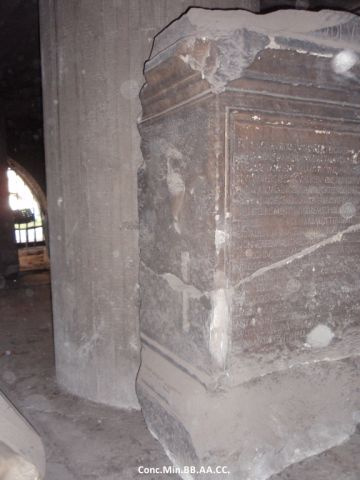
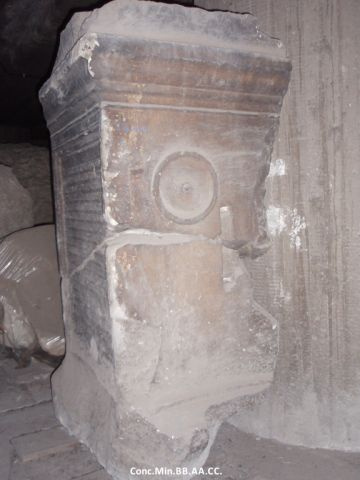
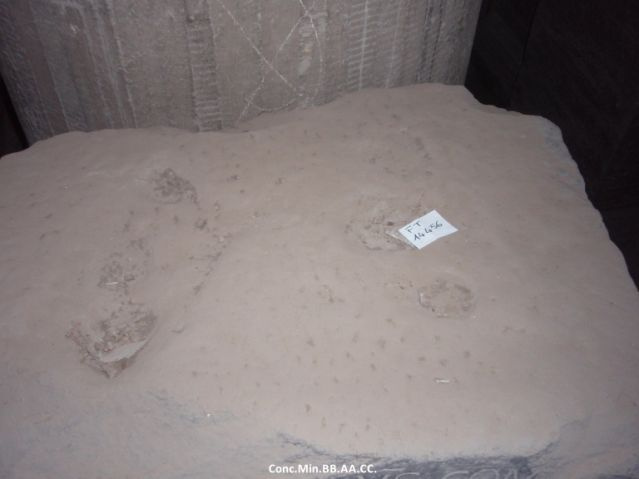
Large marble base, broken in two and restored. 147 x 94 x 68 cm. The was previously held together by metal clamps on the sides, but not anymore. The inscription is affected by the line of the break, but it is still legible. The front is framed by moulding, very deep and damaged on the right side. The epigraphic field is deep and irregular, indicating erasure of an earlier inscription. The right side is damaged at the bottom, and it has a patera at the centre. The back is rough. The left side has the consular date below the upper moulding, and a urceus below it. The top of the base has traces of dowel holes for fitting a statue. Epigraphic field 76 x 65 cm.
The statue is mentioned in a Panegyric written by Merobaudes himself as made of bronze (Merobaud. Pan. 1, frag.2A, ll. 1-5 (MGH (AA) XIV, p. 9), and the same is said by Sidonius Apollinaris (Carm. 9.299-301).
PROVENANCE AND LOCATION
The base was found in th Forum of Trajan, where it was originally dedicated. This is confirmed by the inscription (l. 17), and also a reference in Sidonius Apollinaris (Carm. 9.299-301). Other examples of statues of intellectuals in this area can be found in LSA-1355 (Claudian), LSA-1581 (unknown eruditor), LSA-2674 (Marius Victorinus), and LSA-2675 (Sidonius Apollinaris). The Forum of Trajan was an important space for intellectual activities in Late Antiquity (Marrou 1932). The base is now in the deposit of the basilica Ulpia (FT 14456).
HONORAND AND AWARDER
Flavius Merobaudes was a native of Baetica, and descended from a noble family. He was a poet and a military official, and our statue was dedicated on the same year he was appointed magister utriusque militiae, 435 (PLRE II, 756-758 Merobaudes). He claims that the statue was conferred as a retribution for the panegyric he read for Aetius in the Roman senate in 432 (Pan. 1, frag. 2A, ll. 5-7). The statue was dedicated by the emperors Theodosius II and Valentinian III, but note that the inscription also mentions that Rome itself was also responsible for it (l. 15). Hydatius' Chronicle says that Merobaudes was celebrated with statues, in the plural (Lem. 128 (MGH (AA) XI, p. 24)).
DATE
The date of this dedication is given by the consular date on the left side, in 435.
Discussion references
- Marrou, H.-I., "La vie intellectuelle au forum de Trajan et au forum d'Auguste", Mélanges de l'École Française de Rome, 49 (1), 1932, pp. 97-110
- Martindale, J. R., The Prosopography of the Later Roman Empire. Vol. II A.D. 395-527, Cambridge 1980, pp. 756-758 (Merobaudes)
Cite: Last Statues of Antiquity, LSA-319 (Carlos Machado).