
LSA-320
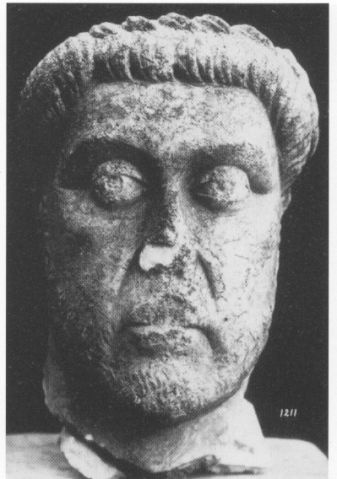
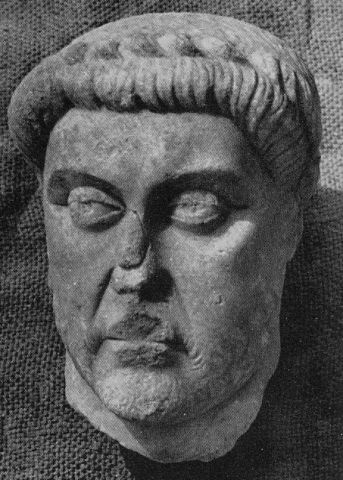
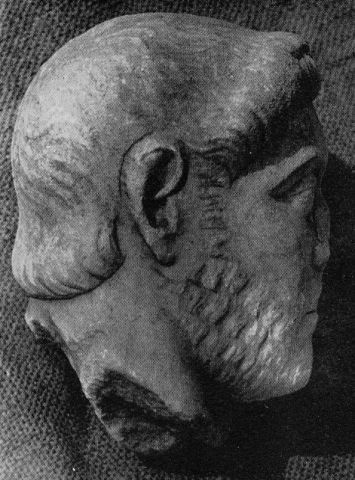
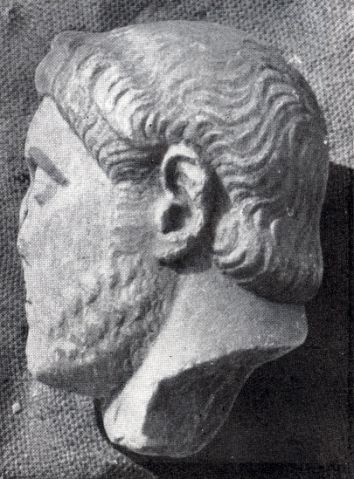
Portrait head of bearded man with hair brushed forward. Smyrna (Asia). Late fourth to early fifth century.
Record details
Photographs
Bibliography
- Inan, J. and E. Rosenbaum, Roman and Early Byzantine Portrait Sculpture in Asia Minor, Oxford 1966, 120, no. 134, pl. 180.1-2 (mid-fifth century)
- Naumann, R. and S. Kantar, 'Die Agora von Smyrna', Kleinasien und Byzanz. Istanbuler Forschungen 17, Berlin 1950, 103-104, no. 28, pl. 39 (fifth century)
Discussion
DESCRIPTION (Object)
Over life-size head. H: 27, H (chin to crown): 17 cm. White marble.
The head is broken from just below the hair line at the back of the neck to the middle of the front of the neck. The tip of the nose and lips are damaged.
The hair at the top of the head is rendered in engraved lines. Around the face, the locks are given volume but are rendered mainly with chisel work. The pupils of the eyes appear to be crescent shapes. The irises do not seem to be indicated.
PROVENANCE
From Smyrna. It was found in the Basilica which is on the north side of the Agora. It is now in the Denver Art Museum (Denver Colorado), having passed through the collection of Clarence Edward and Marie Therese Macy and been gifted to the Museum by the estate of the latter in 1989. Clarence Edward was U.S. Consul General in Istanbul 1946-48. [Note of April 2023: We are very grateful to Lori Iliff, Senior Provenance Researcher at the Denver Museum, for up-dating us on the head’s current location]
DESCRIPTION (Subject)
The head shows a mature bearded man with a combed forward hairstyle who turns to his right. The face is tall and rectangular; it has arched eyebrows, heavy-lidded eyes, deep naso-labial folds, and a small mouth.
The hair is combed flatly forward and ends in two tiers over the brow. Over the nose and the right eye, there are two small partings in the locks. At the base of the skull the mass of hair indents. In front of the ears, the sideburns consist of short horizontal strands. On the cheeks the beard is made of full locks which grow downwards but the beard on the chin and the moustache are rendered as sparse engraved hairs.
DATE
The fashion style of the beard and hair is worn by individuals represented on the Obelisk of Theodosius in Istanbul (c. 390) and can be seen on the consular diptych of Fl. Constantius Felix, AD 428 [see W.F. Volbach, Elefenbeinarbeiten der Spätantike und des frühen Mittelalters, (Mainz 1976), 30, no. 2, pl. 2]. The portrait of Oecumenius LSA-150 from Aphrodisias (and LSA-869 from Cyprus) also shows the same fashion style and has similarly rendered pupils. Oecumenius, identified by his base at Aphrodisias, should be dated to the late fourth or early fifth century.
Examples of similarly-styled portraits, all from Asia Minor, are LSA-158, LSA-178, LSA-380, LSA-445, and LSA-2282.
Discussion references
- Meischner, J., 'Das Porträt der theodosianischen Epoche II (400 bis 460 n. Chr.),' , Jahrbuch des Deutschen Archäologischen Instituts, 106 (1991), 385-407, pl. 88.2
Cite: Last Statues of Antiquity, LSA-320 (J. Lenaghan).