
LSA-321
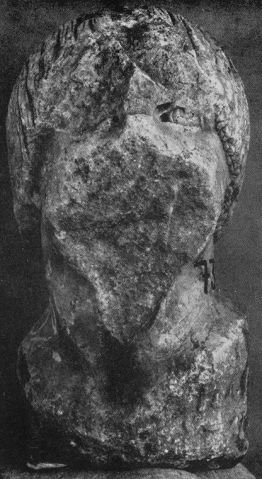
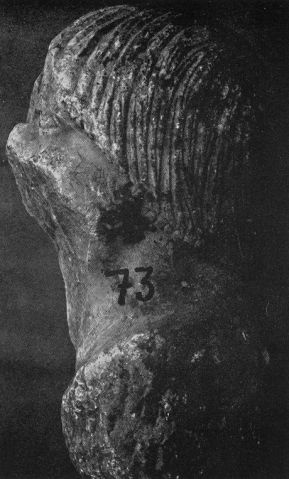
Portrait head with hairstyle of Germanic guard. Antiochia ad Pisidiam (Psidia). Late fourth to fifth century.
Record details
Photographs
Bibliography
- Inan, J. and E. Rosenbaum, Roman and Early Byzantine Portrait Sculpture in Asia Minor, Oxford 1966, 214, no. 297, pl. 168.1-2 (last quarter of fourth c.)
Discussion
DESCRIPTION (Object)
Over life-size head, worked separately. H: 32, W: 17.5 cm. Very fine-grained white marble.
The head was worked together with its neck and a large tenon so as to be inserted into a statue. A wedge-shaped area has broken from the lower face; it included most of the nose, the mouth, chin, and throat. The centre of the brow and right eye are also mainly missing.
The hair has been finely engraved with a flat chisel. The pupils of the eyes appear have been crescent shapes. The irises were once large and more than three-quarters of a circle. The inner canthi were deeply drilled
PROVENANCE
From Antiochia ad Pisidiam.
DESCRIPTION (Subject)
The head shows a man who wears an unusual hairstyle and who turns to his left. The hair is combed down from the crown of the head in long fine locks which covered most of the ears. Over the brow the hair was cut in an arch; it reached to the temples and corners of the eyes but was shorter at the centre of the brow. There are short sideburns in front of the ears. The physiognomy is illegible but for a prominent nose.
DATE
The fashion style of the hair is unusual. Inan and Rosenbaum note that it is similar to that of the Germanic guard on the Obelisk of Theodosius (c. 390). B. Kiilerich, The Obelisk Base in Constantinople: Court Art and Imperial Ideology (Rome 1998) illustrates a selection of these guards from all sides of the Obelisk on p. 94; see also G. Bruns, Der Obelisk und seine Basis auf dem Hippodrom zu Konstantinopel (Istanbul 1935), figures 66 and 67. An example of a similarly-styled portrait, probably also from Asia Minor, is now in Munich LSA-1081.
Discussion references
- Babelon, M. E., Guide illustré au Cabinet des Médailles, Paris 1900
Cite: Last Statues of Antiquity, LSA-321 (J. Lenaghan).