
LSA-325
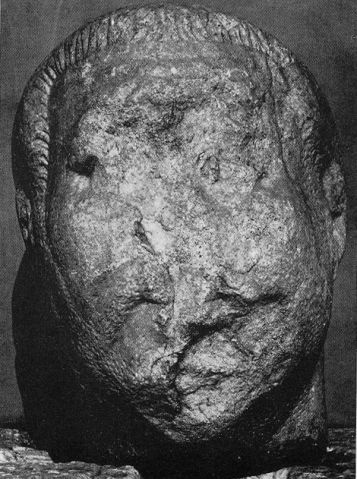
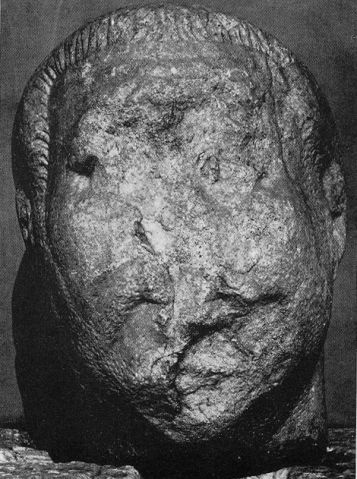
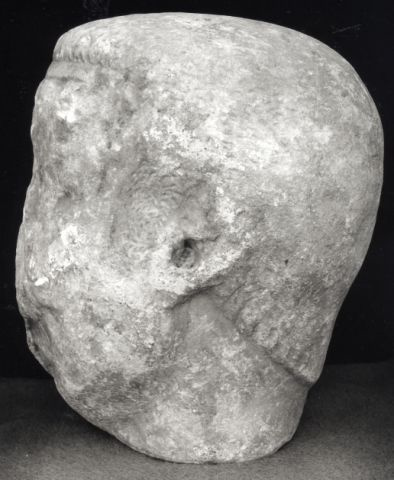
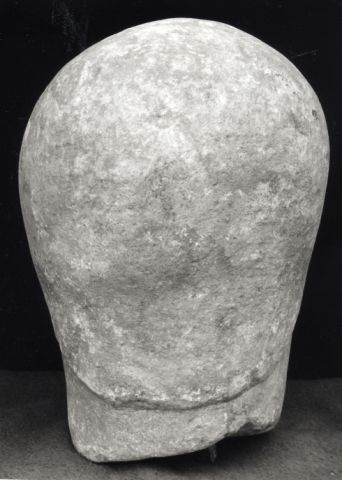
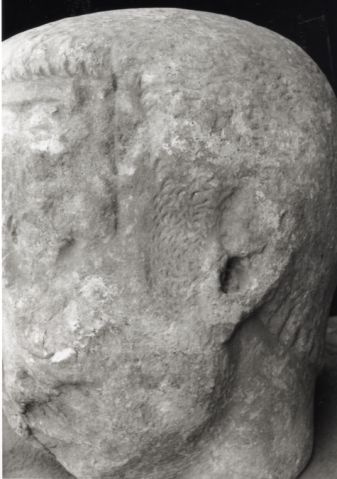
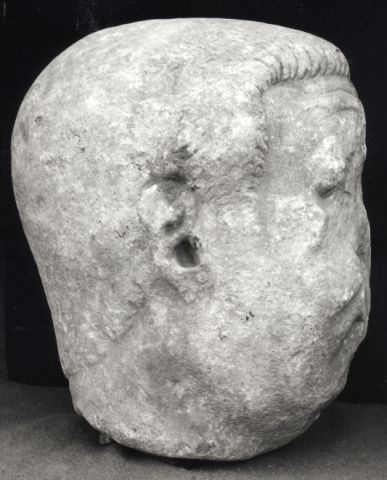
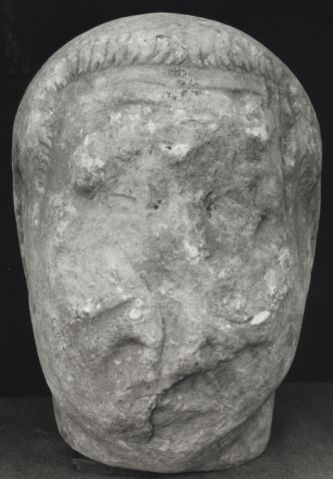
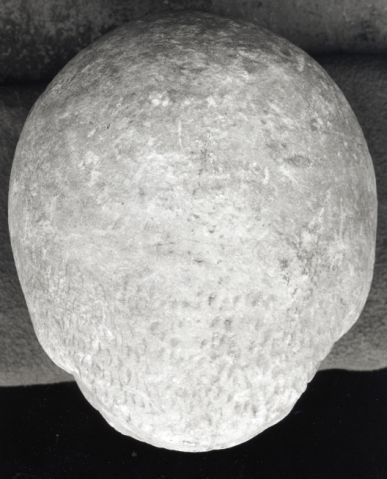
Colossal portrait (Vienna-Izmir type) of Licinius. From Smyrna. Early fourth century.
Record details
Photographs
Bibliography
- Inan, J. and E. Rosenbaum, Roman and Early Byzantine Portrait Sculpture in Asia Minor, Oxford 1966, 119-120, no. 133, pl. 175.3-4
Discussion
PROVENANCE
Excavated in the Agora in 1950. It was found at the west end, near the tribunal, of the Roman basilica.
DESCRIPTION (Object)
Battered colossal head. H: 51 cm. White marble with bluish tone.
The head is broken unevenly through the neck. There is a chip on the lower left side of the face, and the facial features are severely damaged (possibly deliberately). Both ear lobes are missing.
The hair at the back of the head is rendered as a smooth surface. Around the front and sides, a flat chisel has been used to define short locks. The beard is also cut into the facial surface with a flat chisel.
DESCRIPTION (Subject)
The head probably belonged to a monument, perhaps acrolithic, ca. 5 metres tall. It depicts a full-faced, elderly man with short-cropped hair and a stubble beard. It is a replica of a type known in another colossal version from Ephesus, now in Vienna; the type is therefore referred to as the Vienna-Izmir type.
DATE
The colossal scale and replication of the type indicate without doubt that it is an imperial portrait. The prominent find locations at Smyrna and Ephesus (theatre stage, LSA XX) further support this assessment.
Although in its first publications the head and the type to which it belongs were thought to date to the fifth century, the most recent treatment (Smith JRS 1998) has convincingly argued for an early fourth century date. The blocky aspect of the face and the short cropped hair and stubble beard follow the tetrarchic tradition. It also wears no diadem and so should date before AD 324.
IDENTIFICATION
Smith has suggested that the prototype should be identified as Licinius for several reasons: The early fourth-century date and the provenance of the four extant examples of the type (Vienna, Izmir, Leiden, and Canberra: LSA xx, here, LSA 373, and LSA 381) from Asia Minor. In addition the physiognomy and age suit the elderly Licinius and correspond essentially to his numismatic portraits. The military and tetrachic aspect of the portrait as well as the smile (not preserved on this version from Izmir and possibly a reference to such slogans as gaudium Augusti nostri and laeta victoria) form an image that stands almost diametrically opposed to the carefully constructed portrait of the lean-faced youthful Constantine. The identification as Licinius has been accepted in subsequent scholarly literature (La Rocca).
Discussion references
- La Rocca, E. 'Divina ispirazione' in, S. Ensoli and E. La Rocca (eds.), Aurea Roma, Rome 2000, 22, fig. 22, and n. 152
- Smith, R.R.R.,'The public image of Licinius I: Portrait sculpture and imperial ideology in the early fourth century', JRS 87, 1997, 170-202, pls. 3 and 4.2-4.
Cite: Last Statues of Antiquity, LSA-325 (J. Lenaghan).