
LSA-326
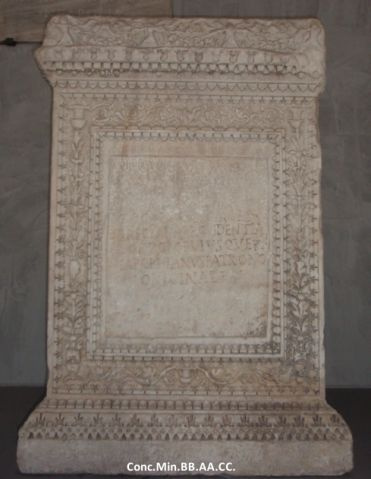
Base for statue of Anicius Auchenius Bassus, former governor of Campania, patron of Neapolis. Neapolis (Campania). 382
Record details
Photographs
Inscription
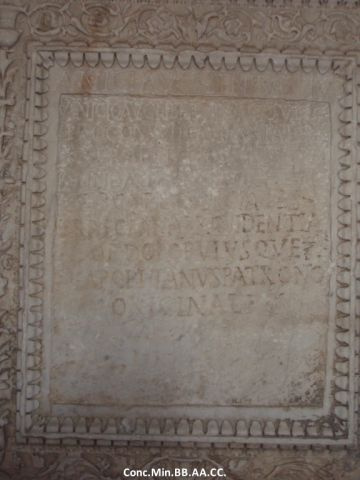
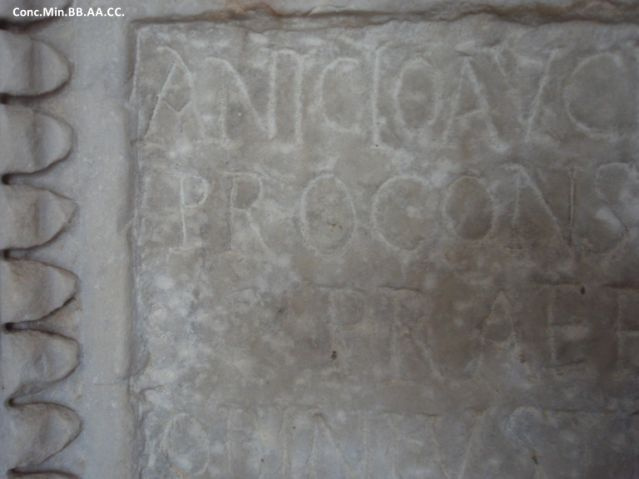
Anici Aucheni Bassi v(iri) c(larissimi) / Anicio Auchenio Basso v(iro) c(larissimo) / proconsul Campaniae / praefecto urbis / ob inlustria merita et / circa provinciales / praeclara providentia / ordo populusque / Neapolitanus patrono / originali.
Inscription translation
[Statue of] Anicius Auchenius Bassus, of clarissimus rank. For Anicius Auchenius Bassus, of clarissimus rank, governor (proconsul) of Campania, prefect of the City. For his illustrious merits and magnificent providence towards provincials, the ordo and people of Naples [dedicated] to their patron by descent.
Bibliography
- Inscriptiones Latinae Selectae, , 8984
- L'Année épigraphique, , 1892, 143
Discussion
INSCRIPTION
In ten lines. Letters of signum: 4 cm; main inscription: 3-3.5 cm.
Anici Aucheni Bassi v(iri) c(larissimi) / Anicio Auchenio Basso v(iro) c(larissimo) / proconsul Campaniae / Praefecto Urbis / ob inlustria merita et / circa provinciales / praeclara providentia / ordo populusque / Neapolitanus patrono / originali.
'[Statue of] Anicius Auchenius Bassus, of clarissimus rank. To Anicius Auchenius Bassus, of clarissimus rank, proconsul of Campania, urban prefect. For his illustrious merits and magnificent providence towards provincials, the ordo and people of Naples [dedicated] to their patron by descent.'
DESCRIPTION (based on personal inspection)
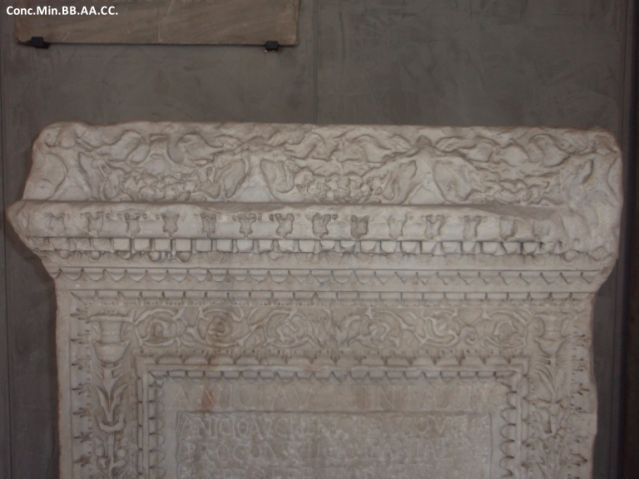
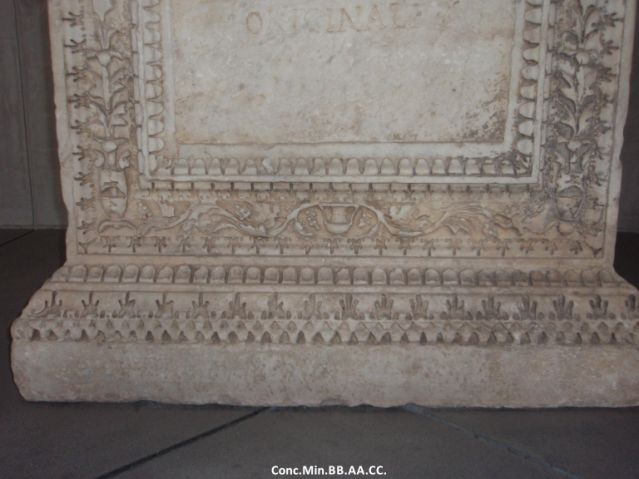
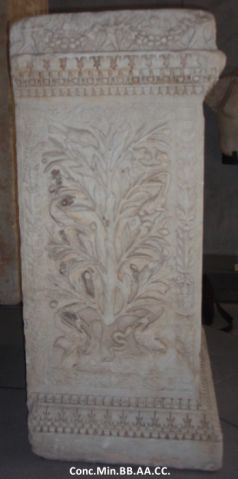
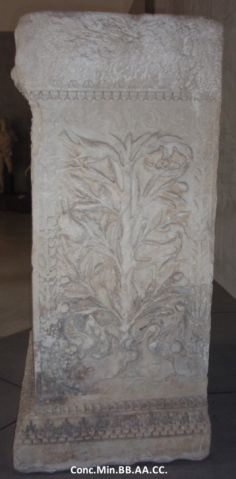
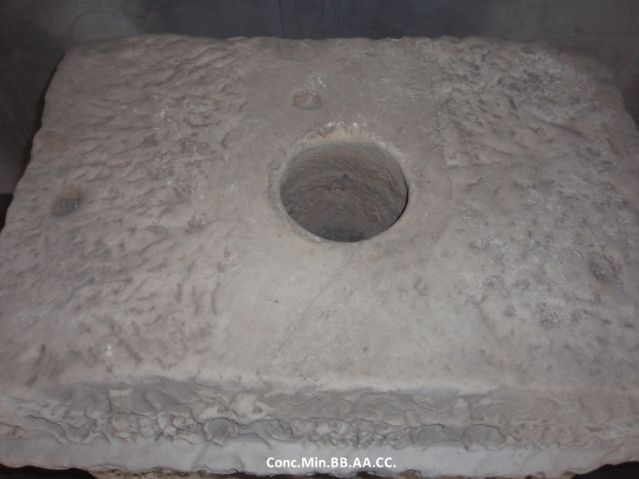
White marble base with decoration on all sides. Front is framed by moulding with birds, leaves and jugs; top has relief of 4 human figures (amorini) supporting garlands. The epigraphic field is rough, the erasure of an earlier inscription is clear; the present inscription is very irregular but clearly legible. Epigraphic field is very deep. Right side has relief with trees and birds in a nest. Back is unfinished. Left side is decorated like the right side. Top has large round hole (35 cm deep and 18 diam.) and 3 smaller round holes; Sogliano, in NSc (1892), dates the altar to 3rd-4th century, and suggests it is contemporary with inscription, but this is certainly incorrect.
PROVENANCE
The base was discovered in Naples, during demolition of a building between via del Cerriglio and the church of Santa Maria la Nova. The base was found already partially buried by later flooring, but probably in situ; it was found with another base without inscription, and a re-used altar with urceus and patera of the same dimensions. The base had been placed on top of a marble fountain (also in Museo Nazionale), re-used to support the statue of Bassus (Sogliano 1892).
HONORAND
Anicius Auchenius Bassus, originally from Benevento, was a Christian and a member of the important family of the Anicii. He was governor of Campania in 379/382 and urban prefect of Rome in 382. The fact that this base identifies him as a 'patron by descent' (patronus originalis) shows that his family also had links with Naples (PLRE I, 152-154 Bassus 11). A number of inscriptions attest to his patronage of different communities in Campania and beyond (LSA-1683 (Praeneste), LSA-1730 (Benevento), and probably LSA-2034).
AWARDER
The statue was dedicated by the ordo populusque Neapolitanus to their patron.
DATE
The earliest date for this dedication was 382, when Bassus was urban prefect of Rome, the latest date possible is 407, since Bassus was consul of the West in 408. The most likely date is 382, when he was appointed to head the urban prefecture.
Discussion references
- Chastagnol, A., Les fastes de la Préfecture de Rome au Bas-Empire, Paris 1962, pp. 211-126
- Jones, A. H. M. et al., The Prosopography of the Later Roman Empire. Vol. I 260-395, Cambridge et al. 1971 (1975), pp. 152-154 (Bassus 11)
- Sogliano, A., "Napoli", Notizie degli scavi di antichita, 1892, pp. 165-167
Cite: Last Statues of Antiquity, LSA-326 (Carlos Machado).