
LSA-331
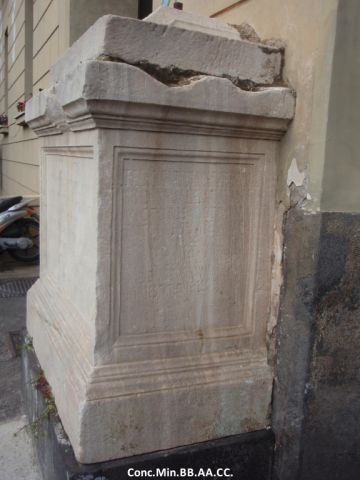
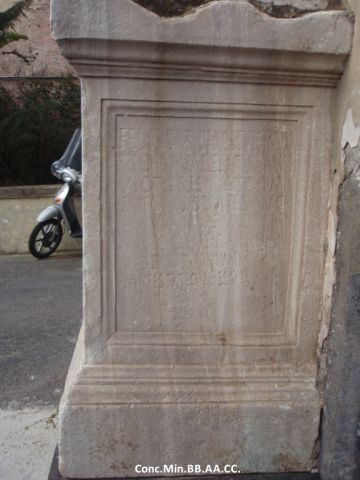
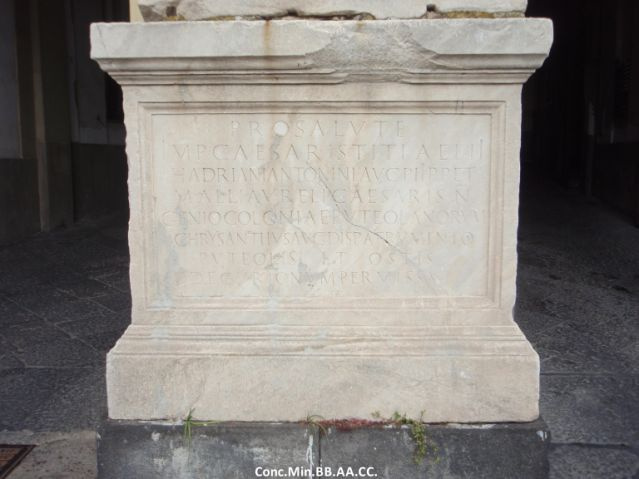
Base for statue of 'The Fortune (Felicitas) of the Times of Valentinian I'. From Puteoli. 364-375
Record details
Photographs
Inscription
Felicitati perpetui (sic) tempo/ris d(omini) n(ostri) Valentiniani, / victoris ac trium/fatoris, semper Aug(usti), / Avianius Valentinus, / v(ir) c(larissimus), cons(ul) Camp(aniae), / devotus numini / maiestatique eius.
Inscription translation
To the perpetual Fortune of the times of our lord Valentinian, victorious and triumphant, forever Augustus; Avianius Valentinus, of clarissimus rank, governor of Campania, devoted to his will and majesty [set this up].
Bibliography
- Corpus Inscriptionum Latinarum; , X, 1656
- Inscriptiones Latinae Selectae, , 764
Discussion
INSCRIPTION:
In 8 lines. Epigraphic field of 4th century inscription: 63.5 x 50 cm; Letters: 5-3.5 cm.
Felicitati perpetui (sic) tempo/ris d(omini) n(ostri) Valentiniani, / victoris ac trium/fatoris, semper Aug(usti), / Avianius Valentinus, / v(ir) c(larissimus), cons(ul) Camp(aniae), / devotus numini / maiestatique eius.
‘To the perpetual Fortune of the times of our lord Valentinian, victorious and triumphant, forever Augustus; Avianius Valentinus, of clarissimus rank, governor of Campania, devoted to his will and majesty [set this up].’
DESCRIPTION (based on personal inspection):
Grey and white marble rectangular base (probably Proconnessian) with mouldings top and bottom on all sides, well preserved. There is an earlier inscription on the long side, a dedication to the Genius of the colony of Puteoli, from the time of Antoninus Pius and Marcus Aurelius (CIL X, 1562). The late antique inscription is on the short right side of the base; the carving is very light, and the letters have partly faded. Epigraphic field is smooth, framed by mouldings. The long side opposite to the early inscription cannot be seen. The short side opposite the 4th century inscription is plain (not photographed), with mouldings. Top is covered by piece of marble, but has two large dowel holes, very near the back and possibly also the front (not photographed).
PROVENANCE AND CURRENT LOCATION
Pozzuoli, discovered in 1683 during excavations of the church of S. Giacomo (modern del Carmine), near the crossing of the modern via del Carmine and via Rosini. It was apparently in situ. The discovery of two bases of equestrian statues (LSA-1922 and LSA-1923) dedicated to emperors in this same area supports Camodeca's suggestion that this was the forum of Puteoli (Camodeca 1980/1981, 63).
The base is now in Naples, in the private garden of Palazzo Eldorado, piazzetta Mondragone 9.
HONORAND:
Rather than to the emperor, this is a dedication to the Fortune of the times of Valentinian I, here identified as victor and triumfator. It is not clear whether the statue surmounting it represented the emperor or Fortuna, but the 4th century dedication followed the example of the earlier (Antonine) one, which is addressed to the Genius of the emperors.
AWARDER:
Avianius Valentinus was governor of Campania. There is no further information about him, but the name Avianius is unusual, and PLRE suggests this might indicate that he was a son of Lucius Avianius Symmachus, and a brother of the orator Quintus Aurelius Symmachus (PLRE I, 936 Valentinus 7).
DATE:
The dedication refers to the reign of Valentinian I, 364-75. There is no element to suggest a more specific date.
Discussion references
- Camodeca, G. "Ricerche su Puteoli tardoromana (fine III-IV secolo)", Puteoli, 4-5, 1980-1981, p. 81-82
- Jones, A. H. M. et al., The Prosopography of the Later Roman Empire. Vol. I 260-395, Cambridge et al. 1971 (1975), p. 936 (Valentinus 7)
Cite: Last Statues of Antiquity, LSA-331 (Carlos Machado).