
LSA-333
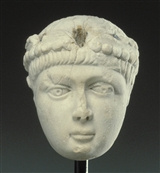
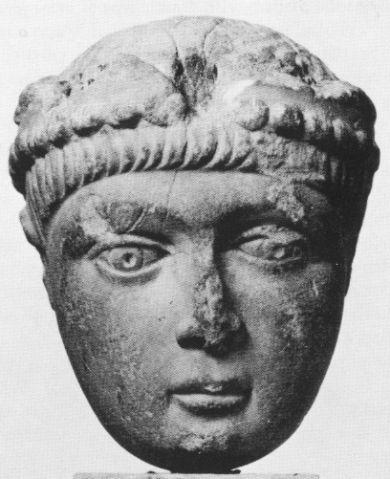
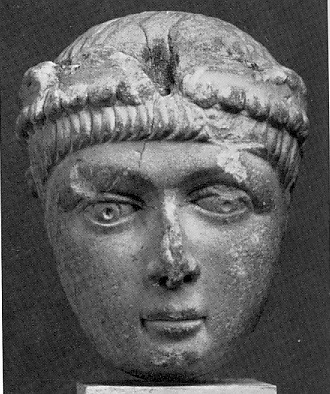
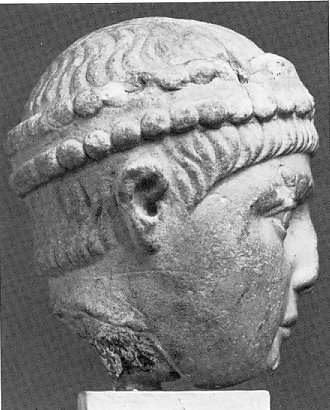
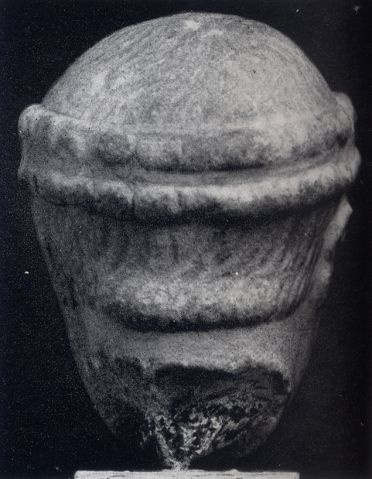
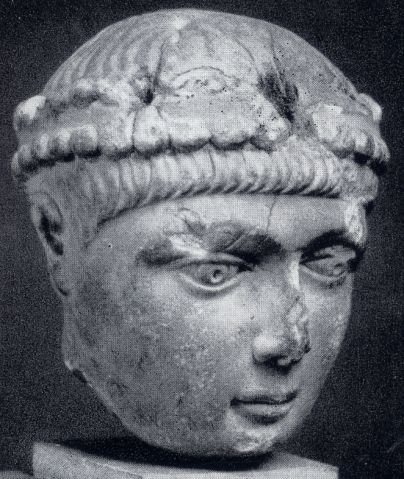
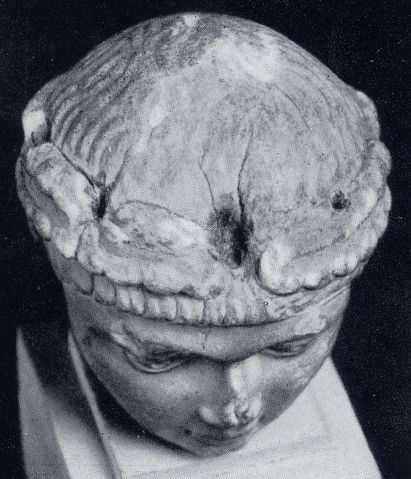
Miniature portrait head of Emperor, Honorius (?). From Asia Minor. Late fourth to early fifth century.
Record details
Photographs
Bibliography
- Delbrueck, R. 'Knabenkopf in Detroit', Mitteilungen des Deutschen Archäologischen Instituts 4, Munich 1951, 7-9, pls.1 and 2.1-3
- Inan, J. & E. Alföldi-Rosenbaum, Römische und frühbyzantinische Porträ̈tplastik aus der Türkei : neue Funde, Mainz 1979, 139-40, no. 83, pl. 74.3-4
Discussion
DESCRIPTION (Object)
Miniature portrait head. H: 10. 2, W: 8.3, D: 9.5 cm. Fine-grained white marble.
The head has broken off its support at the top of the neck. The tip of the nose is broken, and there are chips in the eyebrows. There is a large cutting in the centre of the diadem above the fringe for the insertion of an object, and on two further cuttings on either side of this.
The hair has been schematically rendered with a flat chisel. The irises are almost circular and are incised with a fine flat chisel. The pupils are centrally placed within the iris and are drill points.
PROVENANCE
Purchased in 1937 in New York. Gift to Detroit Institute of Art by Dr. Wilhelm R. Valentiner.
DESCRIPTION (Subject)
The miniature head shows a youth with a full face and short, straight hair. He wears a pearl-edged diadem which is devoid of ties at the back and into which five further decorative elements would have been inserted.
The hair has no part. Over the brow it is an arching mass made of slightly bending locks. Around the ears the hair and at the top of the head, the hair is longer.
The face lacks modelling, and the only distinctive feature is the mouth which is short from side to side and tucked into the cheeks. It is slightly asymmetrical which suggests it may have turned to its left.
Delbrueck proposes that the boy represented is about 10 years old and that the head may have belonged to a statue of c. 80 cm.
DATE
The portrait resembles the portraits of Theodosian Emperors from Aphrodisias (LSA-163 and LSA-168) which are securely dated by their bases to the years of 388-392.
HONORAND
The pearl-edged diadem identifies this head as portrait of an Emperor. The physiognomy and hairstyle accord well with the portraits of the Theodosian princes on the west side of the Obelisk of Theodosius in Istanbul. The head also greatly resembles (age, hairstyle, diadem) full-scale imperial portraits from Istanbul ( l>337">LSA-337) , from Aphrodisias (LSA-163), securely identifiable as Arcadius or Valentinian II, and one from Rome (LSA-594). On the basis of the currently extant evidence it is impossible to distinguish securely the portraits of Valentinian II, Arcadius, and Honorius. The small-scale of the Detroit head makes a distinction even more difficult.
Delbrueck identified the portrait as Honorius because of his physiognomy and his potential position to the right, not left, of a central figure and thus lowest ranking position within a group of three. Stichel considers the head to represent a Theodosian prince, acknowledging both Arcadius and Honorius as possibilities. Rosenbaum tentatively suggests that this is Honorius on the basis of the portrait of a round-faced boy (without a diadem) on the southeast side of the Obelisk.
AUTHENTICITY
Rosenbaum notes that the portrait head bears a striking similarity to a bust in a private collection in Germany, (LSA-1109). She introduces the possibility that both, without provenance, may be modern works.
Discussion references
- Stichel, R. H. W., Die römische Kaiserstatue am Ende der Antike, Roma 1982, 48, pl. 12
Cite: Last Statues of Antiquity, LSA-333 (J. Lenaghan).