
LSA-334
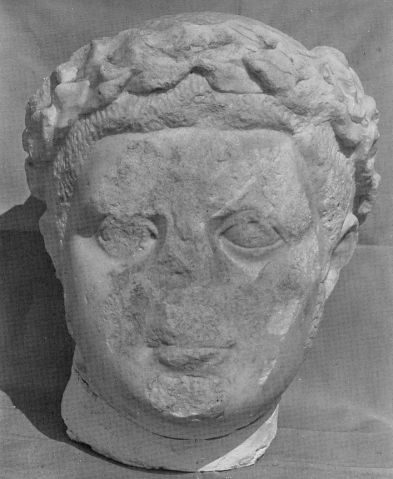
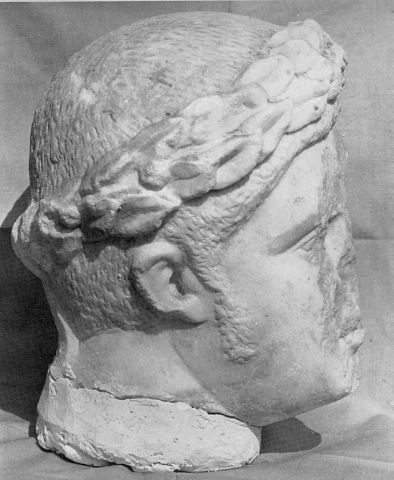
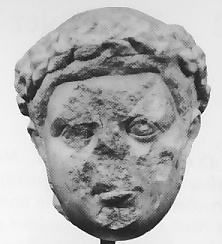
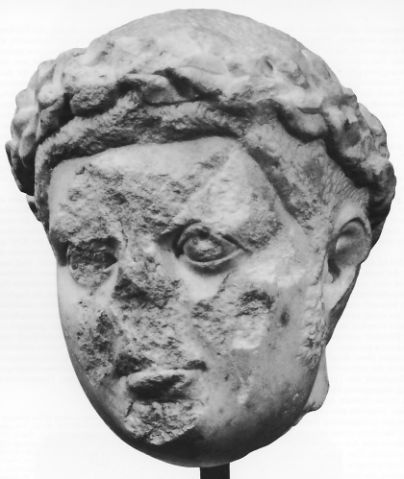
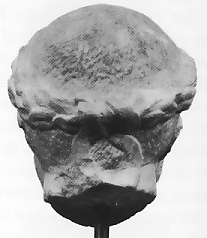
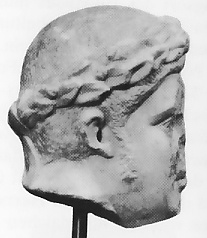
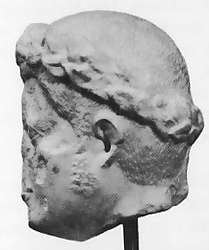
Re-cut portrait head of Emperor, probably Licinius II. Cyzicus (Hellespontus). Early fourth century
Record details
Photographs
Bibliography
- Inan, J. & E. Alföldi-Rosenbaum, Römische und frühbyzantinische Porträ̈tplastik aus der Türkei : neue Funde, Mainz 1979, 133-4, no. 79, pl. 71
Discussion
DESCRIPTION (Object)
Over life-size head. H: 30, W : 21 cm. Large-grained white marble.
The head has broken from a statue or bust at the top of the neck directly under the chin. The nose and rims of the ears are broken. The central area of the face is abraded and has lost its original surface.
The head has been re-cut from an earlier portrait. The surface of the new hair has been etched with a flat chisel. The eyeballs seem to have been given drilled pupils in the second use. The skin surface is polished.
PROVENANCE
There is no more specific indication than Cyzicus.
DESCRIPTION (Subject)
The head represents a youth man with short hair and sideburns who wears a laurel wreath. He turns to his right.
The hair and sideburns stand proud of the head and face and are represented as thick, short, and straight. The individual hairs are copiously etched on to the surface with a fine chisel. The fringe ends high on the brow and gives it a box-like frame.
The face is a full oval devoid of indications of age.
DATE
Rosenbaum as well as Jucker and Willers date the second use of this head to the Tetrarchic period. The re-cutting, the rendering of the hair, and the use of the laurel wreath all support this date. The original portrait had unmarked eyes and a tall square brow, and thus probably represented a Julio-Claudian emperor.
HONORAND
The laurel wreath identifies this portrait as an emperor. On the basis of coins, aurei from Nicomedia, and silver portraits commemorating the Jubilee year of Licinius in AD 322, again from Nicomedia (LSA-522,LSA-462, and LSA-463), Rosenbaum proposes to identify the head as Licinius II. The idea is re-proposed by Jucker and Willers and expanded upon fully by Smith in a discussion of the the portraiture of Licinius I and II.
Discussion references
- Jucker, H. and D. Willers (eds.) , Gesichter : griechische und römische Bildnisse aus Schweizer Besitz: Ausstellung im Bernischen Historischen Museum vom 6. November 1982 bis 6. Februar 1983, Bern 1983, 218-219, no. 93
- Smith, R.R.R.,'The public image of Licinius I: Portrait sculpture and imperial ideology in the early fourth century', JRS 87, 1997, 191, pl. 6.4
Cite: Last Statues of Antiquity, LSA-334 (J. Lenaghan).