
LSA-335
Base for statue of Quintus Flavius Maesius Cornelius Egnatius Severus Lollianus Iunior, senatorial patron; erected to their patron by the 'Decatrenses'. From Puteoli. 334-342
Record details
Photographs
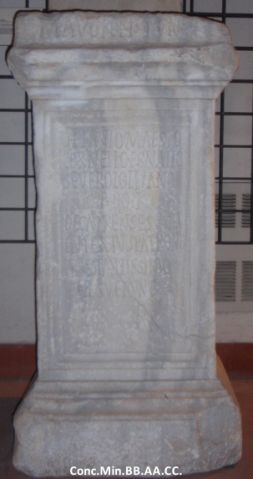
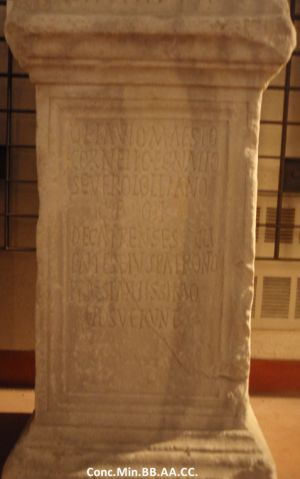
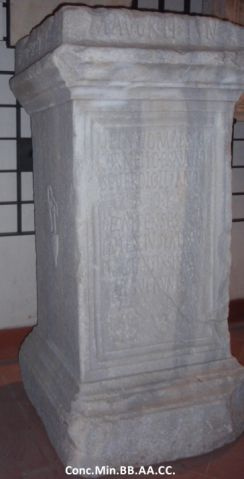
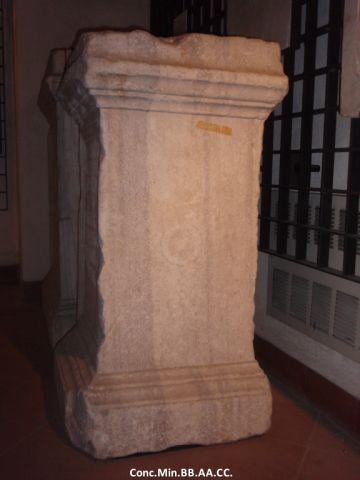
Inscription
Mavorti Iun(ioris). / Q(uinto) Flavio Maesio / Cornelio Egnatio / Severo Lolliano, / c(larissimo) p(uero), q(uaestori) k(andidato), / Decatrenses cli/entes eius patrono/ praestantissimo / posuerunt.
Inscription translation
[Statue of] Mavortius Iunior. To Quintus Flavius Maesius Cornelius Egnatius Severus Lollianus, youth of clarissimus rank, candidate to the quaestorship; the Decatrenses his clients set [this] up to their most distinguished patron.
Bibliography
- Corpus Inscriptionum Latinarum; , X, 1697
- Inscriptiones Latinae Selectae, , 1226
Discussion
INSCRIPTION:
In 9 lines, including signum on top. Epigraphic field 70 x 40 cm; signum 6 cm; letters 5-4.5 cm.
Mavorti Iun(ioris). / Q(uinto) Flavio Maesio / Cornelio Egnatio / Severo Lolliano, / c(larissimo) p(uero), q(uaestori) k(andidato), / Decatrenses cli/entes eius patrono/ praestantissimo / posuerunt.
'[Statue of] Mavortius Iunior. To Quintus Flavius Maesius Cornelius Egnatius Severus Lollianus, youth of clarissimus rank, candidate to the quaestorship; the Decatrenses his clients set [this] up to their most distinguished patron. '
DESCRIPTION (based on personal inspection and CIL):
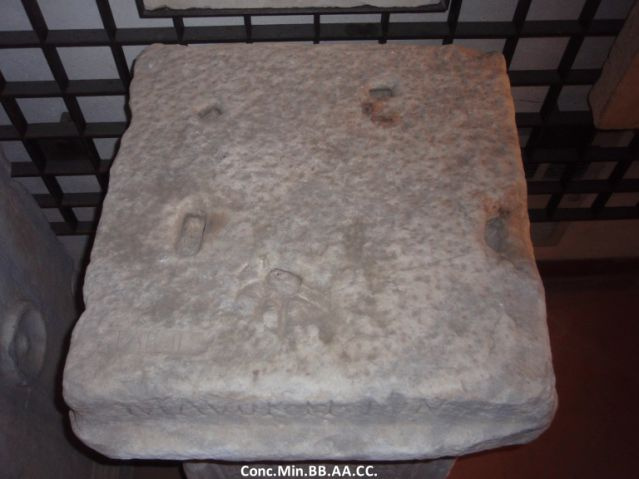
Tall and thin marble base, white marble with grey streaks (probably Proconnesian), well preserved. Base has mouldings top and bottom on all sides. The front is framed by moulding, and the epigraphic field is rough and clearly sunk, indicating re-use. Moulding is damaged on sides. Right side has damaged patera and left side has urceus, which must be associated with the first use of the base. Top is rough, with 5 rectangular holes and post-Roman inscription 'FARII'. The base was found with the statue of a young aristocrat wearing a toga.
PROVENANCE AND CURRENT LOCATION
The base was discovered in 1704 in Puteoli, near the gardens of Pedro de Toledo, where the church of S. Giuseppe is located (on the modern viale Capomazza) (Camodeca 1977, 68). This corresponds to the late antique regio Decatriae, whose inhabitants were responsible for the dedication. The base and statue of Lollianus Iunior were found together with a similar monument dedicated to his father Lollianus by the same regio (LSA-43).
The base is now in Naples, MAN sala 154 (Pozzuoli), inv. 3264.
HONORAND:
Quintus Flavius Maesius Cornelius Egnatius Severus Lollianus Iunior was the son of Quintus Flavius Maesius Egnatius Lollianus, and a praetor triumphalis (PLRE I,514 Lollianus 6). A number of statues were dedicated to his father, showing the importance of personal links between Roman aristocrats and local communities (Camodeca 1980/1981, 102). Lollianus Iunior is identified as a patron of a region of Puteoli in the inscription.
AWARDER:
The dedication was by the inhabitants of the Regio Decatriae, one of the regions of late antique Puteoli (Camodeca 1977, 66-70).
DATE:
The dedication to Lollianus Iunior probably took place together with the setting up of a statue to his father by the same region in the same place, though it could postdate it. The dedication to Lollianus father (LSA-43) mentions his proconsulship of Africa (337), but not his urban prefecture at Rome (342), and therefore must date to this period. However, a slightly later date for the Lollianus Iunior statue cannot be excluded.
Discussion references
- Camodeca, G. "L'ordinamento in 'regiones' e 'vici' di Puteoli", Puteoli, 1, 1977, pp. 62-98
- Camodeca, G., 'Ricerche su Puteoli tardoromana (fine II-IV secolo)', Puteoli, IV (1981) 59-128, pp. 59-128
- Jones, A. H. M. et al., The Prosopography of the Later Roman Empire. Vol. I 260-395, Cambridge et al. 1971 (1975), p. 514 (Lollianus 6)
Cite: Last Statues of Antiquity, LSA-335 (Carlos Machado).