
LSA-336
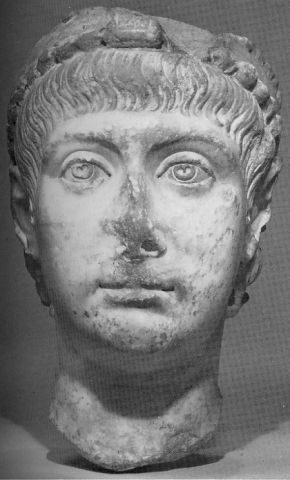
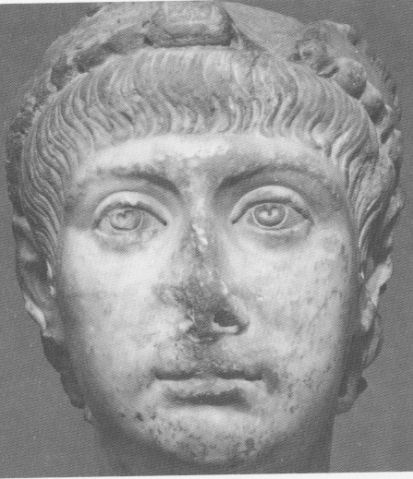
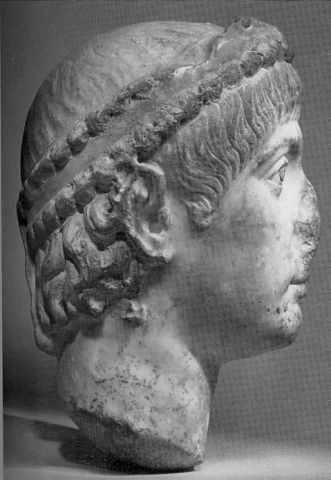
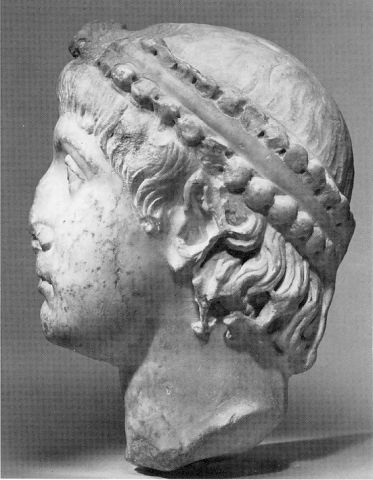
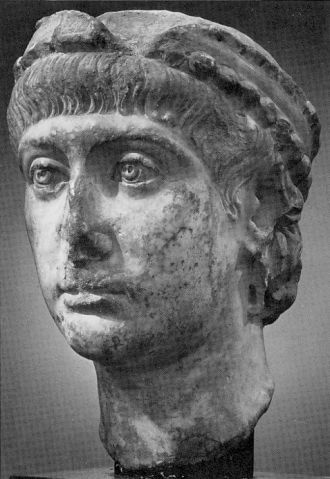
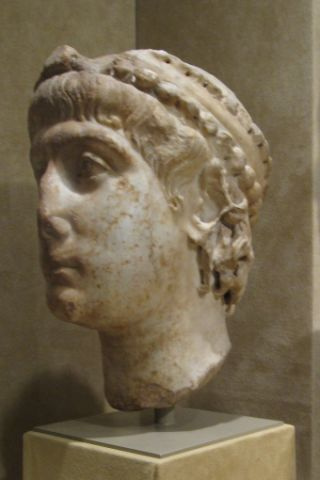
Portrait head of young Emperor. From Kastamonu. Fourth century
Record details
Photographs
Bibliography
- Bruns, G. 'Zwei bildnisse eines spätrömisches Kaisers', Jahrbuch des Deutschen Archäologischen Instituts 47, Berlin 1932, 135-8, figs. 1-3, pls. 5-6 (Constantius II)
- Delbrueck, R., Spätantike Kaiserporträts. Von Constantinus Magnus bis zum Ende des Westreichs , Leipzig 1933, 145-5, pl. 58-9 (Constans?, c. 340)
- Inan, J. & E. Alföldi-Rosenbaum, Römische und frühbyzantinische Porträ̈tplastik aus der Türkei : neue Funde, Mainz 1979, 135-8, no. 81, pl. 73
Discussion
DESCRIPTION (Object)
Life-size portrait head. H: 26.6, W: 15.8 cm. H (from chin to crown): 19 cm. Fine-grained white marble.
The head is preserved until the base of the neck. The head may originally have been made in one piece with its statue (as Rosenbaum argues) or more probably was a separately worked head with a small plug (Bruns). In either case the plug and edges of the neck may have been cut down in the modern era (as Rosenbaum suggests). There apparently are traces of red still in the mouth and on the diadem.
The hair over the brow is rendered with parallel lines made by a flat chisel. Behind the ears there is some drill work in the locks. The irises are incised with a flat chisel and are almost three-quarters of a circle. The pupils are two contiguous drill points which form a ‘bean-shape.’
PROVENANCE
Formerly in an Istanbul private collection. Then in the collection of Wilhelm Fabricius who purchased the head in Istanbul in 1932. It was said to have come from the area of Kastamonu whence comes an early fifth-century togate statue (LSA-607).
DESCRIPTION (Subject)
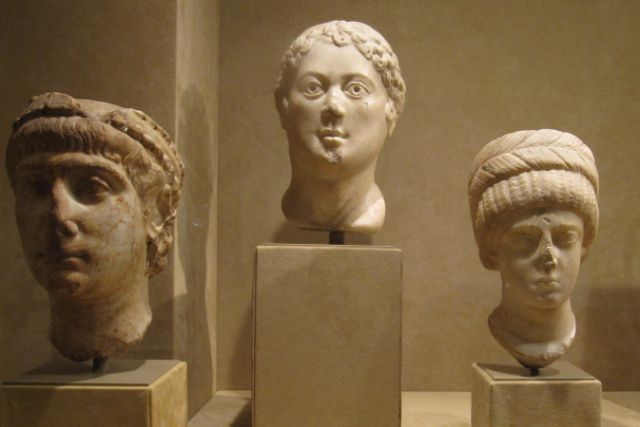
The head shows a youth with medium-length hair that curls at its ends. He wears a pearl-edged diadem that has a central rectangular jewel at the front and the ends of ties at the back.
The hair has no part and falls low on the brow. The locks of the fringe fall in parallel S-shaped waves which change direction over the middle of the left eye. Behind the ears the hair is longer, thicker, and more curly. Behind each ear, one lock extends beyond all others.
The head turns slightly to its right. The face is a full oval with little modelling. The eyes are large and wide-set; the nose curving; the mouth broad and thin-lipped; and the chin round and projecting.
DATE AND IDENTIFICATION
The diadem and hairstyle place this head in the fourth century. Most scholars (Bruns, Delbrueck, Evans, L’Orange, Stichel, Stutzinger) consider it to be a portrait of a son of Constantine, either Constantius II or Constans. Age, diadem, and physiognomy compare well with numismatic images of the younger sons of Constantine. In contrast, Von Sydow (accepted by Bergmann) proposed that it might be a Theodosian prince, either Arcadius or Honorius, since hairstyle, diadem, and even slightly hooked nose are equally suitable for these Augusti. Moreover, he noted the smooth impassive face devoid of modelling is a stylistic marker of the later fourth century, and that the portrait resembles, especially in the treatment of the hair, a head in Berlin (LSA-589), variously identified as Gratian, Theodosius I, or Arcadius. He is also convinced that the youth represented is only 10-15 years old. Rosenbaum allows for all possibilities by asserting that the head represents an Augustus of c. 340-400.
Discussion references
- Bergmann, M. Review of W. v. Sydow, Zur Kunstgeschichte des spätantiken Porträts im 4. Jahrhundert n. Chr., Jahrbuch für Antike und Christentum 15, 1972, 214-25, Münster/ Westfalen 1973, 215 (Theodosian)
- Demandt, A. and J. Engemann, (eds.), Konstantin der Grosse, Mainz 2007
, no. I.9.48 (H. Evans: Constans) - L'Orange, H. P., Das spätantike Herrscherbild von Diokletian bis zu den Konstantin-Söhnen, 284-361 n. Chr. Das Römische Herrscherbild. III. Abteilung ; Bd. 4 , Berlin 1984, 133 (son of Constantine)
- Stichel, R. H. W., Die römische Kaiserstatue am Ende der Antike, Roma 1982, 54-5 (son of Constantine)
- Stutzinger, D. (ed.), Spätantike und frühes Christentum. Ausstellung im Liebieghaus, Museum alter Plastik, Frankfurt am Main. 16. Dezember bis 11. März 1984, Frankfurt a.M. (1983), 437-8, no. 48 (son of Constantine)
- Sydow, W. von, Zur Kunstgeschichte des spätantike Porträts im 4. Jahrhundert. n. Chr, Bonn 1969, 84-5 (Arcadius or Honorius)
Cite: Last Statues of Antiquity, LSA-336 (J. Lenaghan).