
LSA-341
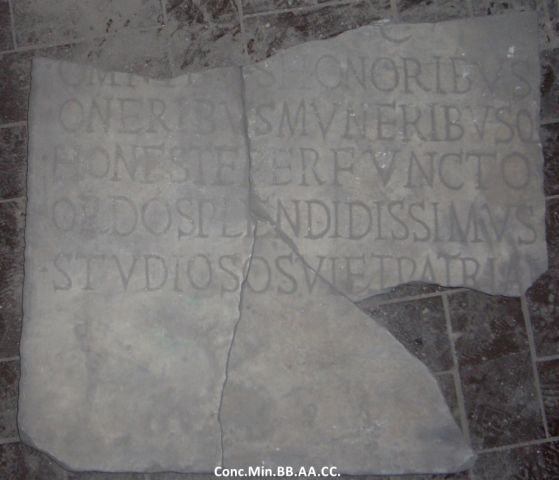
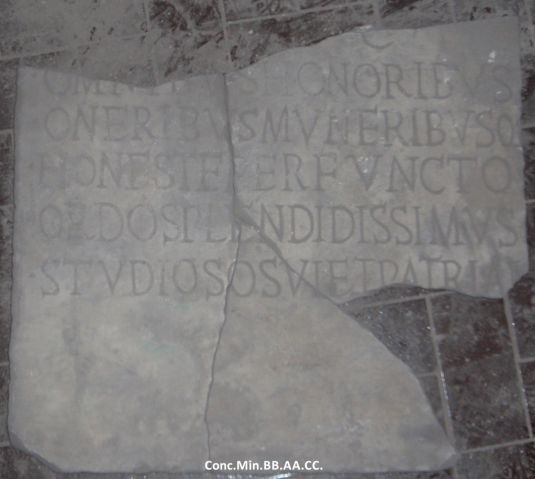
Fragmentary base for statue of Lucius Aurelius Dorotheus, civic office-holder and patron of Puteoli. From Puteoli (Campania). 280-337
Record details
Photographs
Inscription
L(ucio) Aur(elio) Dorot(heo), / v(iro) e(gregio), p(atrono) c(oloniae), / omnibus honoribus / oneribus muneribusq(ue) / honeste perfuncto, / ordo splendidissimus / studioso sui et patriae.
Inscription translation
To Lucius Aurelius Dorotheus, of egregius rank, patron of the colony, who performed all dignities, burdens, and functions in a praiseworthy manner; the most distinguished council, devoted to him and the to the homeland (patria) [set this up].
Bibliography
- Camodeca, G. "Ricerche su Puteoli tardoromana (fine III-IV secolo)", Puteoli, 4-5, 1980-1981, 117
- L'Année épigraphique, , 1983, 196
Discussion
INSCRIPTION
In 7 lines. Letters 4.8-4 cm.
L(ucio) Aur(elio) Dorot(heo), / v(iro) e(gregio), p(atrono) c(oloniae), / omnibus honoribus / oneribus muneribusq(ue) / honeste perfuncto, / ordo splendidissimus / studioso sui et patriae.
'To Lucius Aurelius Dorotheus, of egregius rank, patron of the colony, who performed all dignities, burdens, and functions in a praiseworthy manner; the most distinguished council, devoted to him and the to the homeland (patria) [set this up].'
DESCRIPTION (based on personal inspection)
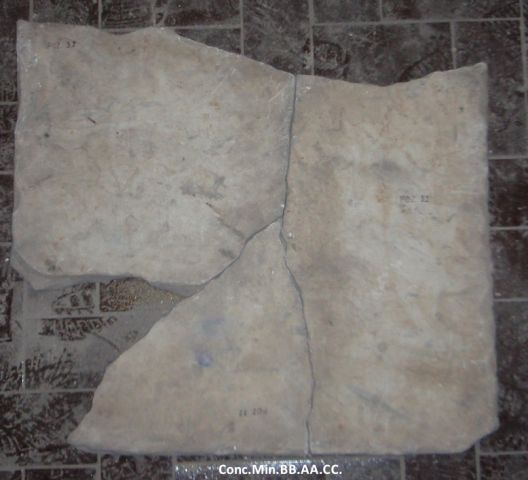
White marble slab, broken into 3 pieces (it had four fragments when discovered, see Camodeca 1980/1981, 117-118). The top and the lower right corner are lost. The back is smooth, suggesting that the slab was fitted into a base, rather than being cut from it.
PROVENANCE
Discovered in November 1955 during excavations for the foundation of the Educandato M. Immacolata, on via Rosini; the large number of honorific inscriptions discovered in this area suggests that this was the forum of Puteoli (Camodeca 1980/1981, 63). It is now in Naples, Museo Archeologico Nazionale, magazzino epigrafico.
HONORAND AND AWARDER
Dorotheus is not attested anywhere else. He was a member of the local elite, having performed all civic functions, and as such was honoured by the local ordo. Dorotheus was a vir egregius, a member of the equestrian order.
DATE:
The dating of this inscription is based on the style of the letters and on the position of Dorotheus as vir egregius. It became common during the reign of Diocletian for members of local Curiae to seek immunity from services by enrolling into the equestrian order, and the egregiate was the lowest rank available (Jones 1964, 70 and 525-526). Dorotheus had performed all civic duties, and the title might have been a reward (Camodeca 1980/1981, 117-118). However, none of these arguments are definitive, and it is not possible to safely rule out an earlier date. The title virtually disappeared from the epigraphic record during the reign of Constantine, and its last official mention (literary) is in Cod. Theod. 6.22.1, from 324. Although there is no scholarly consensus on the date of the disappearance of the egregiate (Lepelley 1986, 236-243), it is safe to assume that this dedication took place before the end of Constantine's reign.
Discussion references
- Camodeca, G. "Ricerche su Puteoli tardoromana (fine III-IV secolo)", Puteoli, 4-5, 1980-1981, pp. 59-128
- Jones, A. H. M., The Later Roman Empire, 2 vols., Oxford 1964
- Lepelley, C., "Fine dell'ordine equestre: le tappe dell'unificazione della classe dirigente romana nel IV secolo", Giardina, A. (ed.), Società romana e impero tardoantico, vol. 2, Bari 1986, p. 236-243
Cite: Last Statues of Antiquity, LSA-341 (Carlos Machado).