
LSA-342
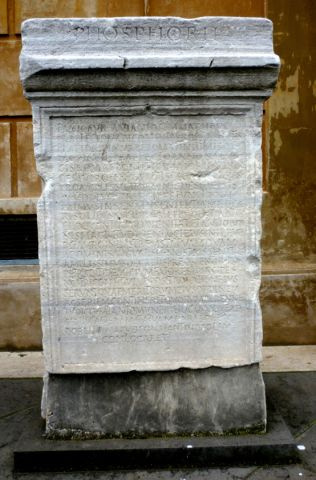
Base for gilded bronze statue of Lucius Aurelius Avianius Symmachus, consul and prefect of the City; commanded by the emperors. Rome, Forum of Trajan. 377
Record details
Photographs
Inscription
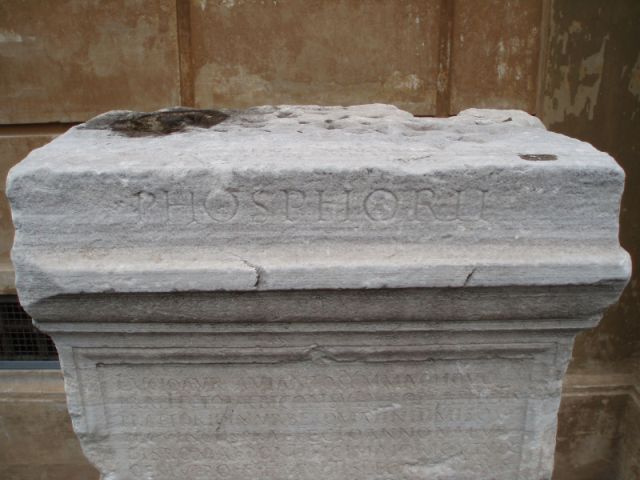
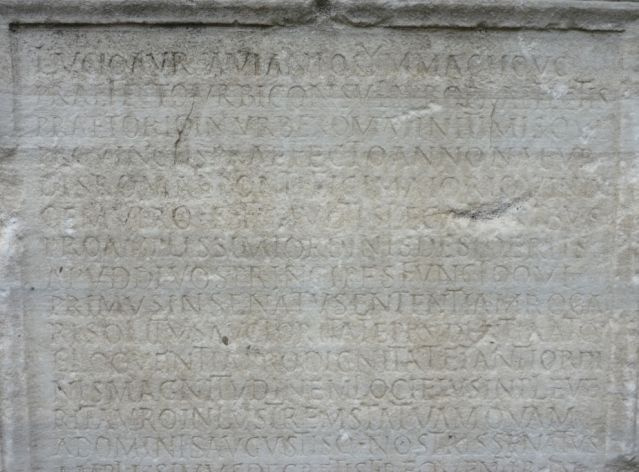
Phosphorii. / Lucio Aur(elio) Avianio Symmacho, v(iro) c(larissimo), / praefecto urbi, consuli, pro praefectis / praetorio in urbe Roma finitimisque /(5) provinciis, praefecto annonae ur/bis Romae, pontifici maiori, quinde/cemviro s(acris) f(aciundis), multis legat[io]nibus / pro amplissimi ordinis desideriis / apud divos principes functo, qui /(10) primus in senatu sententiam roga/ri solitus auctoritate, prudentia atq(ue) / eloquentia pro dignitate tanti ordi/nis magnitudinem loci eius inpleve/rit, auro inlustrem statuam quam /(15) a dominis Augustisq(ue) nostr(is) senatus / amplissimus decretis frequentib(us) in/petrabit idem triumfatores principes / nostri constitui, adposita oratione ius/serunt quae meritorum eius ordinem /(20) ac seriem contineret quorum perenne / iudicium tanto muneri hoc quoque ad/didit ut alteram statuam pari splen/dore etiam apud Constatinopolim /(24) conlocaret. // Dedicata III Kal(endas) Maias / d(omino) n(ostro) Gratiano IIII et Merobaude / co(n)s(ulibus).
Inscription translation
[Statue of] Phosphorius. To Lucius Aurelius Avianius Symmachus, of the senatorial order, urban prefect, consul, legate of the praetorian prefect in Rome and in the neighbouring provinces, prefect of the annona of the city of Rome, higher pontiff, member of the college of the quindecemviri sacris faciundis, responsible on many occasions for embassies to deified emperors following the wishes of the senatorial order, whose opinion in the Senate was usually the first to be asked, who enriched with authority, prudence, and eloquence the seat of this great order. The gilded statue that the great Senate obtained from our Lords Augusti through frequent petitions, and that our victorious emperors commanded to be set up with a list of his merits; and to this honour their [i.e., imperial] judgment also added that a further statue of equal splendour be placed in Constantinople. Dedicated on the III of the Kalends of May, during the fourth consulship of our lord Gratian and Merobaudes.
Bibliography
- Corpus Inscriptionum Latinarum; , VI, 1698 (+p. 4737)
Discussion
INSCRIPTION:
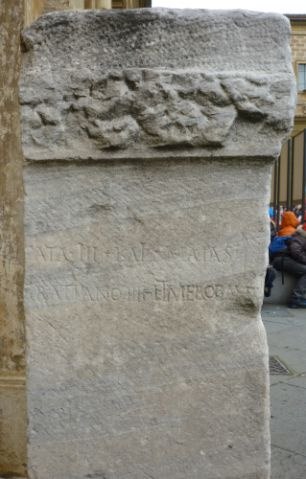
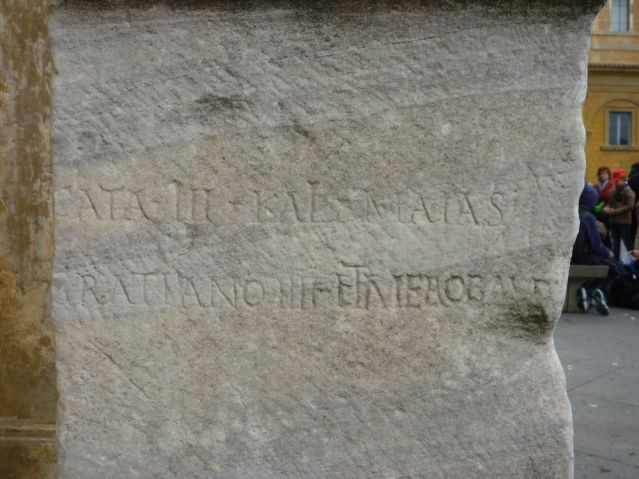
In 27 lines, including one with signum on the top, and 3 with the dating inscription on the left side of the base. Epigraphic field: 74 x 57 cm; letters 3.5 cm.
Phosphorii/ Lucio Aur(elio) Avianio Symmacho v(iro) c(larissimo)/ praefecto urbi consuli pro praefectis/ praetorio in urbe Roma finitimisque/ provinciis praefecto annonae ur/bis Romae pontifici maiori quinde/cemviro s(acris) f(aciundis) multis legat[io]nibus/ pro amplissimi ordinis desideriis/ apud divos principes functo qui/ primus in senatu sententiam roga/ri solitus auctoritate prudentia atq(ue)/ eloquentia pro dignitate tanti ordi/nis magnitudinem loci eius inpleve/rit auro inlustrem statuam quam/ a dominis Augustisq(ue) nostr(is) senatus/ amplissimus decretis frequentib(us) in/petrabit idem triumfatores principes/ nostri constitui adposita oratione ius/serunt quae meritorum eius ordinem/ ac seriem contineret quorum perenne/ iudicium tanto muneri hoc quoque ad/didit ut alteram statuam pari splen/dore etiam apud Constatinopolim / conlocaret// (On the left face of the base:) Dedicata III Kal(endas) Maias / d(omino) n(ostro) Gratiano IIII et Merobaude / co(n)s(ulibus).
'[Statue of] Phosphorius. To Lucius Aurelius Avianius Symmachus, of the senatorial order, urban prefect, consul, legate of the praetorian prefect in Rome and in the neighbouring provinces, prefect of the annona of the city of Rome, higher pontiff, member of the college of the quindecemviri sacris faciundis, responsible on many occasions for embassies to deified emperors following the wishes of the senatorial order, whose opinion in the Senate was usually the first to be asked, who enriched with authority, prudence, and eloquence the seat of this great order. The gilded statue that the great Senate obtained from our Lords Augusti through frequent petitions, and that our victorious emperors commanded to be set up with a list of his merits; and to this honour their [i.e., imperial] judgment also added that a further statue of equal splendour be placed in Constantinople. (On the left face of the base:) Dedicated on the III of the Kalends of May, during the fourth consulship of our lord Gratian and Merobaudes.'
DESCRIPTION (based on personal inspection):
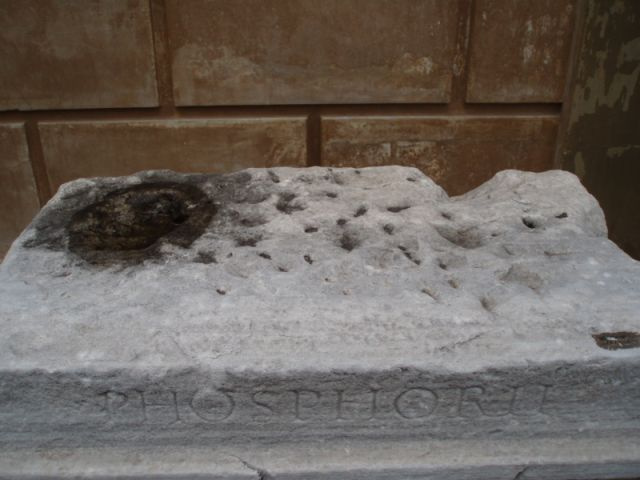
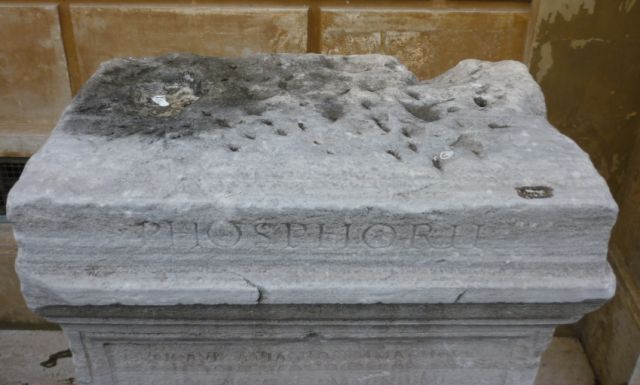
Base of white marble with grey streaks (probably Proconnesian), cut at the bottom. The base has been cut at the back, and the bottom has been lost, replaced by a piece of marble in modern times. The right side is finished, and has a consular date. The left side is finished and smooth. The epigraphic field is deep and rough, indicating erasure of an earlier inscription.
PROVENANCE AND CURRENT LOCATION
The base was found c. 1550 at bottom of the Capitol, ‘ad arcum fuschum’. The Arco Fosco takes its name from the Foschi di Berta, who owned a house in the area of the forum of Trajan (Cecchelli 1958, 301). The Forum of Trajan was an important location for the dedication of statues, celebrating not only the imperial family but also members of the court and of the senatorial aristocracy (Bauer 1996, 94-95).
HONORAND:
Lucius Aurelius Avianius Symmachus was father of the famous orator and prefect of the city Symmachus. He was prefect of the annona (340/350), prefect of the city (364-65), and designated consul in 377, but died before assuming office. The statue was dedicated after his death (PLRE I, 863-865 Symmachus 3).
AWARDER:
The statue was dedicated in the name of the emperors Gratian and Valens, with approval of the Senate. This was a very high honour, usually reserved for very important honorands and in special locations, such as the forum of Trajan.
DATE:
The date (377) is established by the consular date on the right side of the base.
FURTHER DISCUSSION:
This statue represented a very high distinction: it was a gilded statue, requested by the Senate and dedicated by the emperors. According to the inscription, a similar statue was dedicated in Constantinople; it also informs us that a list of Symmachus’ merits accompanied the monument.
Discussion references
- Bauer, F. A., Stadt, Platz und Denkmal in der Spätantike, Mainz 1996
- Cecchelli, C., "Roma Medievale" , Topografia e urbanistica di Roma , Rome 1958.
- Jones, A. H. M. et al., The Prosopography of the Later Roman Empire. Vol. I 260-395, Cambridge et al. 1971 (1975), p. 863-865 (Symmachus)
Cite: Last Statues of Antiquity, LSA-342 (Carlos Machado).